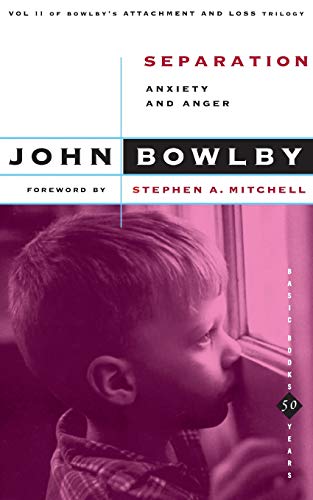

Separation anxiety and anger John Bowlby ; with additional notes by the author.
Series Harper colophon books ; CN 5016 | Bowlby, John. Attachment and loss ; v. 2.Detalles de publicación: New York Basic Books c1973.Descripción: xviii, 456 p. 21 cmISBN:- 0465097162 (pbk.)
| Imagen de cubierta | Tipo de ítem | Biblioteca actual | Biblioteca de origen | Colección | Ubicación en estantería | Signatura topográfica | Materiales especificados | Info Vol | URL | Copia número | Estado | Notas | Fecha de vencimiento | Código de barras | Reserva de ítems | Prioridad de la cola de reserva de ejemplar | Reservas para cursos | |
|---|---|---|---|---|---|---|---|---|---|---|---|---|---|---|---|---|---|---|
| Libro | Biblioteca Encarnación Valdés Colección General bev | 155.418 B7871s (Navegar estantería(Abre debajo)) | v.2 | Disponible | 80000002299298 |
Descripciones mejoradas de Syndetics:
A classic work of psychology shedding new light on parent-child separation and the origins of fear
"A turning point in the history of psychoanalysis and in psychology generally." ― Times Literary Supplement
Written by the pioneering theorist of attachment, John Bowlby's Separation considers separation and the anxiety that accompanies it: the fear of imminent or anticipated separation, the fear induced by parental threats of separation, and the inversion of the parent-child relationship. Building upon his previous work on the ties between parents and children, Bowlby documents children's distress during separation, and the anxiety that often persists afterward, showing that fear is initially aroused by certain elemental situations―sudden movement, darkness or separation. Blending psychoanalytic theory with empirical observation, he re-examines the situations that cause us to feel fear and compares them with evidence from animals, shedding light on the factors that contribute to anxiety and the susceptibility to fear in adulthood.
The second of three volumes in Attachment and Loss , Separation provides a unique exploration of anxiety in the parent-child relationship.
Bibliography : p. 415-437.
Includes index.
pt. 1. Security, anxiety, and distress -- 1. Phototypes of human sorrow -- 2. The place of separation and loss in psychopathology -- 3. Behaviour with and without mother : humans -- 4. Behaviour with and without mother : non-human primates -- pt. 2. An ethological approach to human fear -- 5. Basic postulates in theories of anxiety and fear -- 6. Forms of behaviour indicative of fear -- 7. Situations that arouse fear in humans -- 8. Situations that arouse fear in animals -- 9. Natural clues to danger and safety -- 10. Natural clues, cultural clues, and the assessment of danger -- 11. Rationalization, misattribution, and projection -- 12. Fear of separation -- 3. Individual differences in susceptibility to fear : anxious attachment -- 13. Some variables responsible for individual differences -- 14. Susceptibility to fear and the availability of attachment figures -- 15. Anxious attachment and some conditions that promote it -- 16. 'Overdependency' and the theory of spoiling -- 17. Anger, anxiety, and attachment -- 18. Anxious attachment and the 'phobias' of childhood -- 19. Anxious attachment and 'agoraphobia' -- 20. Omission, suppression, and falsification of family context -- 21. Secure attachment and the growth of self-reliance -- 22. Pathways for the growth of personality.
Tabla de contenidos provista por Syndetics
- Foreword(p. vii)
- Preface(p. xi)
- Acknowledgements(p. xvii)
- Part I Security, Anxiety, and Distress
- 1 Prototypes of Human Sorrow(p. 3)
- Responses of young children to separation from mother(p. 3)
- Conditions leading to intense responses(p. 6)
- Conditions mitigating the intensity of responses(p. 16)
- Presence or absence of mother figure: a key variable(p. 22)
- 2 The Place of Separation and Loss in Psychopathology(p. 25)
- Problem and perspective(p. 25)
- Separation anxiety and other forms of anxiety(p. 30)
- A challenge for theory(p. 30)
- 3 Behaviour with and without Mother: Humans(p. 33)
- Naturalistic observations(p. 33)
- Experimental Studies(p. 39)
- Ontogeny of responses to separation(p. 52)
- 4 Behaviour with and without Mother: Non-human Primates(p. 57)
- Naturalistic observations(p. 57)
- Early experimental studies(p. 60)
- Further studies by Hinde and Spencer-Booth(p. 69)
- Part II An Ethological Approach to Human Fear
- 5 Basic Postulates in Theories of Anxiety and Fear(p. 77)
- Anxiety allied to fear(p. 77)
- Models of motivation and their effects on theory(p. 79)
- Puzzling phobia or natural fear(p. 83)
- 6 Forms of Behaviour Indicative of Fear(p. 87)
- An empirical approach(p. 87)
- Withdrawal behaviour and attachment behaviour(p. 89)
- Feeling afraid and its variants: feeling alarmed and feeling anxious(p. 92)
- 7 Situations that Arouse Fear in Humans(p. 96)
- A difficult field of study(p. 96)
- Fear-arousing situations: the first year(p. 99)
- Fear-arousing situations: the second and later years(p. 105)
- Compound situations(p. 118)
- Fear behaviour and the development of attachment(p. 119)
- 8 Situations that Arouse Fear in Animals(p. 124)
- Natural clues to potential danger(p. 124)
- Fear behaviour of non-human primates(p. 127)
- Compound situations(p. 134)
- Fear, attack, and exploration(p. 136)
- 9 Natural Clues to Danger and Safety(p. 138)
- Better safe than sorry(p. 138)
- Potential danger of being alone(p. 142)
- Potential safety of familiar companions and environment(p. 146)
- Maintaining a stable relationship with the familiar environment: a form of homeostasis(p. 148)
- 10 Natural Clues, Cultural Clues, and the Assessment of Danger(p. 151)
- Clues of three kinds(p. 151)
- Real danger: difficulties of assessment(p. 153)
- 'Imaginary' dangers(p. 156)
- Cultural clues learnt from others(p. 158)
- Continuing role of the natural clues(p. 161)
- Behaviour in disaster(p. 166)
- 11 Rationalization, Misattribution, and Projection(p. 169)
- Difficulties in identifying situations that arouse fear(p. 169)
- Misattribution and the role of projection(p. 172)
- The case of Schreber: a re-examination(p. 174)
- 12 Fear of Separation(p. 178)
- Hypotheses regarding its development(p. 178)
- Need for two terminologies(p. 182)
- Part III Individual Differences in Susceptibility to Fear: Anxious Attachment
- 13 Some Variables responsible for Individual Differences(p. 187)
- Constitutional variables(p. 187)
- Experiences and processes that reduce susceptibility to fear(p. 191)
- Experiences and processes that increase susceptibility to fear(p. 196)
- 14 Susceptibility to Fear and the Availability of Attachment Figures(p. 201)
- Forecasting the availability of an attachment figure(p. 201)
- Working models of attachment figures and of self(p. 203)
- The role of experience in determining working models(p. 207)
- A note on use of the terms 'mature' and 'immature'(p. 209)
- 15 Anxious Attachment and Some Conditions that Promote it(p. 211)
- 'Overdependency' or anxious attachment(p. 211)
- Anxious attachment of children reared without a permanent mother figure(p. 215)
- Anxious attachment after a period of separation or of daily substitute care(p. 220)
- Anxious attachment following threats of abandonment or suicide(p. 226)
- 16 'Overdependency' and the Theory of Spoiling(p. 237)
- Some contrasting theories(p. 237)
- Studies of 'overdependency' and its antecedents(p. 240)
- 17 Anger, Anxiety, and Attachment(p. 245)
- Anger: a response to separation(p. 245)
- Anger: functional and dysfunctional(p. 246)
- Anger, ambivalence, and anxiety(p. 253)
- 18 Anxious Attachment and the 'Phobias' of Childhood(p. 258)
- Phobia, pseudophobia, and anxiety state(p. 258)
- 'School phobia' or school refusal(p. 261)
- Two classical cases of childhood phobia: a reappraisal(p. 283)
- Animal phobias in childhood(p. 289)
- 19 Anxious Attachment and 'Agoraphobia'(p. 292)
- Symptomatology and theories of 'agoraphobia'(p. 292)
- Pathogenic patterns of family interaction(p. 299)
- 'Agoraphobia', bereavement, and depression(p. 309)
- A note on response to treatment(p. 310)
- 20 Omission, Suppression, and Falsification of Family Context(p. 313)
- 21 Secure Attachment and the Growth of Self-reliance(p. 322)
- Personality development and family experience(p. 322)
- Studies of adolescents and young adults(p. 328)
- Studies of young children(p. 350)
- Self-reliance and reliance on others(p. 359)
- 22 Pathways for the Growth of Personality(p. 363)
- The nature of individual variation: alternative models(p. 363)
- Developmental pathways and homeorhesis(p. 366)
- One person's pathway: some determinants(p. 369)
- Appendices
- I Separation Anxiety: Review of Literature(p. 375)
- II Psychoanalysis and Evolution Theory(p. 399)
- III Problems of Terminology(p. 404)
- Additional Notes(p. 409)
- References(p. 415)
- Additional References(p. 436)
- Index(p. 439)