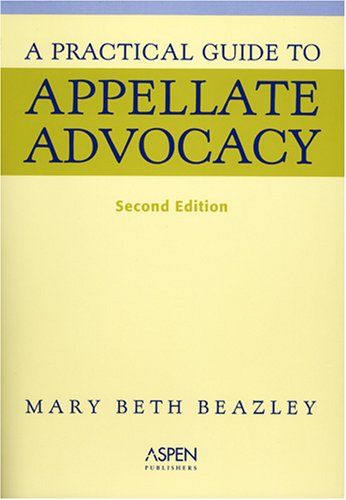

A practical guide to appellate advocacy Mary Beth Beazley.
Detalles de publicación: New York Aspen Law & Business c2006.Edición: 2nd edDescripción: xxv, 369 p. 26 cmISBN:- 0735553777
- KF 251 .B42 2006
| Imagen de cubierta | Tipo de ítem | Biblioteca actual | Biblioteca de origen | Colección | Ubicación en estantería | Signatura topográfica | Materiales especificados | Info Vol | URL | Copia número | Estado | Notas | Fecha de vencimiento | Código de barras | Reserva de ítems | Prioridad de la cola de reserva de ejemplar | Reservas para cursos | |
|---|---|---|---|---|---|---|---|---|---|---|---|---|---|---|---|---|---|---|
| Libro | Biblioteca de Derecho Mons. Fremiot Torres Oliver Colección General biblioteca derecho | KF 251 .B42 2006 (Navegar estantería(Abre debajo)) | Disponible | 70000000773759 |
Descripciones mejoradas de Syndetics:
This accessible paperback earned its success in the classroom by: - providing a complete introduction to the techniques and process of writing appellate briefs - presenting class-tested materials and ample illustrations that are both accessible and teachable - emphasizing the process approach to writing, beginning with large-scale issues like content and organization, moving to smaller-scale issues like signals to the reader, and ending on the smallest-scale concerns of format and polishing methods - using numerous annotated examples -- both good and bad -- of legal writing from briefs, with commentary on the point each example is illustrating - including in the appendices four sample briefs with annotations that identify strengths of the brief and/or why the writer chose a particular technique - teaching students how abstract formulas (IRAC, CREXAC, etc.) can be effective in legal writing by having them identify whether certain elements have been included in a document and giving concrete advice on how to use formulas - encouraging students to critique their own work and improve their final product by using the self-graded draft The Second Edition is strengthened by: - including format and function information about dispositive motion memos (such as motions to dismiss or for summary judgment), along with a sample motion memo - refining the discussion of the use of authority to help students better understand what a citation means - improving the discussion of CREXAC to facilitate easier comprehension of how to use formulas to write effectively - adding the concept of user to complement the concept of reader and explaining the needs of bothgroups - supplying more information on identifying a theme for the argument - including tips on citing to web pages and citing to unpublished opinions
Includes bibliographical references and index.
Tabla de contenidos provista por Syndetics
- Using the Examples in This Book(p. xix)
- Acknowledgments to the First Edition(p. xxiii)
- Acknowledgments to the Second Edition(p. xxv)
- Chapter 1 Introduction(p. 1)
- 1.1 Before We Begin(p. 1)
- 1.2 Know Your Audience(p. 3)
- 1.3 Follow an Effective Writing Process(p. 4)
- 1.4 How to Use This Book(p. 5)
- 1.5 Summary(p. 7)
- Chapter 2 Appellate Jurisdiction and Standards of Review(p. 9)
- 2.1 Jurisdiction in Courts of Last Resort(p. 10)
- 2.2 Jurisdiction in Intermediate Courts of Appeals(p. 11)
- 2.3 Appellate Standards of Review(p. 12)
- 2.3.1 Purpose and Meaning of Appellate Standards of Review(p. 13)
- a Clearly Erroneous(p. 14)
- b De Novo(p. 14)
- c Abuse of Discretion(p. 15)
- d Other Appellate Standards(p. 16)
- 2.3.2 Identifying the Appropriate Appellate Standard of Review(p. 16)
- 2.3.3 Format Considerations(p. 17)
- 2.4 Standards of Review in Motion Briefs(p. 18)
- 2.4.1 Motions to Dismiss(p. 19)
- 2.4.2 Motions for Summary Judgment(p. 20)
- 2.4.3 Identifying the Appropriate Motion Standard of Review(p. 20)
- 2.4.4 Incorporating Motion Standards into Your Argument(p. 21)
- 2.5 Avoiding Confusion(p. 23)
- 2.5.1 Government Action Standards of Review(p. 23)
- 2.5.2 Multiple Standards of Review in the Same Case(p. 24)
- 2.6 Summary(p. 25)
- Chapter 3 Before you Write(p. 27)
- 3.1 Creating an Abstract of the Record(p. 27)
- 3.2 Planning Your Research(p. 31)
- 3.2.1 Begin at the Beginning: Decide What Questions You Need to Answer(p. 31)
- 3.2.2 Broadening Your Horizons (You Can Compare Apples and Oranges)(p. 34)
- 3.2.3 The Abstraction Ladder(p. 35)
- 3.2.4 Using the Abstraction Ladder in Legal Research(p. 36)
- 3.2.5 Identifying a Theme for Your Argument(p. 37)
- 3.2.6 Identifying Valid Authority(p. 39)
- a Relevant Facts(p. 39)
- b Relevant Legal Issues(p. 40)
- c Relevant Sources(p. 40)
- i Legal Sources(p. 40)
- ii "Extra-Legal" Sources(p. 41)
- iii Internet Sources(p. 42)
- 3.3 Executing Your Research Plan(p. 43)
- 3.3.1 Researching Statutory Issues(p. 44)
- 3.3.2 Writing to Courts of Last Resort(p. 44)
- 3.3.3 Mandatory versus Nonmandatory Authorities(p. 45)
- 3.4 Knowing When to Stop(p. 47)
- 3.5 Summary(p. 48)
- Chapter 4 Facing the Blank Pace(p. 49)
- 4.1 Finding Structure(p. 49)
- 4.1.1 Using Existing Rules and the "Phrase-That-Pays" to Structure Your Argument(p. 50)
- 4.1.2 Using Your Research to Help You Structure Your Argument(p. 52)
- 4.1.3 Using Policy-Based Rules in Your Argument(p. 55)
- 4.1.4 Using a Reverse Roadmap to Structure Your Argument(p. 57)
- 4.1.5 The Working Outline(p. 58)
- 4.2 Using "Private Memos" to Quiet Your Inner Demons and Prevent Writer's Block(p. 59)
- 4.3 Summary(p. 60)
- Chapter 5 One Piece at a Time: Drafting the Argument(p. 61)
- 5.1 Using an Analytical Formula(p. 61)
- 5.1.1 State Your Issue as a Conclusion(p. 63)
- 5.1.2 Provide the Rule(p. 65)
- a Stating Established Rules(p. 65)
- b Choosing Among Two or More Rules(p. 66)
- c Using Inductive Reasoning to Find and Articulate Legal Rules(p. 68)
- 5.1.3 Explain the Rule(p. 69)
- 5.1.4 Apply the Rule to the Facts(p. 71)
- a Apply Rules, Not Cases(p. 72)
- b Facts Are Relevant to Questions of Law(p. 73)
- c Sometimes Statutory Language Is a Fact(p. 74)
- 5.1.5 Make the Connection(p. 75)
- 5.2 Summary(p. 76)
- Chapter 6 Practice Pointers: Using Case Authority Effectively(p. 77)
- 6.1 Addressing Negative Authorities(p. 78)
- 6.2 Providing Appropriate Detail in Case Descriptions(p. 80)
- 6.2.1 Making Case Descriptions as Succinct as Possible(p. 82)
- a Focus(p. 82)
- b Using Language Effectively(p. 84)
- c Verb Tense in Case Descriptions(p. 85)
- 6.2.2 Writing and Using Effective Parenthetical Descriptions(p. 86)
- 6.3 Using Quotations Effectively in Case Descriptions(p. 89)
- 6.3.1 Not Enough Context(p. 89)
- 6.3.2 Too Much Quoted Language(p. 90)
- 6.4 Using Language Precisely When Analogizing and Distinguishing Cases(p. 94)
- 6.5 Dealing with Unpublished Decisions(p. 95)
- 6.6 Using Citations Effectively(p. 98)
- 6.6.1 When to Cite(p. 98)
- 6.6.2 Distinguishing Between Authorities and Sources(p. 98)
- 6.6.3 Where to Cite(p. 101)
- 6.6.4 Using Effective Sentence Structures to Accommodate Citation Form(p. 102)
- 6.6.5 Avoiding String Citations(p. 103)
- 6.6.6 Cases That Cite Other Cases(p. 105)
- 6.6.7 Importance of Pinpoint Citations(p. 107)
- 6.7 Summary(p. 107)
- Chapter 7 Seeing What You Have Written(p. 109)
- 7.1 Focusing Your Revision: Using the Self-Graded Draft(p. 109)
- 7.1.1 Background(p. 110)
- 7.1.2 Completing the Self-Grading(p. 112)
- 7.2 Common Self-Grading Tasks and Explanations(p. 112)
- 7.2.1 Identify the Focus of Each Unit of Discourse(p. 113)
- 7.2.2 Identify the Phrases-That-Pay Within Each Unit of Discourse(p. 113)
- 7.2.3 Identify Cited Authorities(p. 115)
- 7.2.4 Identify the Explanation of Each Focus(p. 115)
- 7.2.5 Identify Your Client's Facts(p. 115)
- 7.2.6 Identify the Application of Each Focus to Your Client's Facts(p. 116)
- 7.2.7 Identify the Connection-Conclusion(p. 116)
- 7.2.8 Create a Separate Focus List(p. 117)
- 7.2.9 Write a Final Comment(p. 117)
- 7.3 Summary(p. 118)
- Chapter 8 Following Format Rules(p. 119)
- 8.1 Length Requirements(p. 120)
- 8.2 Typefaces and Margins(p. 121)
- 8.3 Filing Requirements and Number of Copies(p. 122)
- 8.4 Document Format Requirements and Service Requirements(p. 123)
- 8.4.1 Cover Page(p. 124)
- 8.4.2 Issue(p. 124)
- 8.4.3 Parties to the Proceeding(p. 124)
- 8.4.4 Table of Contents(p. 125)
- 8.4.5 Table of Authorities(p. 125)
- 8.4.6 Opinions Below(p. 126)
- 8.4.7 Jurisdiction(p. 126)
- 8.4.8 Relevant Enacted Law(p. 127)
- 8.4.9 Standard of Review(p. 127)
- 8.4.10 Statement of the Case(p. 128)
- 8.4.11 Summary of the Argument(p. 128)
- 8.4.12 The Argument(p. 128)
- 8.4.13 The Conclusion(p. 129)
- 8.4.14 Signature(p. 130)
- 8.4.15 Certificate of Service(p. 130)
- 8.4.16 Certificate of Compliance(p. 131)
- 8.4.17 Appendix(p. 131)
- 8.5 Summary(p. 131)
- Chapter 9 Special Teams: Issue Statements, Statement of the Case, Summary of the Argument, Point Headings(p. 133)
- 9.1 Writing the Issue Statement(p. 134)
- 9.1.1 Motion Brief Introductions(p. 134)
- 9.1.2 Appellate Brief Questions Presented(p. 135)
- a Elements to Include(p. 136)
- b Persuasive Questions Presented(p. 137)
- c Problems to Avoid(p. 139)
- i Assuming Elements at Issue(p. 139)
- ii Overlong Questions(p. 139)
- d Summing Up(p. 141)
- 9.2 Statements of the Case(p. 142)
- 9.2.1 Formal Requirements(p. 142)
- 9.2.2 Organizing the Fact Statement(p. 144)
- 9.2.3 Making the Fact Statement Persuasive(p. 145)
- a Positions of Emphasis(p. 148)
- b Pointillism(p. 148)
- c Spending the Reader's Time, Saving the Reader's Energy(p. 149)
- 9.2.4 Special Considerations for Motion Brief Fact Statements(p. 150)
- 9.2.5 Summing Up(p. 152)
- 9.3 Summary of the Argument(p. 152)
- 9.4 Point Headings(p. 155)
- 9.4.1 Format and Function(p. 155)
- 9.4.2 Drafting the Point Headings(p. 158)
- 9.4.3 The Relationships Between and Among Point Headings(p. 159)
- 9.4.4 Summing Up(p. 161)
- 9.5 Summary(p. 161)
- Chapter 10 Six Degrees of Legal Writing: Making Your Document Reader-Friendly(p. 163)
- 10.1 Find Your "Kevin Bacon"(p. 164)
- 10.2 Install a Symbolic Template to Help Your Reader and Your User(p. 167)
- 10.2.1 Topic Sentences(p. 168)
- 10.2.2 Headings(p. 171)
- 10.2.3 Roadmaps and Mini-Roadmaps(p. 172)
- 10.2.4 Explicit Connection-Conclusions(p. 175)
- 10.3 Summary(p. 177)
- Chapter 11 Exploiting Opportunities for Persuasion(p. 179)
- 11.1 Opportunities for Persuasion(p. 179)
- 11.2 How Not to Persuade(p. 180)
- 11.3 Choosing Issues Responsibly(p. 182)
- 11.4 Exploiting Positions of Emphasis(p. 183)
- 11.4.1 Persuading with Large-Scale Organization(p. 184)
- 11.4.2 Persuading Within Each Issue(p. 185)
- 11.4.3 Persuasive Paragraph Structure(p. 186)
- 11.4.4 Persuading with Sentence Structure(p. 188)
- a Subject-Verb Combinations(p. 188)
- i Nominalizations(p. 189)
- ii Active and Passive Voice(p. 190)
- b Independent and Dependent Clauses(p. 192)
- c Using Short Sentences for Emphasis(p. 193)
- 11.4.5 Effective Word Choice(p. 193)
- 11.4.6 Persuasive Punctuation(p. 194)
- a The Semicolon(p. 195)
- b The Dash(p. 196)
- c The Colon(p. 196)
- 11.5 Avoiding Spelling, Grammatical, and Typographical Errors(p. 197)
- 11.6 Credibility Through Document Design(p. 198)
- 11.6.1 Typeface(p. 198)
- 11.6.2 Citations and Emphatic Text: Underlining, Italics, Bold Faced Type, and Capitalization(p. 199)
- 11.6.3 Justification(p. 202)
- 11.6.4 Effective Tables(p. 202)
- 11.7 Summary(p. 204)
- Chapter 12 Polishing(p. 205)
- 12.1 Methods to Use on the Computer(p. 207)
- 12.2 Methods to Use on the Hard Copy(p. 208)
- 12.3 Proofreading Your Revisions(p. 210)
- 12.4 The Last Thing to Do with the Document(p. 210)
- 12.5 Summary(p. 211)
- Chapter 13 Oral Argument(p. 213)
- 13.1 Purpose of Oral Argument(p. 214)
- 13.2 Format(p. 215)
- 13.3 Intellectual Preparation: What Do You Need to Know?(p. 215)
- 13.3.1 Deciding What Points to Argue(p. 216)
- 13.3.2 Gathering Information(p. 217)
- 13.4 Physical Preparation: What Should You Bring to the Courtroom?(p. 219)
- 13.5 Presenting the Argument(p. 220)
- 13.5.1 Introduction(p. 220)
- 13.5.2 The Argument Itself(p. 225)
- 13.5.3 The Conclusion(p. 225)
- 13.6 Handling Questions from the Bench(p. 227)
- 13.7 Rebuttal(p. 229)
- 13.8 Word Use(p. 231)
- 13.9 Public Speaking Tips(p. 232)
- 13.10 Summary(p. 233)
- Chapter 14 Moot Court Competitions(p. 235)
- 14.1 Typical Competition Requirements(p. 236)
- 14.2 Differences Between Moot Court Competitions and "Real Life"(p. 237)
- 14.3 Choosing Which Side to Brief(p. 238)
- 14.4 Writing the Brief(p. 239)
- 14.4.1 Dividing Up the Work(p. 239)
- 14.4.2 Critiquing Your Teammates' Work(p. 241)
- 14.4.3 Polishing the Brief(p. 242)
- 14.5 Practice Arguments(p. 243)
- 14.5.1 The Introduction(p. 244)
- 14.5.2 Planning for Awkward Moments(p. 245)
- a The Cold Court(p. 245)
- b Dealing with Opponents' Misstatements of Law or Facts(p. 246)
- 14.5.3 The Conclusion(p. 248)
- 14.6 Professionalism(p. 249)
- 14.7 Summary(p. 250)
- Appendix A For Reference: Citation Form and Punctuation Information(p. 251)
- A.1 Putting Citations in Their Place(p. 251)
- A.1.1 When to Cite(p. 251)
- A.1.2 When Not to Cite(p. 252)
- A.2 Common Case Citation Formats(p. 252)
- A.2.1 Long Form(p. 252)
- A.2.2 Short Form(p. 254)
- A.3 Changing Sentence Structure to Accommodate Citation Form(p. 255)
- A.4 Statutory Citations(p. 257)
- A.5 Common Punctuation Problems(p. 258)
- A.5.1 Apostrophe Problems(p. 258)
- a Common Homonym Problems(p. 258)
- b Rules of Possessives(p. 260)
- A.5.2 Semicolon Use(p. 261)
- A.5.3 Common Comma Problems(p. 262)
- Appendix B United States Supreme Court Rules(p. 265)
- Appendix C Sample Briefs(p. 277)
- Petitioner: Minnesota v. Carter(p. 279)
- Respondent: Minnesota v. Carter(p. 309)
- Petitioner: Miller v. Albright(p. 327)
- Defendant: Garrett v. Kirkby(p. 349)
- Index(p. 357)