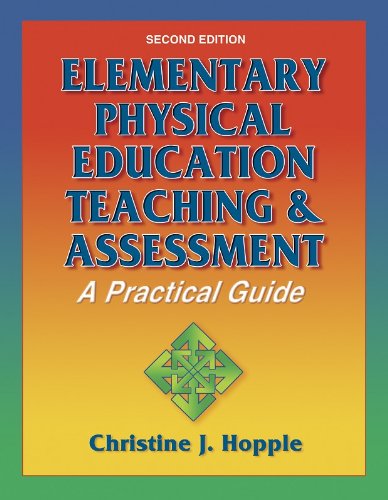

Elementary physical education teaching & assessment a practical guide Christine J. Hopple.
Detalles de publicación: Champaign, IL Human Kinetics c2005.Edición: 2nd edDescripción: x, 293 p. ill. 29 cmISBN:- 0736044051
- GV443 .H66 2005
| Imagen de cubierta | Tipo de ítem | Biblioteca actual | Biblioteca de origen | Colección | Ubicación en estantería | Signatura topográfica | Materiales especificados | Info Vol | URL | Copia número | Estado | Notas | Fecha de vencimiento | Código de barras | Reserva de ítems | Prioridad de la cola de reserva de ejemplar | Reservas para cursos | |
|---|---|---|---|---|---|---|---|---|---|---|---|---|---|---|---|---|---|---|
| Libro | Biblioteca de Mayagüez Colección General mb | GV443 .H66 2005 (Navegar estantería(Abre debajo)) | Disponible | 50000002165610 |
Descripciones mejoradas de Syndetics:
Assessments are a part of a physical educator's daily life. But most teachers struggle to find enough time to analyze their curriculum and develop assessments to track students' learning.
Enter Elementary Physical Education Teaching & Assessment: A Practical Guide, Second Edition . This guide is designed to make the assessment process not only easier but also more manageable. Assessment becomes not a burden in a teacher's life but an essential teaching tool that assists students in learning what they need to learn--and indeed can motivate and challenge them to take charge of their learning.
This book, greatly expanded and revised from its original publication as Teaching for Outcomes in Elementary Physical Education , will help teachers
- plan and implement school- or district-wide curriculum based on the latest NASPE (National Association for Sport and Physical Education) Standards (2004);
- create their own assessment tools;
- understand, develop, and use alternative methods of assessment;
- assess program effectiveness and students' progress toward understanding and acquisition of movement and fitness concepts and skills; and
- design and use rubrics for each assessment task.
In addition, teachers using this guide will learn to
- streamline and manage their day-to-day assessment tasks and paperwork, applying the technology most suited to assist them;
- interpret and communicate assessment results effectively; and
- make assessments an integrated part of their program.
In Elementary Physical Education Teaching & Assessment: A Practical Guide, Second Edition , teachers will discover tips for handling paperwork, tools for communicating with parents, and practical guidance on coordinating teaching and assessment and dealing with grading issues. In addition, they will find more sample rubrics, more assessment tasks, and more curriculum ideas. Dozens of reproducibles complete the most comprehensive and practical book available on assessment in elementary physical education.
Previous ed. published as: Teaching for outcomes in elementary physical education.
Includes bibliographical references (p. 289-291).
gccoct2006
Tabla de contenidos provista por Syndetics
- Preface
- Acknowledgments
- Part I Assessment in Elementary Physical Education
- Chapter 1 Introducing Alternative Assessment
- Defining Alternative Assessment
- The Four Ps of Alternative Assessments
- Seamless Assessment
- Characteristics of Quality Assessment
- Attributes of Assessment Tasks
- So Why Assess?
- Summary
- Chapter 2 Scoring and Creating Alternative Assessment Tasks
- Checklists
- Rating Scales
- Rubrics
- Summary
- Chapter 3 Managing the Assessment Process
- Finding Time to Assess
- Organizing and Setting Up Protocols for Assessment
- Recording Performance Data
- Using Technology in Assessment
- Summary
- Chapter 4 Using Your Assessment Data
- Improving Curriculum
- Placement
- Grading and Reporting
- Communicating Assessment Results to Parents
- Communicating Results to Administrators
- Summary
- Part II Standards and Curriculum in Elementary Physical Education
- Chapter 5 Standards and Curriculum
- A Brief History of the Move Toward Standards
- Definitions and Types of Standards
- Principles of Standards-Based Education
- Levels of Standards in the Designing-Down Process
- Summary
- Chapter 6 Using Standards to Develop Your Curriculum
- Step 1 Define the Content of Your Course Standards
- Step 2 Compare Curriculum Units and Standards
- Step 3 Develop Your Unit Overview
- Step 4 Revise Your Unit Overview
- Step 5 Plan Lesson Activities and Assessments
- Summary
- Part III Sample Assessment Tasks and Curriculum Ideas
- Chapter 7 Safety and Participation
- Chapter 8 Movement Concepts
- Body Awareness
- Space Awareness
- Effort
- Relationships
- Chapter 9 Locomotor Skills
- Locomotor Movements
- Chasing, Fleeing, and Dodging
- Jumping and Landing
- Chapter 10 Nonlocomotor Skills
- Rolling
- Balancing
- Weight Transfer
- Chapter 11 Manipulative Skills
- Dribbling With the Hands
- Kicking and Punting
- Throwing and Catching
- Volleying
- Striking With Short-Handled Implements
- Striking With Long-Handled Implements
- Chapter 12 Health, Activity, and Fitness
- Introduction to Physical Activity and Physical Fitness
- Cardiorespiratory Fitness
- Muscular Strength and Endurance
- Flexibility
- Training and Conditioning
- Healthy Habits
- Appendix A Sample Performance Indicators for Selected Themes
- Appendix B NASPE Performance Indicators
- Glossary
- Bibliography
- About the Author
Notas de autor provistas por Syndetics
Christine J. Hopple, MS , has taught elementary physical education for eight years in Florida and Virginia. She has also taught physical education teacher preparation courses at Ithaca College for five years. Hopple authored Teaching for Outcomes in Elementary Physical Education: A Guide for Curriculum and Assessment , and she coauthored the first edition of NASPE's Developmentally Appropriate Physical Education Practices for Children . Hopple, currently at work on her PhD, has presented on assessment and other topics at numerous state and national conferences and has worked with numerous teachers and school districts across the country on this subject.
Hopple is a member of AAHPERD (American Alliance for Health, Physical Education, Recreation and Dance), a past editor of TEPE ( Teaching Elementary Physical Education ), and an instructor for the American Master Teacher Program for Children's Physical Education.