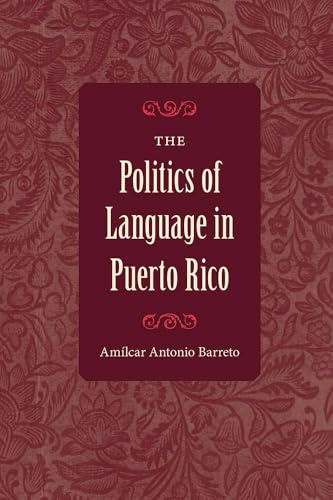

The politics of language in Puerto Rico Amílcar Antonio Barreto.
Detalles de publicación: Gainesville University Press of Florida c2001.Descripción: xiv, 221 p. ill. 24 cmISBN:- 0813020778 (alk. paper)
- 306.449795 B273p 21
- P119.32.P84 B37 2001
| Imagen de cubierta | Tipo de ítem | Biblioteca actual | Biblioteca de origen | Colección | Ubicación en estantería | Signatura topográfica | Materiales especificados | Info Vol | URL | Copia número | Estado | Notas | Fecha de vencimiento | Código de barras | Reserva de ítems | Prioridad de la cola de reserva de ejemplar | Reservas para cursos | |
|---|---|---|---|---|---|---|---|---|---|---|---|---|---|---|---|---|---|---|
| Libro | Biblioteca Encarnación Valdés Colección de Puerto Rico | 306.449795 B273p (Navegar estantería(Abre debajo)) | Disponible | 80000002291113 |
Descripciones mejoradas de Syndetics:
"A [book] rich in detail and analysis, which anyone wanting to understand the language debate in Puerto Rico will find essential."--Arlene Davila, Syracuse University
This is the first book in English to analyze the controversial language policies passed by the Puerto Rican government in the 1990s. It is also the first to explore the connections between language and cultural identity and politics on the Caribbean island.
Shortly after the U.S. invasion of Puerto Rico in 1898, both English and Spanish became official languages of the territory. In 1991, the Puerto Rican government abolished bilingualism, claiming that "Spanish only" was necessary to protect the culture from North American influences. A few years later bilingualism was restored and English was promoted in public schools, with supporters asserting that the dual languages symbolized the island's commitment to live in harmony with the United States.
While the islanders' sense of ethnic pride was growing, economic dependency enticed them to maintain close ties to the United States. This book shows that officials in both San Juan and Washington, along with English-first groups, used the language laws as weapons in the battle over U.S.-Puerto Rican relations and the volatile debate over statehood. It will be of interest to linguists, political scientists, students of contemporary cultural politics, and political activists in discussions of nationalism in multilingual communities.
Includes bibliographical references (p. [191]-214) and index.