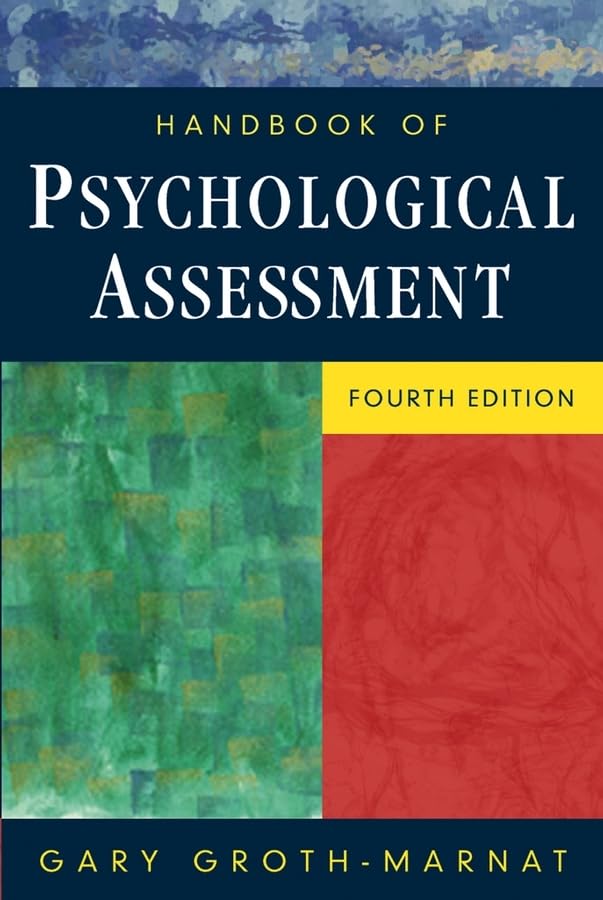

Handbook of psychological assessment Gary Groth-Marnat.
Detalles de publicación: Hoboken, N.J. Wiley c2005.Edición: 4th edDescripción: xv, 846 p. ill. 26 cmISBN:- 0471419796
- Psychological assessment
- 150.287 G8814h4 21
- BF176 .G76 2005
| Imagen de cubierta | Tipo de ítem | Biblioteca actual | Biblioteca de origen | Colección | Ubicación en estantería | Signatura topográfica | Materiales especificados | Info Vol | URL | Copia número | Estado | Notas | Fecha de vencimiento | Código de barras | Reserva de ítems | Prioridad de la cola de reserva de ejemplar | Reservas para cursos | |
|---|---|---|---|---|---|---|---|---|---|---|---|---|---|---|---|---|---|---|
| Referencia | Biblioteca Encarnación Valdés Sala de Referencia bev | 150.287 G8814h4 (Navegar estantería(Abre debajo)) | Disponible | 80000002285420 |
Descripciones mejoradas de Syndetics:
From Previous Editions:
"A commendable volume in which the author condenses information, normally in several locations, into one reading . . . an excellent text for graduate courses on psychological assessment. It . . . familiarizes the student with the entire enterprise of clinical assessment and provides enough of a how-to guide for the student to carry out an assessment practicum."
--Contemporary Psychology
"For both practitioners and students of psychological assessment, the expanded and updated Handbook provides guidance to the selection, administration, evaluation, and interpretation of the most commonly used psychological tests."
--Reference and Research Book News
The updated and expanded fourth edition of the highly acclaimed classic text on psychological assessment
The Handbook of Psychological Assessment, Fourth Edition presents a step-by-step guide on how to conduct a comprehensive psychological evaluation. It provides a complete review of the most commonly used assessment instruments and the most efficient methods for selecting and administering tests, evaluating data, and integrating results into a coherent, problem-solving report.
Updated reviews and interpretive guidelines are included for the most frequently used assessment techniques, including structured and unstructured interviews, Wechlser intelligence scales (WAIS-III/WISC-III), Minnesota Multiphasic Personality Inventory (MMPI-2/MMPI-A), Millon Multiaxial Clinical Inventory-III, California Psychological Inventory, Rorschach, Thematic Apperception Test, and frequently used instruments for neuropsychological screening (e.g., Bender Gestalt and Rey Auditory Verbal Learning Test). Each test is reviewed according to its history and development, psychometrics, administration, and interpretation of results.
In addition, this revised and expanded Fourth Edition includes:
* Completely updated research on all assessment techniques
* A chapter on the Wechsler Memory Scales (WMS-III)
* A new chapter on brief instruments for treatment planning, patient monitoring, and outcome assessment (Beck Depression Inventory-II, State Trait Anxiety Inventory, and Symptom Checklist-90-R)
Organized according to the sequence psychologists follow when conducting an assessment, the Handbook of Psychological Assessment, Fourth Edition is a practical, valuable reference for clinical psychologists, therapists, school psychologists, and counselors.
Includes bibliographical references (p. 725-820) and indexes.
Tabla de contenidos provista por Syndetics
- Preface(p. xiii)
- Chapter 1 Introduction(p. 1)
- Organization of the Handbook(p. 1)
- Role of the Clinician(p. 3)
- Patterns of Test Usage in Clinical Assessment(p. 5)
- Evaluating Psychological Tests(p. 9)
- Validity in Clinical Practice(p. 20)
- Clinical Judgment(p. 23)
- Phases in Clinical Assessment(p. 28)
- Recommended Reading(p. 32)
- Chapter 2 Context of Clinical Assessment(p. 33)
- Types of Referral Settings(p. 33)
- Ethical Practice of Assessment(p. 43)
- Assessing Diverse Groups(p. 51)
- Selecting Psychological Tests(p. 58)
- Computer-Assisted Assessment(p. 62)
- Recommended Reading(p. 64)
- Chapter 3 The Assessment Interview(p. 65)
- History and Development(p. 66)
- Issues Related to Reliability and Validity(p. 70)
- Assets and Limitations(p. 71)
- The Assessment Interview and Case History(p. 73)
- Mental Status Examination(p. 79)
- Interpreting Interview Data(p. 84)
- Structured Interviews(p. 85)
- Recommended Reading(p. 94)
- Chapter 4 Behavioral Assessment(p. 95)
- History and Development(p. 97)
- Issues Related to Reliability and Validity(p. 99)
- Assets and Limitations(p. 101)
- Strategies of Behavioral Assessment(p. 102)
- Recommended Reading(p. 117)
- Chapter 5 Wechsler Intelligence Scales(p. 119)
- Testing of Intelligence: Pro and Con(p. 119)
- History and Development(p. 122)
- Reliability and Validity(p. 126)
- Assets and Limitations(p. 129)
- Use with Diverse Groups(p. 132)
- Meaning of IQ Scores(p. 134)
- Cautions and Guidelines in Administration(p. 136)
- WAIS-IV/WISC-IV Successive-Level Interpretation Procedure(p. 138)
- Wechsler Indexes and Subtests(p. 149)
- Assessing Brain Damage(p. 166)
- Assessing Additional Special Populations(p. 173)
- Short Forms(p. 178)
- Recommended Reading(p. 181)
- Chapter 6 Wechsler Memory Scales(p. 183)
- History and Development(p. 184)
- Reliability and Validity(p. 189)
- Assets and Limitations(p. 191)
- Use with Diverse Groups(p. 193)
- Interpretation Procedure(p. 193)
- Interpreting Patterns of Index Scores(p. 196)
- Comparing Scores on the WAIS-IV and the WMS-IV(p. 203)
- Additional Considerations: Malingering and Evaluating Change(p. 205)
- Recommended Reading(p. 206)
- Chapter 7 Minnesota Multiphasic Personality Inventory(p. 207)
- History and Development(p. 209)
- Reliability and Validity(p. 214)
- Assets and Limitations(p. 217)
- Use with Diverse Groups(p. 220)
- Administration(p. 222)
- Interpretation Procedure(p. 223)
- Computerized Interpretation(p. 230)
- Validity Scales(p. 231)
- Clinical Scales(p. 237)
- 2-Point Codes(p. 257)
- MMPI-2 Content Scales(p. 280)
- MMPI-A Content Scales(p. 282)
- Harris-Lingoes and Si Subscales(p. 285)
- Critical Items(p. 288)
- MMPI-2 and MMPI-A Supplementary Scales(p. 288)
- Recommended Reading(p. 294)
- Chapter 8 Million Clinical Multiaxial Inventory(p. 295)
- History and Development(p. 297)
- Reliability and Validity(p. 300)
- Assets and Limitations(p. 302)
- Use with Diverse Groups(p. 306)
- Interpretation Procedure(p. 307)
- Modifying Indices (Validity Scales)(p. 310)
- Clinical Personality Patterns(p. 312)
- Severe Personality Pathology(p. 327)
- Clinical Syndromes(p. 331)
- Severe Syndromes(p. 333)
- Recommended Reading(p. 333)
- Chapter 9 California Psychological Inventory(p. 335)
- History and Development(p. 336)
- Comparison with the MMPI(p. 338)
- Reliability and Validity(p. 339)
- Assets and Limitations(p. 340)
- Use with Diverse Groups(p. 343)
- Interpretation Procedures(p. 343)
- Vector Scale Interpretation(p. 348)
- Individual Scales(p. 349)
- Special Purpose Scales(p. 371)
- Configural Interpretation(p. 372)
- Recommended Reading(p. 384)
- Chapter 10 The Rorschach(p. 385)
- History and Development(p. 386)
- Reliability and Validity(p. 389)
- Assets and Limitations(p. 393)
- Use with Diverse Groups(p. 396)
- Future Directions(p. 396)
- Administration(p. 397)
- Scoring(p. 400)
- Structural Summary(p. 407)
- Interpretation(p. 415)
- Recommended Reading(p. 446)
- Chapter 11 Thematic Apperception Test(p. 447)
- History and Development(p. 447)
- Theoretical Perspectives(p. 450)
- Reliability and Validity(p. 452)
- Assets and Limitations(p. 455)
- Use with Diverse Groups(p. 457)
- Administration(p. 458)
- Typical Themes Elicited(p. 461)
- Scoring Procedures(p. 474)
- Interpretation(p. 482)
- Recommended Reading(p. 483)
- Chapter 12 Screening for Neuropsychological Impairment(p. 485)
- History and Development(p. 486)
- Interviewing for Brain Impairment(p. 489)
- Domains of Neuropsychological Functioning(p. 492)
- Bender Visual Motor Gestalt Test(p. 501)
- Repeatable Battery for the Assessment of Neuropsychological Status(p. 511)
- Recommended Reading(p. 517)
- Chapter 13 Brief Instruments for Treatment Planning, Monitoring, and Outcome Assessment(p. 519)
- Selecting Brief Instruments(p. 520)
- Symptom Checklist-90-R (SCL-90-R) and Brief Symptom Inventory (BSI)(p. 521)
- Beck Depression Inventory(p. 526)
- State Trait Anxiety Inventory (STAI)(p. 530)
- Recommended Reading(p. 533)
- Chapter 14 Psychological Assessment and Treatment Planning(p. 535)
- Development and Approaches to Treatment Planning(p. 536)
- A Systematic Approach to Treatment Selection(p. 541)
- Functional Impairment(p. 542)
- Social Support(p. 545)
- Problem Complexity/Chronicity(p. 547)
- Coping Style(p. 549)
- Resistance(p. 551)
- Subjective Distress(p. 553)
- Problem-Solving Phase(p. 556)
- Recommended Reading(p. 558)
- Chapter 15 Psychological Report(p. 559)
- General Guidelines(p. 560)
- Format for a Psychological Report(p. 570)
- Sample Reports(p. 582)
- Recommended Reading(p. 604)
- Appendix A Test publishers/distributors(p. 605)
- Appendix B Testing organizations(p. 609)
- Appendix C WISC-IV Norms Tables for Clinical Clusters(p. 611)
- Appendix D Directions for Hand Scoring the Minnesota Multiphasic Personality Inventory (MMPI-2) Validity and Clinical Scales(p. 621)
- Appendix E Rorschach Norms for Scoring Categories(p. 623)
- Appendix F Rorschach Norms for Ratios, Percentages, and Special Indices(p. 627)
- References(p. 629)
- Author Index(p. 709)
- Subject Index(p. 731)