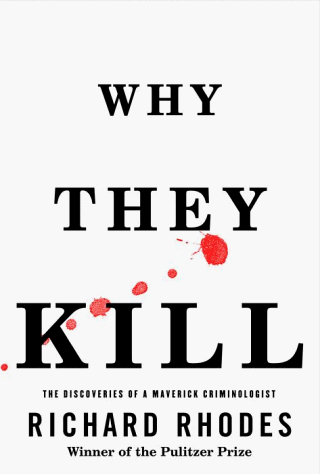

Why they kill the discoveries of a Maverick criminologist / Richard Rhodes.
Descripción: x,371 pISBN:- 0375402497
| Imagen de cubierta | Tipo de ítem | Biblioteca actual | Biblioteca de origen | Colección | Ubicación en estantería | Signatura topográfica | Materiales especificados | Info Vol | URL | Copia número | Estado | Notas | Fecha de vencimiento | Código de barras | Reserva de ítems | Prioridad de la cola de reserva de ejemplar | Reservas para cursos | |
|---|---|---|---|---|---|---|---|---|---|---|---|---|---|---|---|---|---|---|
| Libro | Biblioteca de Mayagüez Colección General mb | HV 6080 .R46 1999 (Navegar estantería(Abre debajo)) | Disponible | 50000002080884 |
Descripciones mejoradas de Syndetics:
Why do some men, women and even children assault, batter, rape, mutilate and murder? In his stunning new book, the Pulitzer Prize-winner Richard Rhodes provides a startling and persuasive answer. Why They Killexplores the discoveries of a maverick American criminologist, Dr. Lonnie Athens -- himself the child of a violent family -- which challenge conventional theories about violent behavior. By interviewing violent criminals in prison, Dr. Athens has identified a pattern of social development common to all seriously violent people -- a four-stage process he calls "violentization": -- First, brutalization: A young person is forced by violence or the threat of violence to submit to an aggressive authority figure; he witnesses the violent subjugation of intimates, and the authority figure coaches him to use violence to settle disputes. -- Second, belligerency: The dispirited subject, determined to prevent his further violent subjugation, heeds his coach and resolves to resort to violence. -- Third, violent performances: His violent response to provocation succeeds, and he reads respect and fear in the eyes of others. -- Fourth, virulency: Exultant, he determines from now on to utilize serious violence as a means of dealing with people -- and he bonds with others who believe as he does. Since all four stages must be fully experienced in sequence and completed to produce a violent individual, we see how intervening to interrupt the process can prevent a tragic outcome. Rhodes supports Athens's theory with historical evidence and shows how it explains such violent careers as those of Perry Smith (the killer central to Truman Capote's narrativeIn Cold Blood), Mike Tyson, "preppy rapist" Alex Kelly, and Lee Harvey Oswald. Why They Killchallenges with devastating evidence the theory that violent behavior is impulsive, unconsciously motivated and predetermined. It offers compelling insights into the terrible, ongoing dilemma of criminal violence that plagues families, neighborhoods, cities and schools.
Includes bibliographical references and index.
Tabla de contenidos provista por Syndetics
- Part I The Man Who Talks to Murderers
- Prologue(p. 5)
- 1 Bring It On(p. 7)
- 2 Thoughts Filled with Ghosts(p. 18)
- 3 How the System Works(p. 27)
- 4 The Full, Ugly Reality(p. 38)
- 5 Taking the Attitude of the Other(p. 48)
- 6 Beautiful Narrative(p. 59)
- 7 Conscious Constructions(p. 66)
- 8 Phantom Communities(p. 79)
- 9 Academic Crackers and Cheese(p. 96)
- 10 The Creation of Dangerous Violent Criminals (I)(p. 109)
- 11 The Creation of Dangerous Violent Criminals (II)(p. 125)
- Part II The Civilizing Process
- 12 Cheryl Crane(p. 143)
- 13 Alex Kelly, Perry Smith, Mike Tyson(p. 156)
- 14 Lee Harvey Oswald(p. 175)
- 15 Murders with Motives(p. 199)
- 16 Monopolies of Violence(p. 214)
- 17 The History of Childhood(p. 228)
- 18 Primitive Violence(p. 251)
- Part III The Self as a Soliloquy
- 19 Dramatic Self-Change(p. 267)
- 20 Universal Processes(p. 273)
- 21 The Gates of Mercy Shut Up(p. 286)
- 22 Strategies of Prevention and Control(p. 313)
- Notes(p. 325)
- Bibliography(p. 343)
- Acknowledgments(p. 351)
- Index(p. 353)
Extracto provisto por Syndetics
Reseñas proporcionadas por Syndetics
Library Journal Review
Drawing on exhaustive interviews with violent prison inmates, criminologist Lonnie Athens asserts that people do not commit violent crimes because they live in poverty, are mentally ill or on drugs, have a genetic predisposition to violence, "just snap," or have been brutalized as children (though the latter plays a part). Rather, they have undergone a four-step "violentization" process that leads them, under certain circumstances, to decide consciously to beat, rape, or kill. Together with Athens's own hardscrabble, violence-filled upbringing, this theoryÄderived as it is from qualitative rather than quantitative researchÄhas made his existence within the academic community difficult. Rhodes, a Pulitzer Prize winner (The Making of the Atomic Bomb) and himself a victim of childhood violence, offers a compelling look at Athens, his work, and its application to noted violent offenders, different eras and cultures, and men at war. Recommended for academic and larger public libraries. [Previewed in Prepub Alert, LJ 5/1/99.]ÄJim G. Burns, Ottumwa P.L., IA (c) Copyright 2010. Library Journals LLC, a wholly owned subsidiary of Media Source, Inc. No redistribution permitted.Publishers Weekly Review
What transforms an ordinary person into a violent criminal? Not genetic inheritance or low self-esteem or coming from a violent subculture, answers Pulitzer PrizeÄwinning author Rhodes (The Making of the Atomic Bomb, etc.), but rather a process of brutalization by parents or peers that usually occurs in childhood. In this provocative study, Rhodes focuses on the work of criminologist Lonnie Athens, who teaches at Seton Hall University in New Jersey. Athens believes that violent crime results from "social retardation," a process whereby an individual who was abused in childhood guides his or her actions by recourse to a "phantom community" of the internalized voices of caregivers and others. Rhodes tests Athens's theory against specific cases, including those of boxer and convicted rapist Mike Tyson; Cheryl Crane, daughter of actress Lana Turner, who at age 14 stabbed to death her mother's lover; and Lee Harvey Oswald. The author champions Athens as a pioneering genius battling a criminological establishment that ascribes violent crime to psychopathology or antecedent social conditions; yet he overestimates the originality of Athens's work (the "phantom community" in some ways resembles Freud's superego), and his well-intentioned study is at times belabored. Both Rhodes and Athens suffered through horrifically abusive childhoods, which adds a compelling personal note to this study but may also color their views. Rhodes strongly endorses Athens's call for school-based prevention programs to break the cycle of domestic and societal violence. Agents, Morton Janklow and Anne Sibbald, Janklow & Nesbit Associates. (Sept.) (c) Copyright PWxyz, LLC. All rights reservedCHOICE Review
Rhodes's study is based on the life and work of Lonnie H. Athens. The author begins with a brief biography, then turns to an assessment of the theory Athens developed in his book The Creation of Dangerous Violent Criminals (1989). Growing out of interviews of violent criminals in prison, Athens's theory states that violent people evolve through four specific stages: brutalization, belligerency, violent performances, and virulency. Rhodes, a noted journalist and Pulitzer Prize winner, evaluates this theory by examining several prominent violent people and suggests that the theory can be more broadly applied. Both Rhodes and Athens recommend early intervention to reduce the incidence of violence in contemporary society. The book is well written and readable and is lightly referenced. Recommended for general readers. R. T. Sigler; University of AlabamaBooklist Review
If the words true crime conjure up images of cheap paperbacks with lurid covers, or quickie hardcovers designed to cash in on some headline-making atrocity, here's a book that will change your image of the genre. Rhodes, who won a Pulitzer for The Making of the Atomic Bomb (1987), has crafted a serious, intelligent, and altogether mesmerizing portrait of evil and the people who fight it. Chief among the fighters (at least in this book) is Lonnie Athens, whose rocky childhood led him into a career as a criminologist. His decade-long study of criminals behind bars revealed things no one had yet begun to suspect--including, most importantly, the reasons why people commit violence on one another. Rhodes' profile of Athens--this is in many ways a traditional biography--strongly suggests that the people best equipped to understand violence are those who, like Athens, have seen it close up. This is not a flashy book, and some readers may be turned off by Rhodes' somewhat dry style. Others may find some of the graphic language unsettling. But Rhodes tells a remarkable story, and the book ranks near the top of the true-crime genre. --David PittNotas de autor provistas por Syndetics
Richard Lee Rhodes is a writer. He was born in Kansas City, Kansas on July 4, 1937. Rhodes received a B.A. from Yale University in 1959.Rhodes has received grants from the Guggenheim Foundation, the Ford Foundation, the Sloan Foundation, the MacArthur Foundation, and the National Endowment for the Arts. He began writing articles and essays that appeared in Harper's, Reader's Digest, Esquire, The New Yorker, and Rolling Stone. Rhodes first book, The Island Ground, was published in 1970. He has written more than two dozen books. Rhodes' book, The Making of the Atomic Bomb won the 1988 Pulitzer Prize for Nonfiction, the National Book Award for Nonfiction, and the National Book Critics Circle Award in General Nonfiction. Another book, Dark Sun: The Making of the Hydrogen Bomb, was a finalist for the Pulitzer Prize in History in 1996.
(Bowker Author Biography)