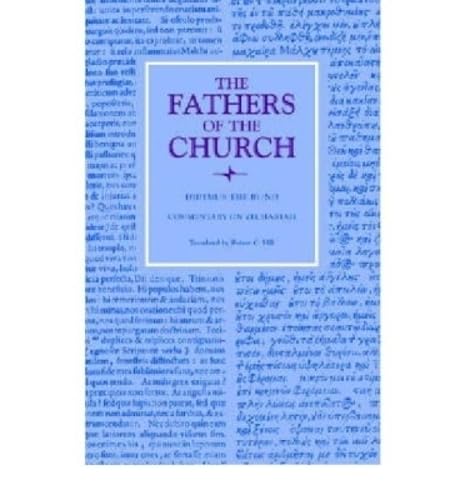

Commentary on Zechariah translated by Robert C. Hill.
Idioma: Inglés Lenguaje original: griego antiguo (hasta 1453) Series The Fathers of the church ; v. 111Detalles de publicación: Washington, D.C. Catholic University of America Press c2006.Descripción: xi, 372 p. 22 cmISBN:- 081320111X (cloth : alk. paper)
- 224.9807 22
- BR60.F3 D53 2006 BS1665.53
| Imagen de cubierta | Tipo de ítem | Biblioteca actual | Biblioteca de origen | Colección | Ubicación en estantería | Signatura topográfica | Materiales especificados | Info Vol | URL | Copia número | Estado | Notas | Fecha de vencimiento | Código de barras | Reserva de ítems | Prioridad de la cola de reserva de ejemplar | Reservas para cursos | |
|---|---|---|---|---|---|---|---|---|---|---|---|---|---|---|---|---|---|---|
| Libro | Biblioteca Encarnación Valdés Colección General bev | 281.1 F252 I (Navegar estantería(Abre debajo)) | Disponible | 80000002179557 |
Descripciones mejoradas de Syndetics:
The book of Zechariah is the longest and most obscure of the Twelve Minor Prophets, Jerome remarked. That may have been the reason why in 386 he visited the Alexandrian scholar Didymus the Blind and requested a work on this prophet. Though long thought to be lost, the work was rediscovered in 1941 at Tura outside Cairo along with some other biblical commentaries. As a result we have in our possession a commentary on Zechariah by Didymus that enjoys particular distinction as his only complete work on a biblical book extant in Greek whose authenticity is established, which comes to us by direct manuscript tradition, and has been critically edited. Thus it deserves this first appearance in English. A disciple of Origen, whose work on Zechariah reached only to chapter five and is no longer extant, Didymus's commentary on this apocalyptic book illustrates the typically allegorical approach to the biblical text that we associate with Alexandria. Even Cyril of Alexandria in the next generation will lean rather to the historical style of commentary found in the Antiochene scholars Theodore and Theodoret, whose works on the Twelve are also extant and who had Didymus open before them. obscure verses of Zechariah, capitalizing on his extraordinary familiarity with Holy Writ (despite his disability), and proceeding on a process of interpretation-by-association, frequently invoking also etymology and number symbolism to plumb the meaning of the text. No wonder he remarks, The reader who understands it is a seer; such is the richness of the hermeneutical offering.
Includes bibliographical references (p. ix-xi) and indexes.
Circumstances of composition of the Zechariah Commentary -- Text of the Commentary, Didymus's biblical text -- Didymus's approach to scripture -- Style of commentary -- Didymus as interpreter of Zechariah -- Theological accents of the Commentary -- Significance of the Commentary on Zechariah -- Commentary on Zechariah.
Translated from the Ancient Greek.