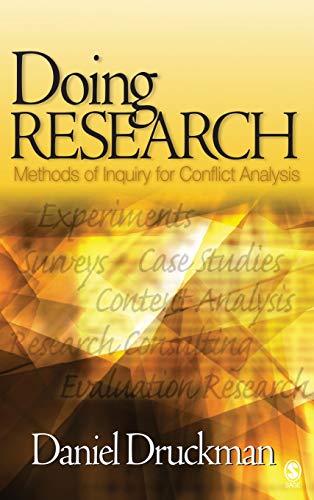

Doing research methods of inquiry for conflict analysis Daniel Druckman.
Detalles de publicación: Thousand Oaks, Calif. Sage Publications c2005.Descripción: xv, 387 p. ill. 24 cmISBN:- 0761927786 (cloth)
- 0761927794 (pbk.)
- 303.69072 D7942d 22
- HM1126 .D78 2005
| Imagen de cubierta | Tipo de ítem | Biblioteca actual | Biblioteca de origen | Colección | Ubicación en estantería | Signatura topográfica | Materiales especificados | Info Vol | URL | Copia número | Estado | Notas | Fecha de vencimiento | Código de barras | Reserva de ítems | Prioridad de la cola de reserva de ejemplar | Reservas para cursos | |
|---|---|---|---|---|---|---|---|---|---|---|---|---|---|---|---|---|---|---|
| Libro | Biblioteca Encarnación Valdés Colección General bev | 303.69072 D7942d (Navegar estantería(Abre debajo)) | Disponible | 80000002288259 |
Descripciones mejoradas de Syndetics:
Winner of the 2006 outstanding book award (for books published in 2004-2005) from the International Association for Conflict Management at their annual meeting held in Montreal!
An award-winning book, Doing Research is a must read. Designed for students across a variety of social science disciplines, it is the first research methods text devoted to conflict analysis and resolution. It begins with a discussion of the philosophical foundations for doing research, providing guidelines on how to develop research questions and how these questions can be addressed with various methodologies. The book presents a wide-ranging treatment of both quantitative and qualitative approaches to the design and analysis of problems of conflict.
The approaches covered include experiments, simulations and models, surveys, single and comparative case studies, ethnographies, content analysis, narrative analysis, evaluation research, action research, and research consulting. These approaches come alive in a variety of applications culled from the published literature. A concluding chapter provides an integration of the various methodologies, including their complementary strengths. Throughout the book, author Daniel Druckman illustrates the value of a multi-method approach to doing research on conflict analysis and more generally across the social sciences.
Key Features
Guides readers through how to do literature reviews and ask research questions, easing students into the research process Weaves together qualitative and quantitative, as well as deductive and inductive, approaches to analysis, allowing for the widest possible diversity in methodology Includes numerous examples from published articles and dissertations and a discussion of research consultingDoing Researchis perfectly suited as a text for research methods courses across the social sciences, especially those dealing with conflict analysis in departments of political science, communication, psychology, sociology, and management. Professional researchers and consultants will also want to add this book to their libraries for guidance on multi-method techniques."This is an extremely important book for our field because it is the first research methods book that focuses on techniques that are common in this area but transcends disciplines. I am confident that the book will be used widely in our field because it is both practical and engaging."-- William A. Donohoe, Michigan State University"Doing Researchis a gem. It provides multiple research methods and models focusing on conflict analysis and resolution that can be used by any student in a variety of social science disciplines or fields of study. I wish this book had been written 20 years ago."--Brian Polkinghorn, Salisbury State University
"Doing Researchis the most widely acclaimed book on research methods for conflict resolution students to appear in recent years. The book provides a wonderfully rich array of ideas about ways to do research for both the scholar and practitioner--pracademic--enriching the analysis and practice in the conflict resolution field. The author has a diverse intellectual background and his wide-ranging research experience informs the contributions made by this book to conflict analysis and resolution and to related social-science fields."--Sean Byrne, University of Manitoba
Includes bibliographical references (p.351-366) and index.
Why do research? -- Getting started to do research -- Designing experiments and conducting simulations -- Evaluating data from experiments : methods of analysis -- Survey research / Scott Keeter -- Enhanced-case and time series analyses -- Comparative case study approaches -- Ethnographic methods / Linda J. Seligmann -- Content analysis -- Narrative analysis / Linda M. Johnston -- Evaluation research -- Research for action and consulting.
Tabla de contenidos provista por Syndetics
- Preface
- Prologue
- Doing Research on Conflict
- Part Introduction
- Why Do Research?
- Research Foundations: Debating Points
- Research Motivations, Assumptions, Questions
- Some Contributions from Research on Conflict
- Discussion Questions
- Getting Started to Do Research
- Where Ideas Come From
- Choosing a Research Topic
- Alternative Methodological Approaches
- Choosing an Approach
- Discussion Questions
- Performing Experiments
- Part Introduction
- Designing Experiments and Conducting Simulations
- The Experimental Method: An Overview
- Internal and External Validity
- Experimental Designs: Examples from CA&R
- Summary
- Discussion Questions
- Evaluating Data from Experiments: Methods of Analysis
- Essential Ideas of Statistical Analysis
- Measurement and Statistical Power: Two-Group Designs
- Measurement and Power: Three-Group Designs
- Factorial Designs
- Repeated Measures and Other ANOVA Designs
- Summary
- Discussion Questions
- Designing and Conducting Surveys
- Part Introduction
- Survey Research
- Overview
- Survey Research Design
- Measurement
- Sampling
- Data Collection
- Ethics
- Conclusions
- Discussion Questions
- Doing Case-Based Research
- The Case-Study Method: An Overview
- Enhanced-Case and Time Series Analyses
- Theory and the Case Study
- Time-Series Designs and Analyses
- Systematic Expert Judgment
- Qualitative Time-Series Analysis
- Summary
- Comparative Case Study Approaches
- Focussed Case Comparisons
- Aggregate Case Comparisons
- Discussion Questions
- Writing Ethnographies
- Part Introduction
- Ethnographic Methods
- What is Ethnography?
- Why do Ethnography?
- The Logic of Ethnography
- Making Sense of Other Worlds
- Taking Notes
- The Ethnographer's Tool Kit
- Discussion Questions
- Analyzing Documents: Texts and Process Analysis
- Part Introduction
- Content Analysis
- Overview of the Approach
- Technical Issues for the Content Analyst
- Content Analysis Applications
- Discussion Questions
- Narrative Analysis
- Overview of the Approach
- Narrative Theory
- Analysis of Narratives
- Discussion Questions
- Evaluating Interventions and Applying Research
- Part Introduction
- Evaluation Research
- Challenges of Evaluation
- Tasks in an Evaluation Project
- Evaluation Issues
- Evaluating Interventions: An Example of a Framework
- Discussion Questions
- Research for Action and Consulting
- Basic and Applied Research
- Action Research
- Research Consulting
- Discussion Questions
- Concluding
- Part Introduction
- From Philosophies to Research Methods: The Value of Doing Research in Conflict Analysis and Resolution
- Doing Research: Philosophies and Methodologies
- Research Issues
- Summary of Methods Covered
- Comparing the Methodologies: Experiments, Surveys, and Case Studies
- Types of Data
- Wrapping Up
- Epilogue
- References
Notas de autor provistas por Syndetics
Daniel Druckmanis a 2004-2005 visiting Professor at the University of Queensland′s Australian Centre for Peace and Conflict Studies in Brisbane, Australia. He is the Vernon M. and Minnie I. Lynch Professor of Conflict Resolution at George Mason University in Fairfax, Virginia, where he has coordinated the doctoral program at the Institute for Conflict Analysis and Resolution (ICAR). He is also a member of the faculty at Sabanci University in Istanbul, Turkey and has held senior positions at several consulting firms, as well as at the U.S. National Academy of Sciences. He received a Ph.D. from Northwestern University and was awarded a best-in-field prize from the American Institutes for Research for his doctoral dissertation. He has published widely (approximately 150 publications, including 12 authored or edited books) on such topics as negotiating behavior, nationalism and group identity, human performance, peacekeeping, political stability, nonverbal communication, and methodology (including simulation). He serves as a board member or associate editor for eight Journals. He received the 1995 Otto Klineberg award for Intercultural and International Relations from the Society for the Psychological Analysis of Social Issues for his work on nationalism, a Teaching Excellence award in 1998 from George Mason University, and an award for the outstanding article published in 2001 from the International Association for Conflict Management. He is the recipient of the 2003 Lifetime Achievement award from the International Association for Conflict Management.