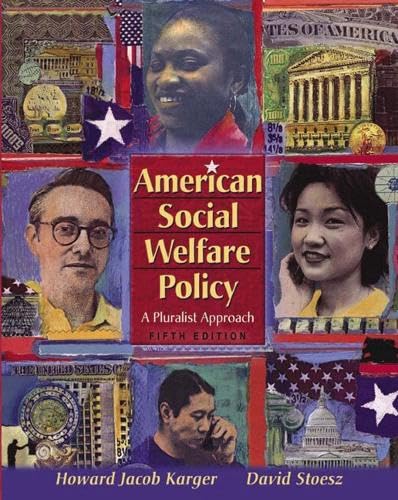

American social welfare policy a pluralist approach Howard Jacob Karger, David Stoesz.
Detalles de publicación: Boston Pearson/ Allyn & Bacon c2006.Edición: 5th edDescripción: xxii, 520 p. ill. (some col.) 26 cmISBN:- 0205401821
- 361.973 K1836a5 22
- HV95 .K354 2006
| Imagen de cubierta | Tipo de ítem | Biblioteca actual | Biblioteca de origen | Colección | Ubicación en estantería | Signatura topográfica | Materiales especificados | Info Vol | URL | Copia número | Estado | Notas | Fecha de vencimiento | Código de barras | Reserva de ítems | Prioridad de la cola de reserva de ejemplar | Reservas para cursos | |
|---|---|---|---|---|---|---|---|---|---|---|---|---|---|---|---|---|---|---|
| Libro | Biblioteca Encarnación Valdés Colección General bev | 361.973 K1836a5 (Navegar estantería(Abre debajo)) | Disponible | 80000002274390 | ||||||||||||||
| Libro | Biblioteca Mons. Iñaki Mallona (Arecibo) Colección General ab | 361.973 K1836a5 (Navegar estantería(Abre debajo)) | Disponible | 60000010007174 |
Descripciones mejoradas de Syndetics:
Now featuring a color design, this best-selling text for policy analysis provides students with a comprehensive overview of social welfare policy in the United States while examining cutting-edge issues.
Thoroughly updated and revised to reflect the impact of dramatic changes in social welfare policy, the fifth edition continues to focus on the examination of how the major sectors of social welfare policy - the voluntary, governmental, corporate, and corporate sectors - operate and co-exist (the "pluralist approach"), while also offering a clear, user-friendly framework for policy analysis. Among the cutting edge issues covered in this edition are: technology and social welfare policy, the fringe economy, religion and social policy, the transformation of public assistance policy into labor policy, and the relationship between tax policy and social welfare policy.
In the fifth edition, you will find a new chapter on Religion and Social Policy that examines the past and present relationship between religion and the creation and the implementation of social policy. The discrimination chapter now includes coverage of the minority middle class and a comprehensive examination of gay and lesbian marriage policies. This chapter also has an updated section on immigration policies since 9/11. Chapter 5, Poverty in America, now includes a section on the fringe economy and its impact on poverty, as well as a new section on Individual Development Accounts (IDAs) and the digital divide. Chapter 8, Making of Governmental Policy, provides up-dates on special interests, lobbyists, and their influence on the 2004 election. Chapter 9, Tax Policy and Income Distribution, examines the impact of the Bush tax cuts on social welfare policy. Chapter 11, Public Assistance Programs, includes updated information on public assistance programs, including an evaluation of the effects of welfare reform legislation and new changes to TANF.
Chapter 16, Housing Policies, includes new material on obstacles to homeownership, such as predatory home mortgages, increases in housing prices, and racial and class discrimination.
Includes bibliographical references and index.
Tabla de contenidos provista por Syndetics
- Preface(p. vii)
- Note to Readers(p. vii)
- Note to Instructors(p. viii)
- How Can Instructional Design Improve My Teaching?(p. ix)
- INTASC Standards(p. ix)
- Using This Text(p. xiii)
- How This Text Is Organized(p. xiii)
- Teacher Decision Cycle(p. xiv)
- Chapter Features(p. xv)
- Acknowledgments(p. xvii)
- Section I Making Connections(p. 1)
- Chapter 1 Connecting Learning and Teaching(p. 3)
- Connections(p. 4)
- DA 1 What Is Learning? What Is Instruction?(p. 5)
- Views of Learning(p. 5)
- DA 2 Learning Principles List(p. 11)
- Views of Teaching(p. 11)
- DA 3 What Is Effective Teaching?(p. 14)
- DA 4 Your Mission Statement(p. 15)
- Chapter 2 Connecting Planning and Designing(p. 23)
- Lesson Plans and Instructional Designs(p. 24)
- DA 5 Design a Lesson(p. 26)
- Planning(p. 26)
- DA 6 How Teachers Plan(p. 29)
- Instructional Design(p. 31)
- Instructional Design Models(p. 39)
- DA 7 Critique an ID Model(p. 45)
- Section II Understanding Your Classroom(p. 49)
- Chapter 3 Content, Learners, and Context(p. 51)
- Where Are We in the ID Process?(p. 52)
- What This Chapter Is About(p. 52)
- What "Content" Is to Be Learned?(p. 53)
- DA 8 Thinking About Content(p. 68)
- Who Are Your Learners?(p. 68)
- DA 9 Learner Profile(p. 71)
- What Is the Context of the Learning Setting?(p. 71)
- DA 10 Context of the Learning Environment(p. 76)
- Summarizing Your Learning in Pre-Lesson Thinking(p. 76)
- DA 11 Pre-Lesson Thinking(p. 77)
- Section III Developing Lessons(p. 83)
- Chapter 4 Determining Learning Outcomes(p. 85)
- Where We Are in the ID Process(p. 86)
- Scope of This Chapter(p. 86)
- Teacher Decision Cycle: Question I(p. 87)
- Learning Outcomes(p. 88)
- DA 12 Learning Topics and Learning Outcomes(p. 96)
- Searching for and Evaluating Lesson Plans(p. 97)
- DA 13 Lesson Search and Evaluation(p. 98)
- Lesson Plan Components(p. 99)
- Lesson Plan Example(p. 105)
- Lesson Drafts(p. 110)
- DA 14 Lesson Plant Draft(p. 111)
- Teacher Decision Cycle(p. 112)
- Chapter 5 Exploring Assessment Options(p. 117)
- Exploring Assessment(p. 118)
- Teacher Decision Cycle: Question 2(p. 118)
- Views of Assessment(p. 120)
- DA 15 Views on Assessment(p. 121)
- Purposes for Assessment(p. 121)
- Assessment Tools(p. 122)
- DA 16 Matching Learning Outcomes with Assessment Tools(p. 129)
- DA 17 Develop a Rubric(p. 133)
- Assessment in Your Lessons(p. 134)
- DA 18 Assessment Overview(p. 134)
- Summary(p. 134)
- Chapter 6 Exploring Teaching Options(p. 139)
- Exploring Teaching(p. 140)
- Teacher Decision Cycle: Question 3(p. 140)
- Views of Teaching(p. 141)
- DA 19 Views of Teaching(p. 142)
- Instructional Events(p. 142)
- DA 20 Instructional Events(p. 146)
- Teaching Models(p. 147)
- Content-Specific Teaching Strategies(p. 155)
- General Teaching Strategies(p. 159)
- Your Teaching Options(p. 163)
- DA 21 Teaching Options for Lessons(p. 164)
- Summary(p. 164)
- Chapter 7 Exploring Technology Options(p. 169)
- Scope of This Chapter(p. 170)
- Teacher Decision Cycle: Question 4(p. 170)
- Views of Technology(p. 172)
- DA 22 Views of Technology(p. 173)
- Technology Skills(p. 173)
- DA 23 Technology Skills(p. 174)
- Media and Technology Definitions(p. 175)
- ISTE Standards(p. 175)
- Technology Across Learning Outcomes(p. 178)
- DA 24 Universal Design for Learning (UDL)(p. 190)
- Technology Across Teaching(p. 191)
- DA 25 Technology in Instructional Events(p. 195)
- Teaching and Technology Options(p. 199)
- DA 26 Teaching and Technology Options in Your Lessons(p. 200)
- Using Technology to Rethink Teaching Decisions(p. 200)
- Wrapup Completing Your Lessons(p. 206)
- Systematic Decision Making(p. 208)
- Revisiting Lesson Plan Components(p. 208)
- DA 27 Revised Lesson Plans(p. 211)
- Teaching Your First Lessons(p. 212)
- Section IV Developing Units(p. 213)
- Chapter 8 Designing and Teaching Units(p. 215)
- Building a Unit(p. 216)
- Teacher Decision Cycle in Units(p. 216)
- Determining Scope-Learning Focus-Sequence(p. 217)
- DA 28 Unit Intent Statement(p. 219)
- Using a Unit Format(p. 219)
- DA 29 Pre-Unit Thinking(p. 223)
- Developing Integrated Units(p. 224)
- Examining an Elementary Level Unit(p. 226)
- Examining a Secondary Level Unit(p. 236)
- Summarizing Your Unit(p. 243)
- DA 30 Unit Overview(p. 244)
- Summary(p. 244)
- Wrapup Completing Your Unit(p. 248)
- Documenting Teaching Decisions in Your Unit(p. 249)
- Revisiting Unit Components(p. 252)
- DA 31 Unit Outline and Checklist(p. 253)
- Evaluating Your Unit(p. 254)
- DA 32 Unit Evaluation(p. 257)
- Teaching Your Unit(p. 257)
- Section V Growing as a Teacher(p. 261)
- Chapter 9 Developing Curriculum(p. 263)
- What This Chapter Is About(p. 264)
- Lessons, Units, and Curriculum(p. 264)
- Curriculum Views and Influences(p. 265)
- Content Area Curriculum Models(p. 272)
- DA 33 Content Area Standards Using an Integrated Curriculum(p. 277)
- School Curriculum Models(p. 277)
- DA 34 School Themes(p. 280)
- Summary(p. 280)
- Chapter 10 Reflecting on Your Learning(p. 286)
- What This Chapter Is About(p. 287)
- Reflecting and Self-Evaluation Are Good(p. 287)
- Evaluate Your Learning(p. 288)
- DA 35 Evaluate Your Learning(p. 291)
- Reevaluate Your View of Teaching(p. 291)
- DA 36 Reevaluate Your View of Teaching(p. 293)
- Reevaluate Your Planning Process(p. 293)
- DA 37 Reevaluate Your Planning Process(p. 295)
- Seek National Board Certification(p. 295)
- DA 38 Choose a National Board Certification Area(p. 298)
- Improve Your Technology Skills(p. 298)
- DA 39 Improve Your Technology Skills(p. 299)