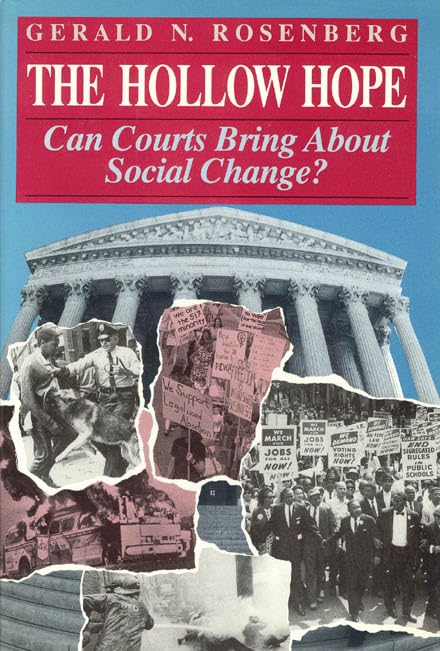
Imagen de portada de Amazon
Imagen de Amazon.com
Imagen de cubierta Syndetics
Portada de Syndetics
Imagen de OpenLibrary

The hollow hope can courts bring about social change? Gerald N. Rosenberg.

Por: Series American politics and political economyDetalles de publicación: Chicago University of Chicago 1991.Descripción: xii, 425 p. ill. 24 cmISBN:
  • 0226727025 (alk. paper)
Tema(s): Clasificación CDD:
  • 340/.115 20
Clasificación LoC:
  • KF8700 .R66 1991
Valoración
    Valoración media: 0.0 (0 votos)
Existencias
Imagen de cubierta Tipo de ítem Biblioteca actual Biblioteca de origen Colección Ubicación en estantería Signatura topográfica Materiales especificados Info Vol URL Copia número Estado Notas Fecha de vencimiento Código de barras Reserva de ítems Prioridad de la cola de reserva de ejemplar Reservas para cursos
Libro Biblioteca de Mayagüez Colección General mb KF8700 .R66 1991 (Navegar estantería(Abre debajo)) Disponible 50000001830297
Total de reservas: 0

Descripciones mejoradas de Syndetics:

Liberals have acclaimed, and conservatives decried, reliance on courts as tools for changes. But while debate rages over whether the courts should be playing such a legislative role, Gerald N. Rosenberg poses a far more fundamental question-- can courts produce political and social reform?

Rosenberg presents, with remarkable skill, an overwhelming case that efforts to use the courts to generate significant reforms in civil rights, abortion, and women's rights were largely failures.

"The real strength of The Hollow Hope . . . is its resuscitation of American Politics--the old-fashioned representative kind--as a valid instrument of social change. Indeed, the flip side of Mr. Rosenberg's argument that courts don't do all that much is the refreshing view that politics in the best sense of the word--as deliberation and choice over economic and social changes, as well as over moral issues--is still the core of what makes America the great nation it is. . . . A book worth reading."--Gary L. McDowell, The Washington Times

Includes bibliographical references (p. 367-414) and index.

Reseñas proporcionadas por Syndetics

Publishers Weekly Review

Efforts by civil rights, women's rights and pro-abortion activists to use the courts to produce progressive social change have largely been failures, maintains Rosenberg. Focusing on the historic 1954 Brown decision on school desegregation, on Roe v. Wade , upholding women's right to abortion, and on other Supreme Court cases, this University of Chicago political scientist argues that such decisions actually had little effect in generating positive change, partly because the judiciary has no powers of implementation. Rosenberg views the courts as ``fly-paper for social reformers who succumb to `the lure of litigation.' '' and who, in so doing, siphon off crucial movement resources while mistaking symbolic victories for substantive ones. In a concluding section, the author finds that activists' judicial victories with regard to the environment, criminal rights and reapportionment of state legislatures have been equally hollow. His strained analysis runs counter to accepted wisdom and to scholarship. (Sept.) (c) Copyright PWxyz, LLC. All rights reserved

CHOICE Review

In an insightful, sophisticated (and sure to be controversial) empirical study of the impact of court decisions in the areas of civil rights, abortion and women's rights, the environment, reapportionment, and criminal law, Rosenberg (University of Chicago) concludes that "U.S. Courts can almost never be effective producers of significant social reform." Moreover, reliance on litigation often has been counterproductive e.g., "in the abortion field, reliance on the Court seriously weakened the political efficacy of pro-choice forces". In a work divided into three parts, each with three to five chapters, Rosenberg builds his analysis on a detailed examination of civil rights (more than half the book) and abortion and women's rights (another quarter), focusing on two cases emblematic of the US Supreme Court's involvement in social change: Brown v. Board of Education I (1954) and Roe v. Wade (1973). Good tables, figures, footnotes, and appendixes; adequate index and list of case references; superb bibliography. An important book. For upper-division undergraduate and graduate collections and for general readers.-F. W. Neuber, Western Kentucky University
Compartir
logopucpr-y-vive

Contáctanos

¡Queremos saber de ti!

Tel. 787.841.2000 Ext. 1801

bibliotecavaldes@pucpr.edu

⁣Búscanos en las redes

© 2026 Desarrollado por Ignite Online • All Rights Reserved • Powered by Koha.