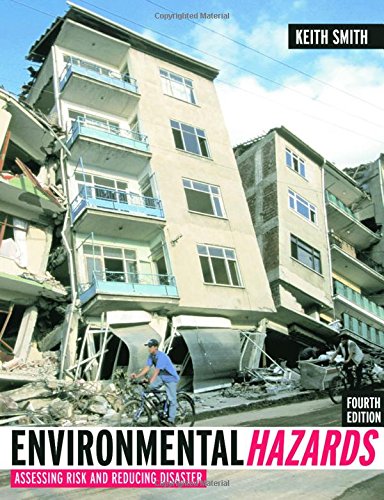

Environmental hazards assessing risk and reducing disaster Keith Smith.
Detalles de publicación: London New York Routledge 2004.Edición: 4th edDescripción: xiv, 306 p. ill. (some col.), maps 25 cmISBN:- 0415318033 (alk. paper)
- 0415318041 (pbk. : alk. paper)
- 363.34 S6421e4 22
- GB5014 .S6 2004
| Imagen de cubierta | Tipo de ítem | Biblioteca actual | Biblioteca de origen | Colección | Ubicación en estantería | Signatura topográfica | Materiales especificados | Info Vol | URL | Copia número | Estado | Notas | Fecha de vencimiento | Código de barras | Reserva de ítems | Prioridad de la cola de reserva de ejemplar | Reservas para cursos | |
|---|---|---|---|---|---|---|---|---|---|---|---|---|---|---|---|---|---|---|
| Libro | Biblioteca Encarnación Valdés Colección General bev | 363.34 S6421e4 (Navegar estantería(Abre debajo)) | Disponible | 80000002162710 |
Descripciones mejoradas de Syndetics:
The fourth edition of Environmental Hazards continues to blend physical and social sciences to provide a thoroughly balanced, contemporary introduction to hazards analysis and mitigation strategies. It covers all the major rapid-onset events, whether natural, human or technological in origin which directly threaten humans and what they value.
Environmental Hazards provides a lucid comprehensive introduction to both the theory and practice of hazards and their mitigation, drawing on interdisciplinary insights. It is essential reading for students of geography, environmental science, earth science and geology.
Includes bibliographical references (p. [272]-299) and index.
I: The nature of hazard -- Hazard in the environment -- Dimensions of disaster -- Risk assessment and management -- Reducing the impacts of disaster -- II: The experience and reduction of hazard -- Tectonic hazards: earthquakes -- Tectonic hazards: volcanoes -- Mass movement hazards -- Severe storm hazards -- Biophysical hazards -- Hydrological hazards: floods -- Hydrological hazards: droughts -- Technological hazards -- Context hazards -- Postscript.
Tabla de contenidos provista por Syndetics
- Part 1 The Nature of Hazard
- 1 Hazard in the Environment
- 2 Dimensions of Disaster
- 3 Risk Assessment and Management
- 4 Reducing the Impacts of Disaster
- Part 2 The Experience and Reduction of Hazard
- 5 Tectonic Hazards: Earthquakes
- 6 Tectonic Hazards: Volcanoes
- 7 Mass Movement Hazards
- 8 Severe Storm Hazards
- 9 Biophysical Hazards
- 10 Hydrological Hazards: Floods
- 11 Hydrological Hazards: Droughts
- 12 Technological Hazards
- 13 Context Hazards