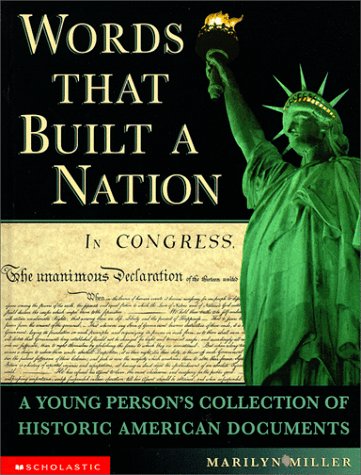
Tema: A collection of thirty-nine contemporary documents tracing the history of the United States, including such areas as human rights, the environment, and immigration. Includes commentary, photographs, and engravings.
Presenting documents from the Mayflower Compact to Hillary Rodham Clinton's speech at the UN Conference on Women, this is an elegant addition to more traditional histories for children. The words of politicians, activists, dreamers, and writers are accompanied by an introductory text, biographies, and an overview of the documents' impact on the nation.
Includes index.
A collection of thirty-nine contemporary documents tracing the history of the United States, including such areas as human rights, the environment, and immigration. Includes commentary, photographs, and engravings.
Reseñas proporcionadas por Syndetics
School Library Journal Review
Gr 5-9-Arranged in chronological order, this collection of 39 original documents and speeches begins with the Mayflower Compact and concludes with Hillary Clinton's 1995 "Speech to the United Nations Conference on Women in China." The selections range from the well known (The Declaration of Independence, The Constitution, and The Gettysburg Address) to those that address the problems and concerns of minorities, such as the Brown v. Board of Education of Topeka decision and statements by Chief Joseph, Malcolm X, Csar Ch vez, Rachel Carson, and Shirley Chisholm. Accompanying each document is introductory commentary, a note about the author, and a short description of the public response to the document. Black-and-white illustrations include photos or reproductions of the authors and contemporary posters, engravings, or paintings. Although this book is attractive and the presentation engaging, its audience will be limited. Most libraries already hold general collections such as Robert Baron's Soul of America (Fulcrum, 1994) and John G. Hunt's Words of Our Nation (Gramercy, 1993), both of which offer a broader range of documents. Most of these selections are also widely available through electronic reference sources. While there is not enough commentary and supplementary material to make this collection stand out in a crowded field, libraries needing circulating material should consider it as an additional resource.-Mary Mueller, Rolla Junior High School, MO (c) Copyright 2010. Library Journals LLC, a wholly owned subsidiary of Media Source, Inc. No redistribution permitted.
Booklist Review
Gr. 4^-8. From the Mayflower Compact to Hillary Rodham Clinton's "Speech at the United Nations Conference on Women," these 37 selections of historical documents are arranged in chronological order. Each handsomely designed entry includes an introduction, author information, public response, and black-and-white reproductions of photographs, portraits, and engravings. As expected, "cornerstone" documents such as the Declaration of Independence, U.S. Constitution, and Gettysburg Address are here. Unfortunately, the signers of the Declaration are not listed, and the Constitution only goes through the Bill of Rights, a serious flaw for a "reference" tool. Some selections have been included because they "represent turning points in American history," for example, FDR's "War Message to Congress, the Immigration Act of 1924," and Malcolm X's "The Ballot or the Bullet." Other entries include "The Star Spangled Banner" and excerpts from pamphlets, letters, and books, such as a short passage from Jane Addams' Twenty Years at Hull-House. The collection reflects the country's diversity but mostly focuses on positive aspects of U.S. history. Suggested Web sites are appended. A hodgepodge of American history, this may be a good teaching tool but won't have much reference value. --Linda Perkins
Words that built a nation /
APA
Miller M., . (1999). Words that built a nation. New York: Scholastic.
Chicago
Miller Marilyn, . 1999. Words that built a nation. New York: Scholastic.
Harvard
Miller M., . (1999). Words that built a nation. New York: Scholastic.
MLA
Miller Marilyn, . Words that built a nation. New York: Scholastic. 1999.