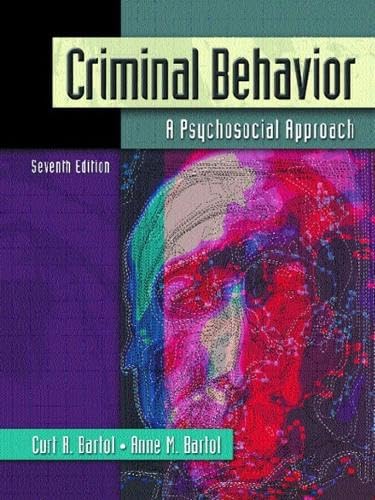

Criminal behavior a psychosocial approach Curt R. Bartol, Anne M. Bartol.
Detalles de publicación: Upper Saddle River, N.J. Pearson c2005.Edición: 7th ed. Curt R. Bartol, Anne M. BartolDescripción: xvii, 654 p. ill. 24 cmISBN:- 0131850490
- 364.3 22
- HV6080 .B37 2005
| Imagen de cubierta | Tipo de ítem | Biblioteca actual | Biblioteca de origen | Colección | Ubicación en estantería | Signatura topográfica | Materiales especificados | Info Vol | URL | Copia número | Estado | Notas | Fecha de vencimiento | Código de barras | Reserva de ítems | Prioridad de la cola de reserva de ejemplar | Reservas para cursos | |
|---|---|---|---|---|---|---|---|---|---|---|---|---|---|---|---|---|---|---|
| Libro | Biblioteca de Mayagüez Colección General mb | HV 6080 .B37 2005 (Navegar estantería(Abre debajo)) | Disponible | 50000002116548 | ||||||||||||||
| Libro | Biblioteca Mons. Iñaki Mallona (Arecibo) Colección General ab | 364.3 B292c7 2005 (Navegar estantería(Abre debajo)) | Disponible | 60000010007158 |
Descripciones mejoradas de Syndetics:
Criminal Behavior: A Psychosocial Approach, Seventh Edition presents a critical and interdisciplinary look at criminals and crime, challenging students to look beyond over-simplified or prejudicial conclusions about the "crime problem." The book considers the behavioral, emotional and cognitive aspects of criminals, looks at specific criminal offenses, and explores the causes, classification, prediction, intervention and treatment of criminal behavior. NEW TO THE SEVENTH EDITION Greatly expanded and reorganized coverage of criminal profiling More information about careers in forensic psychology and correctional psychology Updated chapters on the psychopath, juvenile delinquency, the mentally disordered offender, and correctional psychology An updated chapter on drugs and crime that reflects the latest drug abuse research Expanded coverage of: crime scene analysis, cyber crime, the effects of the mass media on aggression, crime & physical anomalies, gender differences in aggression, infanticide, and robbery Numerous new tables, figures, charts, and other in-text learning aids
Includes bibliographical references (p. 571-636) and indexes.
Tabla de contenidos provista por Syndetics
- Preface(p. xi)
- Chapter 1 Introduction to Criminal Behavior(p. 1)
- Perspectives of Human Nature in Theories of Crime(p. 2)
- Perspectives in Criminology(p. 4)
- Definition of Criminal Behavior(p. 7)
- FBI Reporting Systems(p. 8)
- Self-Report Studies(p. 16)
- Victimization Surveys(p. 18)
- The Focus of the Book(p. 24)
- Chapter 2 Juvenile Delinquency: Developmental Factors(p. 26)
- A Brief History of Juvenile Justice(p. 26)
- Definition of Juvenile Delinquency(p. 29)
- The Nature and Extent of Juvenile Offending(p. 31)
- School Crime(p. 35)
- The Serious Delinquent(p. 37)
- Social Risk Factors(p. 38)
- Psychological Risk Factors(p. 40)
- Family Background(p. 45)
- Intelligence and Delinquency(p. 47)
- Gender and Juvenile Offending(p. 50)
- Prevention and Treatment of Juvenile Offending(p. 51)
- Summary and Conclusions(p. 55)
- Chapter 3 Origins of Criminal Behavior: Biological Factors(p. 58)
- The Born Criminal(p. 59)
- Physique and Crime(p. 61)
- Twin Studies(p. 65)
- Adoption Studies(p. 68)
- Eysenck's Theory of Personality and Crime(p. 70)
- Summary and Conclusions(p. 85)
- Chapter 4 The Psychopath: A Focus on Biopsychological Factors(p. 87)
- Behavioral Descriptions(p. 90)
- The Criminal Psychopath(p. 93)
- The Female Psychopath(p. 97)
- Basic Neurophysiological Concepts and Terminology(p. 99)
- Childhood of the Psychopath(p. 113)
- Summary and Conclusions(p. 119)
- Chapter 5 Origins of Criminal Behavior: Learning and Situational Factors(p. 121)
- Behaviorism(p. 122)
- Social Learning(p. 126)
- Frustration-Induced Criminality(p. 131)
- Situational Instigators and Regulators of Criminal Behavior(p. 133)
- Summary and Conclusions(p. 138)
- Chapter 6 The Mentally Disordered Offender(p. 140)
- Mental Disorders and Crime(p. 140)
- Mental Disorders and Violence(p. 147)
- The Mentally Disordered Offender and Criminal Responsibility(p. 151)
- The Insanity Defense(p. 152)
- Guilty but Mentally Ill (GBMI)(p. 156)
- Incompetency to Stand Trial(p. 158)
- Transfers(p. 160)
- The Mentally Disordered Sex Offender(p. 161)
- Mental Disorders as Unique Defenses(p. 163)
- Dangerousness(p. 169)
- Summary and Conclusions(p. 178)
- Chapter 7 Human Aggression and Violence(p. 180)
- Defining Aggression(p. 181)
- Theoretical Perspectives on Aggression(p. 183)
- Cognitive Models of Aggression(p. 191)
- Overt and Covert Acts of Aggression(p. 194)
- Environmental Factors(p. 196)
- Effects of Mass Media(p. 200)
- Victim-Precipitated Aggression(p. 203)
- The Physiology of Aggression(p. 204)
- Summary and Conclusions(p. 212)
- Chapter 8 Homicide, Assault, and Family Violence(p. 214)
- Definitions(p. 216)
- Sociological Correlates of Homicide(p. 218)
- Sociological Correlates of Assault(p. 225)
- Family Violence(p. 227)
- Theoretical Explanations of Family Violence(p. 243)
- Cessation of Family Violence(p. 243)
- Summary and Conclusions(p. 245)
- Chapter 9 Criminal Homicide: A Closer Look(p. 247)
- Investigative Methods(p. 247)
- Criminal Investigative Analysis (Profiling)(p. 249)
- Multiple Murderers(p. 254)
- Serial Murderers(p. 255)
- Mass Murderers(p. 262)
- Satanic Cults and Homicide(p. 266)
- Psychological Factors in Violent Crime(p. 272)
- Cognitive Self-Regulation and Violence(p. 275)
- Deindividuation and Crowd Violence(p. 279)
- Summary and Conclusions(p. 282)
- Chapter 10 Sexual Offenses(p. 284)
- Legislation on Sex Offenders(p. 285)
- Rape(p. 287)
- Pedophilia(p. 307)
- Exhibitionism(p. 319)
- Voyeurism and Fetishism(p. 321)
- Treatment of Sexual Offenders(p. 323)
- Summary and Conclusions(p. 326)
- Chapter 11 Economic Crime, Public Order Crime, and Other Crime(p. 328)
- Burglary(p. 330)
- Larceny and Motor Vehicle Theft(p. 337)
- Fraud and Identity Theft(p. 338)
- Shoplifting(p. 339)
- Robbery(p. 344)
- White-Collar and Occupational Crime(p. 349)
- Cybercrime(p. 354)
- Hostage-Taking Offenses(p. 355)
- Arson(p. 359)
- Bombings(p. 366)
- Prostitution(p. 368)
- Summary and Conclusions(p. 372)
- Chapter 12 Drugs and Crime(p. 374)
- Major Categories of Drugs(p. 379)
- The Hallucinogens: Cannabis(p. 381)
- The Stimulants(p. 385)
- Narcotic Drugs(p. 393)
- The Depressants(p. 397)
- Summary and Conclusions(p. 407)
- Chapter 13 Correctional Psychology(p. 409)
- Careers in Correctional Psychology(p. 410)
- The Correctional System(p. 411)
- Societal Rationale for Imprisonment of Offenders(p. 415)
- Classification and Prediction(p. 416)
- Psychological Effects of Imprisonment(p. 417)
- Treatment and Rehabilitation(p. 421)
- Rehabilitation and Psychological Treatment(p. 422)
- Glossary(p. 431)
- Cases Cited(p. 445)
- References(p. 446)
- Author Index(p. 502)
- Subject Index(p. 512)