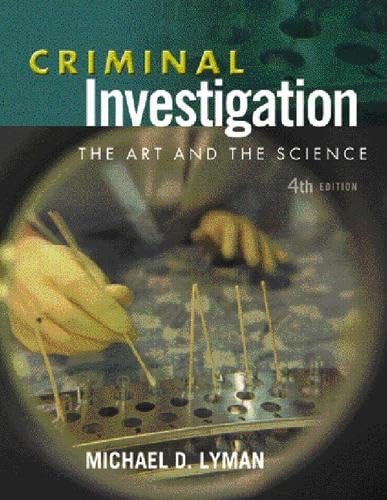

Criminal investigation the art and the science Michael D. Lyman.
Detalles de publicación: Upper Saddle River, N.J. Pearson/Prentice Hall c2005.Edición: 4th edDescripción: xxi, 536 p. ill. (some col.) 27 cmISBN:- 0131198777
- 363.25 22
- HV8073 .L94 2005
| Imagen de cubierta | Tipo de ítem | Biblioteca actual | Biblioteca de origen | Colección | Ubicación en estantería | Signatura topográfica | Materiales especificados | Info Vol | URL | Copia número | Estado | Notas | Fecha de vencimiento | Código de barras | Reserva de ítems | Prioridad de la cola de reserva de ejemplar | Reservas para cursos | |
|---|---|---|---|---|---|---|---|---|---|---|---|---|---|---|---|---|---|---|
| Libro | Biblioteca de Mayagüez Colección General mb | HV8073 .L94 2005 (Navegar estantería(Abre debajo)) | Disponible | 50000002116464 |
Descripciones mejoradas de Syndetics:
For courses in Criminal Investigation. This book presents crime detection as a dynamic field relying heavily on the past experiences of investigators as well as recent practical and technological innovations. It explores the many external variables that can influence the investigator's success and the specific methods of crime detection and prosecution of law available in today. The text is intended to meet the needs of both students and professors by presenting information in a logical flowlike the steps and considerations observed in an actual criminal investigation.
Includes bibliographical references and index.
Tabla de contenidos provista por Syndetics
- Part 1 Fundamentals of Criminal Investigation
- Chapter 1 Criminal Investigation: An Overview
- Chapter 2 The Preliminary Investigation
- Part 2 The Investigative Process
- Chapter 3 Field Notes, Documenting, & Reporting the Crime Scene
- Chapter 4 Report Writing & Documentation of the Investigation
- Chapter 5 Search & Seizure
- Chapter 6 Identification of Criminal Suspects
- Chapter 7 The Criminal Intelligence Function
- Chapter 8 Undercover & Surveillance Operations
- Chapter 9 Making an Arrest
- Chapter 10 Interviews & Interrogations
- Chapter 11 Development & Management of Informants
- Part 3 Interpersonal Violence
- Chapter 12 Wrongful Death
- Chapter 13 Robbery
- Chapter 14 Assault & Related Offenses
- Chapter 15 Sex Offenses
- Chapter 16 Child Abuse & Neglect
- Part 4 Property Claims
- Chapter 17 Burglary
- Chapter 18 Larceny-Theft
- Chapter 19 Motor Vehicle Theft
- Chapter 20 Arson & Bombings
- Part 5 Vice Crimes & Related Offenses
- Chapter 21 Drug Offenses
- Chapter 22 Money Laundering & Computer-Assisted Crime
- Part 6 Prosecution
- Chapter 23 Preparation for Court
- Appendix A
- Appendix B
- Glossary
- Index
Extracto provisto por Syndetics
Notas de autor provistas por Syndetics
Michael Lyman is a member of the faculty of the Criminal Justice and Social Work Department at Columbia College, Columbia, Missouri. In addition to being a teaching faculty member, he serves the Department as the Director or Graduate Studies for the Master of Science in Criminal Justice and advisor of the Forensic Science Program. Prior to entering the field of college teaching, he was employed as a Special Agent for the Intelligence and Organized Crime Division (IOCD) of the Kansas Bureau of Investigation and later as a Senior Intelligence Agent for the Oklahoma Bureau of Narcotics and Dangerous Drugs. Dr. Lyman has authored several textbooks in criminal justice dealing with the areas of criminal investigation, policing, organized crime, and drug abuse. He received both his bachelor's and master's degrees from Wichita State University and his Ph.D. from the University of Missouri-Columbia.
The author welcomes communication and correspondence about his work and can be contacted at Columbia College, 1001 Rogers Street, Columbia, MO 65216.