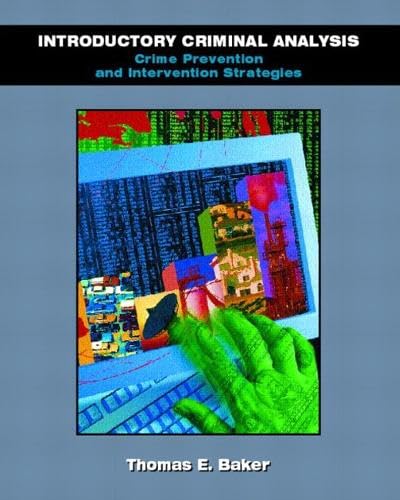
Imagen de portada de Amazon
Imagen de Amazon.com
Imagen de cubierta Syndetics
Portada de Syndetics
Imagen de OpenLibrary

Introductory criminal analysis crime prevention and intervention strategies Thomas E. Baker.

Por: Detalles de publicación: Upper Saddle River, N.J. Pearson Prentice Hall c2005.Descripción: xix, 506 p. ill. 25 cmISBN:
  • 0130996092
Tema(s): Clasificación CDD:
  • 363.25 22
Clasificación LoC:
  • HV7936.C88 B35 2005
Valoración
    Valoración media: 0.0 (0 votos)
Existencias
Imagen de cubierta Tipo de ítem Biblioteca actual Biblioteca de origen Colección Ubicación en estantería Signatura topográfica Materiales especificados Info Vol URL Copia número Estado Notas Fecha de vencimiento Código de barras Reserva de ítems Prioridad de la cola de reserva de ejemplar Reservas para cursos
Libro Biblioteca de Mayagüez Colección General mb HV7936 .C88 B35 2005 (Navegar estantería(Abre debajo)) Disponible 50000002116498
Libro Biblioteca Encarnación Valdés Colección General bev 363.25 B1671i (Navegar estantería(Abre debajo)) Disponible 80000002270380
Total de reservas: 0

Descripciones mejoradas de Syndetics:

Written by a pioneer in the field, this book introduces readers to the cutting edge field of criminal analysis. Its lively, easy-to-read writing style combines theory, case studies, and applications to impart the necessary skills for preventing crime in the future. The book brings together coverage of criminal analysis, GIS crime mapping, and emerging technologies to show readers how to utilize these tools to help create strategies to suppress and prevent crime. For twenty-first century crime fighters.

Includes bibliographical references and index.

Tabla de contenidos provista por Syndetics

  • I The Role of the Analyst
  • Prologue: The Functions and Responsibilities of the Crime Analyst
  • 1 Introduction: Criminal Analysis Strategies
  • 2 Crime Analysis: Geographic Information Systems Mapping
  • 3 Crime Analysis: Domestic Violence
  • II Crime Analysis: Street Crimes
  • 4 Criminal Investigative Analysis: Child Predators
  • 5 Crime Analysis: Burglary/Robbery
  • 6 Criminal Investigative Analysis: Arson
  • III Criminal Investigative Analysis
  • 7 Criminal Investigative Analysis: Rape
  • 8 Criminal Investigative Analysis: Male Serial Killers
  • 9 Criminal Investigative Analysis: Female Serial Killers
  • IV Intelligence Analysis
  • 10 Intelligence Analysis: Enterprise Crime
  • 11 Intelligence Analysis: Terrorism
  • 12 Intelligence Analysis: Supergangs, Street Gangs or Organized Crime
  • Epilogue

Extracto provisto por Syndetics

We should not be fighting the crime of the twenty-first century with the tools of the nineteenth century. -- Jack Straw, Home Secretary, United Kingdom Crime prevention and intervention requires excellent criminal analysis. The flow of accurate criminal information ensures effective problem-oriented policing and proactive crime-prevention strategies. The consolidation of criminal analysis, problem-oriented policing, and crime-prevention functions requires integration under a unified discipline and command structure. The consolidation of these functions in a crime analysis unit will lead to effective strategic policing. Criminal analysis and computer technology applications play a futuristic and dynamic role in intervention and prevention strategies. The twenty-first century offers police officers a variety of new law enforcement strategies to suppress and prevent crime. Criminal analysis, crime mapping, and today's emerging technologies are the necessary skills for preventing crime in the future. Introductory Criminal Analysis: Crime Prevention and Intervention Strategies integrates those fields and identifies problem-oriented policing and crime-prevention strategies as foundations for applying accurate criminal information. TARGET AUDIENCE Introductory Criminal Analysis: Crime Prevention and Intervention Strategies serves the needs of those who are interested in pursuing the field of criminal analysis and related crime-prevention careers. The text is a crossover book, based on educational theory as it applies to criminal analysis practice. The author strives to serve the needs of law enforcement leaders, police officers, and academic criminal justice majors. The organization of this book differs from the books available on criminal analysis in several ways. This book integrates many educational and practice concepts. Law enforcement practitioners and students of criminal analysis may benefit from the text's design. The text can serve as a reference book and promises to educate from a teaching and learning perspective. Professors will find the text appropriate for introductory criminal analysis and crime-prevention courses. The text emphasizes criminal analysis concepts, basic prevention, and intervention strategies plus potential technological applications. Universities and community colleges offer certificate programs in criminal analysis; associate's and bachelor's degree programs are in the planning stages. Several graduate certificate programs have emerged to meet the needs of field practitioners. This book would serve as a primary or secondary required text for those courses. Further research and literature will assist in expanding the field of criminal analysis. The limited number of textbooks is primarily due to the recent revolution in modern criminal analysis, computer technology, and crime mapping. At this stage of development, the integration of criminal analysis and technology represents a major successful stride into the future. This text assists in satisfying the literature requirements for academia and expands the knowledge base. EDUCATIONAL PHILOSOPHY Criminal analysis is a relatively new discipline with diverse specialties that perform unique contributions. Crime analysts, criminologists, crime-prevention specialists, and crime statisticians represent a major segment of the contributors. However, they only partially represent the field; there are many other disciplines involved. Each discipline has a unique perspective, but, an interdisciplinary approach offers more than one specialty standing alone. The power of criminal analysis is the merger of related professional disciplines. Mutual respect is the key to the successful integration of disciplines. Each discipline offers an opportunity to explore its unique contribution to the field of criminal analysis. Openness to the ideas and contributions of others will enhance the process. The early pioneers in organized crime and intelligence analysis, including the author, served as the foundation for countless modern criminal analysis techniques. The field of criminal analysis continues to evolve and develop as others make significant contributions. The field of criminal analysis is on a new frontier and associated literature continues to expand. This book will not indoctrinate the reader into quick fix solutions but rather allows individuals to find their own way in the pursuit of understanding crime and criminals. This book is designed so the learner does not need a great deal of prerequisite knowledge in the field of criminal analysis; at the same time, it presents insightful avenues of exploring criminal analysis for the experienced police reader. The premise that the pursuit of knowledge is a noble goal serves as the book's foundation. STRUCTURE AND FEATURES The purpose of the text is to support the reader with interesting analytical solutions to everyday law enforcement crime analysis problems. To achieve this purpose, each chapter includes a Crime Analyst Corner penned by leading experts in the field of criminal analysis. Furthermore, case study illustrations demonstrate analytical applications. The goal of the text is to relate to a diverse audience of law enforcement practitioners and career-oriented learners. The book is an amalgamation of academic, freelance, and textbook style writing. At times, it is written in a descriptive manner, the emphasis placed on active sentences and editing of unnecessary elements. The integration of theory and application to achieve better practice summarizes the text's approach. The paragraphs and sentences are deliberately short and to the point. The text addresses diverse learning styles; case illustrations and concrete examples clarify concepts and maintain reader interest. Criminal analysis can be complex; therefore, the writing and illustrations contribute to the learner's understanding. Scope Limitations This book was written from an academic perspective, designed for university students and police officers who are interested in the field of criminal analysis. A secondary audience would include in-service police officers and trainers. The text is not designed for advanced practitioners in the field of criminal analysis. Some areas of expertise were not included in the text because of space considerations and related themes. However, this does not imply that omitted areas are not important. Readability, clarity, and consistency of themes enhance retention and learning process. Introductory Criminal Analysis: Crime Prevention and Intervention Strategies was designed for introductory courses and avoids textbook duplication. There are three major advanced texts that specialize in the field of criminal analysis. The pioneer text in the field of criminal analysis is Patterns in Crime, by Paul Brantingham and Patricia Brantingham. This text explores the conceptual relationship between criminology and criminal justice. The contribution is interdisciplinary and examines temporal and spatial patterns and the microanalysis of crime. Moreover, it considers the study of crime as one of the most important issues in the social sciences and emphasizes a number of the major explanations for crime trends and their correlates. Techniques in criminal analysis have reinforced traditional investigative strategies and allowed investigators to visualize and conceptualize investigations. Marilyn B. Peterson Sommer's book, Applications in Criminal Analysis: A Source Book, is the leading resource on the topic of analytical charting. This text describes twenty-six methods and thirty-seven products available for analytical investigative purposes. A few examples from the Sommer's text include activity flow charts, association analysis, commodity flow analysis, and many other assessment tools in the field of criminal analysis. In addition, the text is an excellent source on report writing and criminal analysis applications. For readers who are interested in reporting and criminal analysis statistics, the best source remains Crime Analysis from First Report to Final Arrest by Steven Gottieb, Sheldon Arenberg, and Raj Singh. Their book is the definitive citation on criminal statistical analysis; this text does not try to duplicate their excellent approach. Some researchers, authors, and practitioners have expressed concerns about terminology and jargon devoted to criminal analysis. The need exists to standardize terminology that relates to criminal analysis, especially "insider" and "outsider" application. For example, atypical error concerns the use of the concepts criminal analysis and crime analysis. The former identifies the entire field, while the latter identifies a specific process. The author accepts full responsibility for any additional errors or cognitive dissonance concerning terminology. INSTRUCTOR'S MATERIALS The Crime Analyst Corner sections strategically placed in the text present a wide variety of supplementary and illustrative materials. I consider them to be one of the more important contributions to this text. This text presents a considerable number of analytical concepts; therefore, numerous illustrations, charts, and graphs supplement written paragraphs. The visual component is a necessary feature that assists in the explanation and writing. Subheadings and short paragraphs enhance transition, coherence, and clarity for the learner. An instructor's manual and PowerPoint presentation have been designed to assist professional educators in their instructional endeavors. The manual highlights learning objectives and features student assignments. It offers an extensive collection of essay and objective questions for student examinations. The questions measure theories and concepts; fairness in testing is the primary objective. TEXT CONTENT Criminal analysis is the study of crime patterns and trends; it applies analytical methods to crime and attempts to produce practical crime prevention and intervention strategies. This text emphasizes the basic concept of criminal analysis and explores a revolution in crime mapping. Introductory Criminal Analysis: Crime Prevention and Intervention Strategies supports educators, students, law enforcement leaders, and officers in the pursuit of strategies to achieve those ends. Text Direction The goal was to write a book that students and law enforcement practitioners would find interesting and informative. The concepts are arranged to support critical thinking and problem-solving skills. The progressions are designed to enhance the learning process and build the prerequisite foundations for basic concepts. The text emphasizes the need for accurate criminal information to engage in effective problem-oriented policing and crime prevention strategies. Part I, Introduction and Foundations of Criminal Analysis, introduces the text and scope of criminal analysis. In addition, it describes criminal analysis strategies and the connection between criminal analysis and GIS crime mapping. Part II, Crime Analysis: Street Crimes, allows the reader to apply the basic concepts to street crimes: domestic violence, child predation, burglary/ robbery, and arson. The reader appraises the role of domestic violence and child predation as catalysts for related as well as unrelated crimes and violence. Part III, Criminal Investigative Analysis, advances the critical thinking process to advanced analysis and investigative problem-solving strategies. The focus is on serial rapists and male and female serial killers. Part IV, Intelligence Analysis, moves to another level of analysis and is directed at criminal enterprise crime, terrorism, and related organized gang crime. The Epilogue articulates the need for criminal analysis, technology, crime mapping, problem-oriented policing, and crime prevention and intervention strategies. Purpose Criminal information is essential to successful crime intervention and prevention outcomes; this text helps facilitate those objectives. Criminal analysis employs a variety of techniques to analyze criminal patterns or methods of operation commonly used by serial offenders; for example, computer- and crime-mapping technology provide an excellent foundation for examining geographical and travel distance patterns to crime. Analyzing crime patterns produces a synthesis from the patterns that may be useful in future crime prevention strategies and lead to successful prosecutions. Analytical methods and data collection serve prevention strategies that look into the future and examine trends. The application of analytical techniques provides new investigative leads and possible crime solutions. Successful criminal analysis and crime prevention exists when police and citizens participate to reduce crime through planned criminal analysis strategies. Why is criminal analysis important? The answer is simple; criminals will find less opportunity to prey on the public. Well-tailored solutions increase police efficiency and effectiveness, producing equity in the communities the police serve. Best wishes as you pursue your professional career in the field of criminal justice and law enforcement. Very Truly Yours, Thomas E. Baker Associate Professor Excerpted from Introductory Criminal Analysis: Crime Prevention and Intervention Strategies by Thomas E. Baker All rights reserved by the original copyright owners. Excerpts are provided for display purposes only and may not be reproduced, reprinted or distributed without the written permission of the publisher.

Notas de autor provistas por Syndetics

Thomas E. Baker is an associate professor at the University of Scranton, Pennsylvania. He served as a USAR Lt. Col. in the United States Army Military Police Corps. Professor Baker was assigned as a special agent and commander with the United States Army Criminal Investigation Command. In addition, he served as a former police officer for the Henrico County Police, Richmond, Virginia, and as an intelligence analyst and undercover officer with the Vice, Intelligence, and Organized Crime Unit, Montgomery County Police Department, Montgomery County, Maryland.

He is the author of more than fifty articles that have appeared in professional journals and has presented research at professional meetings. In addition, Professor Baker serves as an editorial reviewer for the Journal of Criminal Justice, The Journal of American Criminal Justice, Journal of Homicide Studies, and the FBI Law Enforcement Bulletin. His research focus includes police leadership, criminal investigation, crime prevention, organized crime, community-oriented and problem-oriented policing, grantmanship, and crime analysis. Professor Baker serves as a police consultant to local law enforcement agencies, police administrators, police testing, and Department of Justice COPPS grants.

Compartir
logopucpr-y-vive

Contáctanos

¡Queremos saber de ti!

Tel. 787.841.2000 Ext. 1801

bibliotecavaldes@pucpr.edu

⁣Búscanos en las redes

© 2026 Desarrollado por Ignite Online • All Rights Reserved • Powered by Koha.