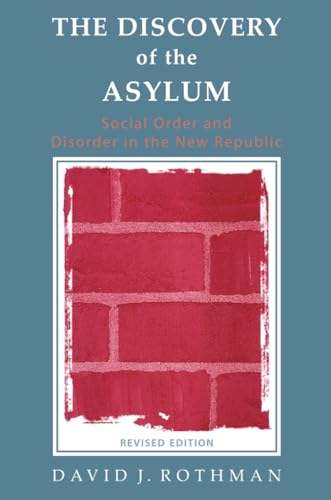

The discovery of the asylum social order and disorder in the new republic David J. Rothman with a foreword byThomas G. Blomberg.
Series New lines in criminologyDetalles de publicación: New York Aldine de Gruyter c2002.Edición: rev. edDescripción: xlviii, 380 p. ill. 21 cmISBN:- 0202307158 (pbk. : alk. paper)
- 306.20973 R8467d 21
- HV91 .R73 2002
| Imagen de cubierta | Tipo de ítem | Biblioteca actual | Biblioteca de origen | Colección | Ubicación en estantería | Signatura topográfica | Materiales especificados | Info Vol | URL | Copia número | Estado | Notas | Fecha de vencimiento | Código de barras | Reserva de ítems | Prioridad de la cola de reserva de ejemplar | Reservas para cursos | |
|---|---|---|---|---|---|---|---|---|---|---|---|---|---|---|---|---|---|---|
| Libro | Biblioteca Encarnación Valdés Colección General bev | 306.20973 R8467d (Navegar estantería(Abre debajo)) | Disponible | 80000002209339 |
Descripciones mejoradas de Syndetics:
This is a masterful effort to recognize and place the prison and asylums in their social contexts. Rothman shows that the complexity of their history can be unraveled and usefully interpreted. By identifying the salient influences that converged in the tumultuous 1820s and 1830s that led to a particular ideology in the development of prisons and asylums, Rothman provides a compelling argument that is historically informed and socially instructive. He weaves a comprehensive story that sets forth and portrays a series of interrelated events, influences, and circumstances that are shown to be connected to the development of prisons and asylums. Rothman demonstrates that meaningful historical interpretation must be based upon not one but a series of historical events and circumstances, their connections and ultimate consequences. Thus, the history of prisons and asylums in the youthful United States is revealed to be complex but not so complex that it cannot be disentangled, described, understood, and applied.
This reissue of a classic study addresses a core concern of social historians and criminal justice professionals: Why in the early nineteenth century did a single generation of Americans resort for the first time to institutional care for its convicts, mentally ill, juvenile delinquents, orphans, and adult poor? Rothman's compelling analysis links this phenomenon to a desperate effort by democratic society to instill a new social order as it perceived the loosening of family, church, and community bonds. As debate persists on the wisdom and effectiveness of these inherited solutions, The Discovery of the Asylum offers a fascinating reflection on our past as well as a source of inspiration for a new century of students and professionals in criminal justice, corrections, social history, and law enforcement.
Originally published: Boston : Little, Brown, 1971.
Includes bibliographical references (p. 299-367) and index.
Introduction to the 1990 edition -- The boundaries of colonial society -- Charity and correction in the Eighteenth Century -- The challenge of crime -- The invention pf the penitentiary -- Insanity and the social order -- The new world of asylum -- The paradox of poverty -- The almshouse experience -- The well-ordered asylum -- The legacy of reform -- The enduring institution.