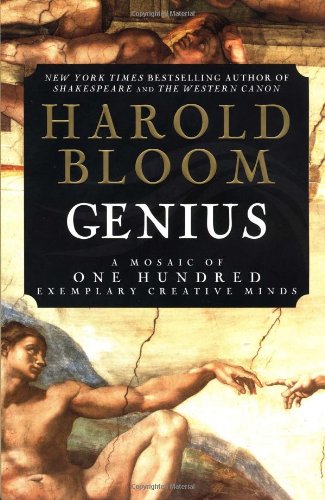

Genius a mosaic of one hundred exemplary creative minds Harold Bloom.
Detalles de publicación: New York Warner Books c2002.Descripción: xviii, 814 p. ill. 25 cmISBN:- 0446527173
- 153.98 B6552g E 21
- BF412 .B58 2002
| Imagen de cubierta | Tipo de ítem | Biblioteca actual | Biblioteca de origen | Colección | Ubicación en estantería | Signatura topográfica | Materiales especificados | Info Vol | URL | Copia número | Estado | Notas | Fecha de vencimiento | Código de barras | Reserva de ítems | Prioridad de la cola de reserva de ejemplar | Reservas para cursos | |
|---|---|---|---|---|---|---|---|---|---|---|---|---|---|---|---|---|---|---|
| Libro | Biblioteca Encarnación Valdés Colección General bev | 153.98 B6552g E (Navegar estantería(Abre debajo)) | Disponible | 80000002270463 |
Descripciones mejoradas de Syndetics:
A monumental achievement of scholarship, GENIUS examines 100 of the most creative and literary minds in history. From the Bible to Socrates, through the transcendent achievements of Shakespeare and Dante, down through the ages to Hemingway, Faulkner, and Ralph Ellison, Bloom discusses the numerous influences of his chosen geniuses and the kinships among them over the centuries. He also offers revealing excerpts from their works that continue to surprise, enchant, and move the reader time after time. Bloom's insightful analyses of the poetry of Milton, Shelley, and Whitman; the drama of Ibsen and Tennessee Williams; and the narratives of Melville and Tolstoy, among many others, will illuminate and expand readers' understanding and appreciation of these great works of art. A wide-ranging study that enriches as it informs, GENIUS is a book to treasure.
Tabla de contenidos provista por Syndetics
- Preface(p. ix)
- On This Book's Arrangement: Genius and Kabbalah(p. xi)
- The Lustres(p. xv)
- Gnosticism: The Religion of Literature(p. xvii)
- Introduction: What is Genius?(p. 1)
- Genius: A Personal Definition(p. 11)
- I. Keter(p. 13)
- Lustre 1 William Shakespeare, Miguel de Cervantes, Michel de Montaigne, John Milton, Leo Tolstoy(p. 15)
- Lustre 2 Lucretius, Vergil, Saint Augustine, Dante Alighieri, Geoffrey Chaucer(p. 67)
- II. Hokmah(p. 111)
- Lustre 3 The Yahwist, Socrates and Plato, Saint Paul, Muhammad(p. 113)
- Lustre 4 Dr. Samuel Johnson, James Boswell, Johann Wolfgang von Goethe, Sigmund Freud, Thomas Mann(p. 155)
- III. Binah(p. 189)
- Lustre 5 Friedrich Nietzsche, Soren Kierkegaard, Franz Kafka, Marcel Proust, Samuel Beckett(p. 191)
- Lustre 6 Moliere, Henrik Ibsen, Anton Chekhov, Oscar Wilde, Luigi Pirandello(p. 225)
- IV. Hesed(p. 257)
- Lustre 7 John Donne, Alexander Pope, Jonathan Swift, Jane Austen, Lady Murasaki(p. 259)
- Lustre 8 Nathaniel Hawthorne, Herman Melville, Charlotte Bronte, Emily Jane Bronte, Virginia Woolf(p. 299)
- V. Din(p. 333)
- Lustre 9 Ralph Waldo Emerson, Emily Dickinson, Robert Frost, Wallace Stevens, T. S. Eliot(p. 335)
- Lustre 10 William Wordsworth; Percy Bysshe Shelley; John Keats; Giacomo Leopardi; Alfred, Lord Tennyson(p. 375)
- VI. Tiferet(p. 419)
- Lustre 11 Algernon Charles Swinburne, Dante Gabriel Rossetti, Christina Rossetti, Walter Pater, Hugo von Hofmannsthal(p. 421)
- Lustre 12 Victor Hugo, Gerard de Nerval, Charles Baudelaire, Arthur Rimbaud, Paul Valery(p. 455)
- VII. Nezah(p. 497)
- Lustre 13 Homer, Luis Vaz de Camoes, James Joyce, Alejo Carpentier, Octavio Paz(p. 499)
- Lustre 14 Stendhal, Mark Twain, William Faulkner, Ernest Hemingway, Flannery O'Connor(p. 551)
- VIII. Hod(p. 581)
- Lustre 15 Walt Whitman, Fernando Pessoa, Hart Crane, Federico Garcia Lorca, Luis Cernuda(p. 583)
- Lustre 16 George Eliot, Willa Cather, Edith Wharton, F. Scott Fitzgerald, Iris Murdoch(p. 619)
- IX. Yesod(p. 651)
- Lustre 17 Gustave Flaubert, Jose Maria Eca de Queiroz, Joaquim Maria Machado de Assis, Jorge Luis Borges, Italo Calvino(p. 653)
- Lustre 18 William Blake, D. H. Lawrence, Tennessee Williams, Rainer Maria Rilke, Eugenio Montale(p. 693)
- X. Malkhut(p. 729)
- Lustre 19 Honore de Balzac, Lewis Carroll, Henry James, Robert Browning, William Butler Yeats(p. 731)
- Lustre 20 Charles Dickens, Fyodor Dostoevsky, Isaac Babel, Paul Celan, Ralph Ellison(p. 775)
- Coda: The Future of Genius(p. 813)
Reseñas proporcionadas por Syndetics
Library Journal Review
Bloom, a distinguished and often controversial literary critic and best-selling author of numerous books about literature (e.g., How To Read and Why), explores the concept of literary genius through the ages by examining 100 writers. Aside from such "must includes" as Shakespeare, Dante, Cervantes, Homer, Virgil, and Plato, Bloom offers some perhaps less well known to American readers, such as Lady Murasaki and Octavio Paz, acknowledging that his selections are idiosyncratic and were chosen because he wanted to write about certain authors, not because they were necessarily in "the top one hundred." In the introduction, Bloom posits a definition of genius that is fleshed out in his discussion of each writer. Authors are clustered into Lustres, or groups of five, while a brief introduction to each section explains why the writers in the section are associated with one another. (Each of the Lustres is based on one of the common names for the Kabbalistic Sefirot, which Bloom describes as representing God's creativity or genius.) Although the book is a delight to read, its real value lies in the author's ability to provoke the reader into thinking about literature, genius, and related topics. No similar work discusses literary genius in this way or covers this many writers. Recommended for public and academic libraries.-Shana C. Fair, Ohio Univ. Lib., Zanesville (c) Copyright 2010. Library Journals LLC, a wholly owned subsidiary of Media Source, Inc. No redistribution permitted.Publishers Weekly Review
With The Western Canon, Yale-based critical eminence Bloom tapped into a strain of the cultural zeitgeist looking for authoritative takes on what to read. Bloom here follows up with 6-10 pages each on 100 "geniuses" of literature (all deceased) pointing to the major works, outlining the major achievements therein, showing us how to recognize them for ourselves. Despite the book's length, Bloom's mostly male geniuses are, as he notes "certainly not `the top one hundred' in anyone's judgement, my own included. I wanted to write about these." Bloom backs up his choices with such effortless and engaging erudition that their idiosyncrasy and casualness become strengths. While organized under the rubric of the 10 Kabalistic Sefirot, "attributes at once of God and of Adam Kadmon or Divine Man, God's Image," Bloom's chosen figures are associated by his own brilliant (and sometimes jabbingly provocative) forms of attention, from a linkage of Dr. Johnson, Goethe and Freud to one of Dickens, Celan and Ellison (with a few others in between them). A pleasant surprise is the plethora of lesser-known Latin American authors, from Luz Vaz de Camoes to Jos Maria Ea de Queiroz and Alejo Carpentier. Many familiar greats are here, too, as is a definition of genius. "This book is not a work of analysis or of close reading, but of surmise and juxtaposition," Bloom writes, and as such readers will find it appropriately enthusiastic and wild. (Oct. 22) Forecast: With the dismantling of Oprah's Book Club, and none of the contenders stepping up convincingly, look for this book to fill the void, particularly as a gift book. A five-city East Coast tour will add some awareness, and national reviews will build on it, but getting the voluble Bloom on morning television and letting him riff would be the clincher. (c) Copyright PWxyz, LLC. All rights reservedBooklist Review
Bloom's great distinction and power as a literary critic, and a best-selling one at that, is the union of his extraordinary erudition and his profound love for literature. A gifted reader, teacher, and writer, he has celebrated literature's munificence in such influential books as The Western Canon (1994) and How to Read and Why (2000), and now conducts a magnificent inquiry into that elusive quality called genius. Bloom strictly profiles "geniuses of language" --poets, dramatists, novelists, philosophers, and religious writers--and, except for a core group that includes Shakespeare, Cervantes, Dante, Milton, and Tolstoy, has selected his 100 (all deceased, including the most contemporary: Octavio Paz, Ralph Ellison, Iris Murdoch) not because they're the top geniuses, but because their quests were in some measure cosmic, their language transcendent, and their lives intriguing. Literature is a spiritual calling for Bloom and his geniuses, so he has organized this bountiful volume according to the Kabbalah's 10 divine attributes or emanations, the Sefirot, which chart "the process of creation." This makes for some wonderfully fresh and provocative juxtapositions, and for an elevating concentration on how each writer extends the path toward wisdom. Personal heroes such as Dr. Samuel Johnson and Ralph Waldo Emerson receive particularly incisive readings, as do Victor Hugo, Isaac Babel, Virginia Woolf, Wallace Stevens--well, one could go on. Bloom's mission in this stupendous yet intimate compendium of succinct yet sophisticated essays is "to activate the genius of appreciation" in his readers for one of humanity's finest callings, and that he does with ardor, art, wit, and deep knowledge. Donna SeamanNotas de autor provistas por Syndetics
Harold Bloom was born on July 11, 1930 in New York City. He earned his Bachelor of Arts from Cornell in 1951 and his Doctorate from Yale in 1955.After graduating from Yale, Bloom remained there as a teacher, and was made Sterling Professor of Humanities in 1983. Bloom's theories have changed the way that critics think of literary tradition and has also focused his attentions on history and the Bible. He has written over twenty books and edited countless others. He is one of the most famous critics in the world and considered an expert in many fields. In 2010 he became a founding patron of Ralston College, a new institution in Savannah, Georgia, that focuses on primary texts.
His works include Fallen Angels, Till I End My Song: A Gathering of Last Poems, Anatomy of Influence: Literature as a Way of Life and The Shadow of a Great Rock: A Literary Appreciation of The King James Bible.
Harold Bloom passed away on October 14, 2019 in New Haven, at the age of 89.
(Bowker Author Biography)