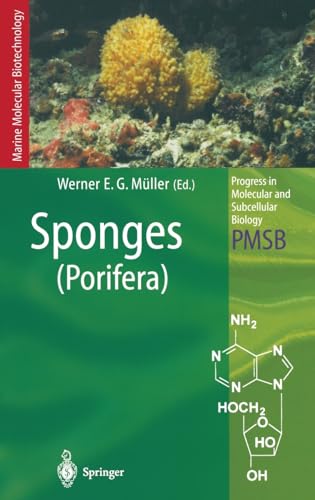

Sponges (Porifera) Werner E.G. Müller, ed.
Series Progress in molecular and subcellular biology ; 37. | Progress in molecular and subcellular biology. Marine molecular biotechnology.Detalles de publicación: Berlin New York Springer c2003.Descripción: xviii, 258 p. ill. (some col.) 24 cmISBN:- 354000968X (alk. paper)
- 593.4 21
- QR106 .S68 2003
| Imagen de cubierta | Tipo de ítem | Biblioteca actual | Biblioteca de origen | Colección | Ubicación en estantería | Signatura topográfica | Materiales especificados | Info Vol | URL | Copia número | Estado | Notas | Fecha de vencimiento | Código de barras | Reserva de ítems | Prioridad de la cola de reserva de ejemplar | Reservas para cursos | |
|---|---|---|---|---|---|---|---|---|---|---|---|---|---|---|---|---|---|---|
| Libro | Biblioteca de Mayagüez Colección General mb | QR106 .S68 2003 (Navegar estantería(Abre debajo)) | Disponible | 50000002172111 |
Descripciones mejoradas de Syndetics:
Sponges (phylum Porifera) are known to be very rich sources for bioactive compounds, mainly secondary metabolites. Main efforts are devoted to cell- and mariculture of sponges to assure a sustainable exploitation of bioactive compounds from biological starting material. These activities are flanked by improved technologies to cultivate bacteria and fungi which are associated with the sponges. It is the hope that by elucidating the strategies of interaction between microorganisms and their host (sponge), by modern cell and molecular biological methods, a more comprehensive cultivation of the symbiotic organisms will be possible. The next step in the transfer of knowledge to biotechnological applications is the isolation, characterization and structural determination of the bioactive compounds by sophisticated chemical approaches.
Includes bibliographical references and index.
Tabla de contenidos provista por Syndetics
- Analysis of the Sponge [Porifera] Gene Repertoire: Implications for the Evolution of the Metazoan Body Plan(p. 1)
- 1 Introduction(p. 2)
- 2 Sponges(p. 3)
- 3 Adhesion Between Cells(p. 5)
- 3.1 Cell-Cell Adhesion in Sponges(p. 6)
- 3.1.1 Galectin(p. 7)
- 3.1.2 The 36-kDa Putative AF(p. 8)
- 3.1.3 The 86-kDa AF-Associated Polypeptide(p. 9)
- 3.1.4 The Core Structure of the AF(p. 9)
- 3.1.5 The Putative AR(p. 9)
- 3.2 Cell-Matrix Adhesion in Sponges(p. 10)
- 3.2.1 Collagen(p. 10)
- 3.2.2 Fibronectin(p. 12)
- 3.2.3 Integrin(p. 13)
- 4 Growth and Differentiation(p. 14)
- 4.1 Primmorphs(p. 15)
- 4.2 Canal Formation(p. 15)
- 4.3 Proliferation(p. 18)
- 5 Migration of Cells - Contraction in Cell Layers(p. 20)
- 6 Elements of a Neuronal Network(p. 21)
- 7 Secretion of Skeletal Elements(p. 21)
- 8 Morphogens(p. 22)
- 8.1 Proteins(p. 22)
- 9 Apoptosis(p. 25)
- 9.1 Induction of Apoptosis in Sponges(p. 25)
- 9.2 Induction of Expression of Apoptotic Genes in Sponges(p. 25)
- 10 Conclusion: Contribution to the Origin of the Metazoan Body Plan(p. 26)
- References(p. 28)
- Sponge-Associated Bacteria: General Overview and Special Aspects of Bacteria Associated with Halichondria panicea(p. 35)
- 1 Introduction(p. 35)
- 2 General Considerations(p. 37)
- 2.1 Microscope Observations(p. 37)
- 2.2 Cultivation of Sponge-Associated Bacteria(p. 38)
- 2.3 Molecular Genetic Analysis of Sponge-Associated Bacteria(p. 40)
- 2.4 Symbiosis Between Bacteria and Sponges(p. 42)
- 2.5 Biologically Active Substances from Sponge-Associated Bacteria(p. 43)
- 3 Bacteria Associated with Halichondria panicea(p. 46)
- 3.1 Eubacteria Isolated from Halichondria panicea(p. 47)
- 3.2 Molecular Diversity of Eubacteria Within Halichondria panicea(p. 49)
- 3.3 Diversity of the Cytophaga/Flavobacteria Group(p. 52)
- 4 Conclusions(p. 53)
- References(p. 54)
- Microbial Diversity of Marine Sponges(p. 59)
- 1 Introduction(p. 59)
- 2 Sponge-Microbe Associations(p. 60)
- 2.1 Sponges as Ancient Niches for Microorganisms(p. 60)
- 2.2 Bacterial Localization(p. 62)
- 2.3 Bacterial Morphotypes(p. 64)
- 3 Tools of Molecular Microbial Ecology(p. 65)
- 3.1 Cultivation-Dependent Techniques(p. 66)
- 3.2 Cultivation-Independent Techniques(p. 67)
- 3.2.1 Fluorescence In Situ Hybridization(p. 69)
- 3.2.2 Denaturing Gradient Gel Electrophoresis(p. 70)
- 3.2.3 16S rDNA Library Construction(p. 70)
- 4 A Uniform Microbial Community in Sponges from Different Oceans(p. 71)
- 4.1 Sponge Model Systems(p. 71)
- 4.1.1 Aplysina aerophoba(p. 71)
- 4.1.2 Rhopaloides odorabile(p. 73)
- 4.1.3 Theonella swinhoei(p. 74)
- 4.2 The Microbial Signature of Sponges(p. 74)
- 4.3 Sponge-Microbe Interaction Model(p. 77)
- 4.4 The Paradigm of Sponge-Microbial Symbiosis(p. 78)
- 5 Biotechnological Potential of Sponge-Associated Microorganisms(p. 79)
- 6 Conclusions and Future Directions(p. 82)
- References(p. 83)
- Full Absolute Stereostructures of Natural Products Directly from Crude Extracts: the HPLC-MS/MS-NMR-CD 'Triad'(p. 89)
- 1 Introduction(p. 90)
- 2 Exemplarily for Naphthylisoquinoline Alkaloids: Constitutions and Relative Configurations by LC-MS/MS-NMR(p. 90)
- 3 Complemented by the LC-CD Option for the Online Assignment of Absolute Configurations: the Triad Is Complete!(p. 93)
- 4 Application of the Triad to the Online Structural Elucidation of New Naphthylisoquinoline Alkaloids and Related Compounds(p. 94)
- 5 An Application to Natural Phenylanthraquinones - Including Quantum Chemical CD Calculations and Total Synthesis(p. 97)
- 6 Stereochemistry of Axially Chiral Biscarbazoles in Plant Extracts, by LC-CD Coupling and CD Calculations(p. 103)
- 7 Without (True) Stereogenic Axes or Centers, but Chiral: a Bis-Bibenzyl Macrocycle(p. 104)
- 8 First Time in Marine Natural Products Analysis: the Analytical Triad HPLC-MS/MS-NMR-CD(p. 105)
- 9 Conclusions(p. 109)
- References(p. 111)
- Bioactive Natural Products from Marine Invertebrates and Associated Fungi(p. 117)
- 1 Introduction: Some Current Issues of Marine Natural Products Research(p. 117)
- 2 Ecological Functions of Sponge Alkaloids(p. 121)
- 2.1 Defensive Pyridoacridine Alkaloids from the Tropical Sponge Oceanapia sp.(p. 122)
- 2.2 Chemical Defense of Mediterranean Aplysina Sponges(p. 124)
- 3 Pharmacologically Active Constituents from Marine Invertebrates(p. 127)
- 3.1 Swinhoeiamide A: a New Calyculin Derivative from the Sponge Theonella swinhoei(p. 127)
- 3.2 Bromopyrrole Alkaloids from the Sponge Stylissa carteri (syn. Axinella carteri)(p. 128)
- 3.3 Staurosporine Derivatives from the Tunicate Eudistoma toealensis and the Flatworm Pseudoceros sp(p. 129)
- 4 Sponge-Associated Fungi as a New Source for Bioactive Metabolites(p. 132)
- 4.1 New Natural Products Isolated from Fungi Associated with the Marine Sponge Aplysina aerophoba(p. 133)
- 4.2 New Natural Products Isolated from Fungi Associated with the Marine Sponge Xestospongia exigua(p. 135)
- 5 Conclusions(p. 137)
- References(p. 138)
- Sustainable Use of Marine Resources: Cultivation of Sponges(p. 143)
- 1 Introduction(p. 144)
- 2 In Situ Cultivation of Bath Sponges(p. 146)
- 3 Sponge Farming(p. 147)
- 4 Ex Situ Maintenance of Sponges in Aquaria(p. 149)
- 5 In Vitro Cultivation of Sponges(p. 154)
- 6 Conclusions and Future Directions(p. 157)
- References(p. 158)
- Sustainable Production of Bioactive Compounds from Sponges: Primmorphs as Bioreactors(p. 163)
- 1 Introduction(p. 164)
- 2 Origin of Biologically Active Compounds from Sponges(p. 168)
- 3 Biologically Active Compounds from S. domuncula(p. 170)
- 3.1 Neurotoxic Compound(p. 170)
- 3.2 Quinolinic Acid(p. 172)
- 4 The Primmorph System(p. 175)
- 4.1 Characteristics(p. 176)
- 4.2 Medium Design(p. 177)
- 4.3 Other Factors(p. 179)
- 4.4 Immunohistological Analysis of Primmorphs(p. 180)
- 5 Production of Bioactive Compounds in the Primmorph System(p. 180)
- 5.1 Avarol(p. 181)
- 5.2 (2'-5')Oligoadenylates(p. 183)
- 6 Future Directions(p. 186)
- 6.1 Immortalization/Cell Lines(p. 188)
- 6.2 Transfection(p. 189)
- 7 Conclusions(p. 191)
- References(p. 192)
- Approaches for a Sustainable Use of the Bioactive Potential in Sponges: Analysis of Gene Clusters, Differential Display of mRNA and DNA Chips(p. 199)
- 1 Introduction(p. 200)
- 2 Genome of Porifera(p. 201)
- 2.1 Genome Size(p. 201)
- 2.2 Gene Density(p. 202)
- 2.2.1 Receptor Tyrosine Kinase Cluster: G. cydonium(p. 202)
- 2.2.2 Allograft Inflammatory Factor [AIF] Cluster: S. domuncula(p. 204)
- 2.3 Intron Lengths(p. 205)
- 2.4 Gene Number(p. 214)
- 3 Nonrandom Distribution of Dinucleotide Repeats(p. 216)
- 4 Burst of Gene Duplication(p. 218)
- 5 Approaches to Identify Genes Involved in the Synthesis of Bioactive Compounds(p. 219)
- 5.1 Analysis of the Expressed Genome of Sponges(p. 220)
- 5.2 Differential Display of mRNA, DNA Chips(p. 221)
- 5.3 DNA-Array Assay(p. 223)
- 5.3.1 DNA Arrays(p. 223)
- 5.3.2 RNA Extraction and Preparation of Probes(p. 224)
- 5.3.3 Hybridization(p. 224)
- 5.3.4 Detection(p. 226)
- 5.3.5 Example(p. 226)
- 6 Conclusions(p. 227)
- References(p. 228)
- Sorbicillactone A: a Structurally Unprecedented Bioactive Novel-Type Alkaloid from a Sponge-Derived Fungus(p. 231)
- 1 Introduction(p. 232)
- 2 Isolation and Cultivation of the Fungus(p. 233)
- 3 Online Analysis of the Extract by the Triad LC/MS/MS-NMR-CD: Hints at a Novel Structural Type(p. 235)
- 4 Isolation of the New Compound and Completion of the Structural Elucidation(p. 236)
- 4.1 Assignment of the Constitution and the Relative Configuration(p. 236)
- 4.2 Establishing the Absolute Configuration: by Quantum Chemical CD Calculations(p. 238)
- 5 Sorbicillactone A: a Unique, Novel-Type Structure and Its Presumable Biosynthetic Origin(p. 239)
- 6 Sorbicillactone A: a Natural Product with Strong--and Selective--Bioactivities(p. 241)
- 6.1 Antifungal Activity(p. 242)
- 6.2 Antibacterial Activity(p. 242)
- 6.3 Antiprotozoic Activity(p. 242)
- 6.4 Cytostatic Activity(p. 243)
- 6.5 Mode of Action of Sorbicillactone A on L5178y Cells(p. 244)
- 6.5.1 Determination of Apoptosis(p. 244)
- 6.5.2 Reversibility of the Inhibitory Effect of Sorbicillactone A on L5178y Cells(p. 245)
- 6.5.3 Effect of Sorbicillactone A on the Synthesis of Macromolecules In Vitro(p. 246)
- 6.6 Antiviral (HIV-1) Effect Caused by Sorbicillactone A(p. 247)
- 6.6.1 Protection by Sorbicillactone A Against Cytopathic Effects of HIV-1(p. 247)
- 6.6.2 Inhibition of Expression of HIV-1 Proteins(p. 248)
- 7 Summary and Future Perspectives(p. 249)
- References(p. 250)
- Subject Index(p. 255)