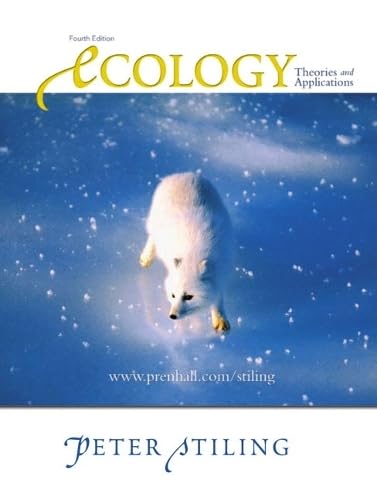

Ecology theories and applications Peter Stiling.
Detalles de publicación: Upper Saddle River, NJ Prentice Hall c2002.Edición: 4th edDescripción: xii, 403 p. col. ill., maps 29 cmISBN:- 013091102X
- 577 S856e4 21
- QH541 .S674 2002
| Imagen de cubierta | Tipo de ítem | Biblioteca actual | Biblioteca de origen | Colección | Ubicación en estantería | Signatura topográfica | Materiales especificados | Info Vol | URL | Copia número | Estado | Notas | Fecha de vencimiento | Código de barras | Reserva de ítems | Prioridad de la cola de reserva de ejemplar | Reservas para cursos | |
|---|---|---|---|---|---|---|---|---|---|---|---|---|---|---|---|---|---|---|
| Libro | Biblioteca Mons. Iñaki Mallona (Arecibo) Colección General ab | 577 S856e4 (Navegar estantería(Abre debajo)) | Disponible | 60000003007769 |
Descripciones mejoradas de Syndetics:
Presents a comprehensive, yet concise and clear, overview of ecologyÂevolutionary, behavioral, population, community and applied. TheThird Edition retains a broad scope and completely integrates the applied sections into the theories of ecology  showing how the theories are applied in the real world. Emphasizes critical thinking and problem solving. Discusses what is currently known about a topic as well as what is yet unknownÂemphasizing that future study in the discipline can lead to important contributions. Completely new first chapter, introductionÂDiscusses the four main sections of the book: behavioral, population, community, and ecosystems ecology. Expanded coverage of behavioral and ecosystems ecology includes a new chapter which features sections on mating systems, sex ratios, habitat selection, dispersal and age structure. Includes discussions on energy flow; features a new, independent chapter for nutrient cycles; separate chapters on species richness, diversity, stability, succession and biogeography. Discusses non-equilibrium theories in coverage of stability and touches on cluster analysis and ordination in discussion of diversity. Broad discussion of evolutionary biology to put conservation and biodiversity in perspective. For ecolgists and environmental scientists.
Includes bibliographical references (p. [380]-390).
Tabla de contenidos provista por Syndetics
- Preface(p. xi)
- Section 1 Introduction(p. 1)
- Chapter 1 Why and How to Study Ecology(p. 2)
- Section 2 Evolution and Behavioral Ecology(p. 19)
- Chapter 2 Genetics and Ecology(p. 20)
- Chapter 3 Extinction(p. 30)
- Chapter 4 Group Selection and Individual Selection(p. 42)
- Chapter 5 Life History Strategies(p. 54)
- Section 3 Population Ecology(p. 65)
- Chapter 6 Population Growth(p. 66)
- Chapter 7 Physical Environment(p. 89)
- Chapter 8 Competition and Coexistence(p. 108)
- Chapter 9 Mutualism(p. 135)
- Chapter 10 Predation(p. 150)
- Chapter 11 Herbivory(p. 170)
- Chapter 12 Parasitism(p. 189)
- Chapter 13 Evaluating the Controls on Population Size(p. 206)
- Section 4 Community Ecology(p. 227)
- Chapter 14 The Main Types of Communities(p. 228)
- Chapter 15 Global Patterns in Species Richness(p. 249)
- Chapter 16 Species Diversity(p. 273)
- Chapter 17 Stability, Equilibrium, and Nonequilibrium(p. 289)
- Chapter 18 Succession(p. 303)
- Chapter 19 Island Biogeography(p. 318)
- Section 5 Ecosystems Ecology(p. 335)
- Chapter 20 Trophic Structure(p. 336)
- Chapter 21 Energy Flow(p. 348)
- Chapter 22 Nutrients(p. 360)
- Glossary(p. 373)
- Literature Cited(p. 380)
- Photo Credits(p. 391)
- Index(p. 393)