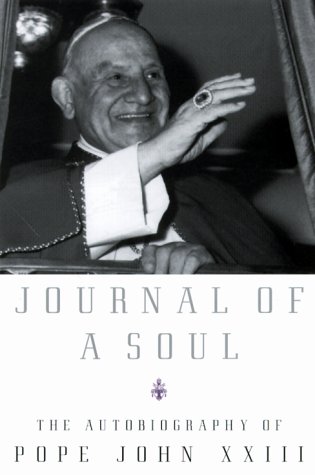

Journal of a soul Pope John XXIII ; translated by Dorothy White.
Detalles de publicación: Garden City, N.Y. Image Books 1980.Edición: Rev. ed. with new introdDescripción: lxii, 441 p., [16] leaves of plates ill. 21 cmISBN:- 0385148429 (pbk.)
- 21 282.092
| Imagen de cubierta | Tipo de ítem | Biblioteca actual | Biblioteca de origen | Colección | Ubicación en estantería | Signatura topográfica | Materiales especificados | Info Vol | URL | Copia número | Estado | Notas | Fecha de vencimiento | Código de barras | Reserva de ítems | Prioridad de la cola de reserva de ejemplar | Reservas para cursos | |
|---|---|---|---|---|---|---|---|---|---|---|---|---|---|---|---|---|---|---|
| Libro | Biblioteca de Mayagüez Colección General mb | BX 1378.2 .A383 1980 (Navegar estantería(Abre debajo)) | Disponible | 50000002102894 |
Revised translation of the work published in 1967 under title: Il giornale dell'anima e altri scritti di pietà.
Includes bibliographical references.
Notas de autor provistas por Syndetics
Born Angelo Giuseppe Roncalli, the son of peasants who rented land as sharecroppers, Pope John XXIII early demonstrated intellectual abilities that saw him through seminary studies in Bergamo, near his home, and on to his ordination in 1904. For a number of years he worked with Catholic women's and youth organizations under the bishop of Bergamo. In World War I he served as a medical sergeant and as a chaplain and after the war was active in the Society for the Propagation of the Faith, with its headquarters in Rome. In 1925 he was appointed to the first of several diplomatic missions, first among the Catholic minority in Bulgaria, then in Turkey, where he set the precedent of introducing Turkish into the Mass, and in Greece, where during World War II military operations destroyed any opportunity he might have had to work with the Orthodox majority and confronted him with a hatred of Italians fueled by the Italian army's occupation of the country.As the war began to heat up on French soil, he was appointed papal nuncio to France and arrived in Paris at the very end of 1944. There, for almost a decade, he worked with first the Germans and then the French government to heal the wounds of warfare, to keep the church intact through rapid changes of government, to keep Catholic schools alive, and to deal with the French bishops who saw the increasing secularization of the nation and the failing religious allegiance of the people as signs pointing to the need for radical new measures to propagate the faith. Nevertheless, it is true that the worker-priest movement, which he watched at first with approval, received its deathblow during his pontificate.
After serving as patriarch of Venice and being made cardinal (1953), he was elected by the College of Cardinals in 1958 to succeed Pius XII. The major accomplishment of his pontificate was the calling of the Second Vatican Council, whose arguments and decrees seemed revolutionary in their time (1962--65) and whose ripples continue to move the barque of Rome to this day. Thirty-nine non-Catholic observers attended with his blessing, special provision being made for translation from Latin documents and speeches, and it is perhaps not surprising that one of the first conciliar decrees was to allow the vernacular to replace Latin in the liturgy. He died of a gastric ulcer on June 3, 1963.
(Bowker Author Biography)