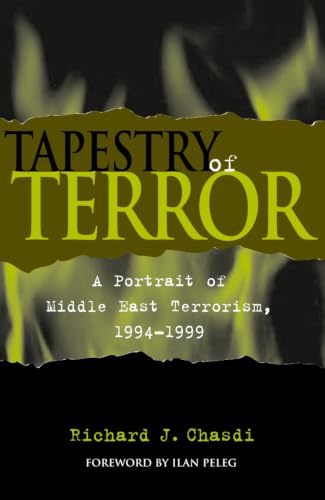

Tapestry of terror a portrait of Middle East terrorism, 1994-1999 Richard J. Chasdi.
Detalles de publicación: Lanham, MD Lexington Books c2002.Descripción: xxiv, 509 p. ill. 24 cmISBN:- 0739103547 (cloth : alk. paper)
- 0739103555 (pbk. : alk. paper)
- 303.6/25/095609049 21
- HV6433.M5 C534 2002
| Imagen de cubierta | Tipo de ítem | Biblioteca actual | Biblioteca de origen | Colección | Ubicación en estantería | Signatura topográfica | Materiales especificados | Info Vol | URL | Copia número | Estado | Notas | Fecha de vencimiento | Código de barras | Reserva de ítems | Prioridad de la cola de reserva de ejemplar | Reservas para cursos | |
|---|---|---|---|---|---|---|---|---|---|---|---|---|---|---|---|---|---|---|
| Libro | Biblioteca Encarnación Valdés Colección General bev | 303.625 C4871t (Navegar estantería(Abre debajo)) | Disponible | 80000002244518 |
Descripciones mejoradas de Syndetics:
The recent terrorist outrages perpetrated against the United States demonstrate the need for a new and rigorous study of modern terrorism. In Tapestry of Terror , Richard J. Chasdi offers fresh insight into the complexities of state-sponsored and nonstate terrorism. Building on the research methods and findings discussed in his previous work, Serenade of Suffering , which covers Middle East terrorism in the period 1968 to 1993, Chasdi presents a detailed statistical and quantitative analysis of four Middle East terrorist systems: in Algeria, Turkey, Egypt, and Israel. He pinpoints the socioeconomic conditions that breed and sustain terrorism, the political factors that ignite terrorist attacks, and those individuals or groups most frequently targeted by terrorists. Tapestry of Terror charts the increasing frequency and intensity of intrastate terrorism in the 1990s; the growing threat posed to Western nations by international terrorism; and the counter-terrorist stratagems and policy decisions needed-now more than ever-to defend against highly coordinated, immensely destructive assaults.ons needed-now more than ever-to defend against highly coordinated, immensely destructive assaults.ons needed-now more than ever-to defend against highly coordinated, immensely destructive assaults.ons needed-now more than ever-to defend against highly coordinated, immensely destructive assaults.
Includes bibliographical references and index.
From the post Cold War world to the Ghost War world -- Methodology and theoretical developments -- The case of Algerian terrorism -- The case of Egyptian terrorism -- The case of Turkish terrorism -- The case of Israeli-Palestinian-Arab terrorism.
Tabla de contenidos provista por Syndetics
- List of Figures(p. ix)
- List of Tables(p. xiii)
- Acknowledgments(p. xvii)
- Foreword(p. xix)
- Preface: From the Post Cold War World to the Ghost War World(p. xxi)
- Chapter 1 Introduction(p. 1)
- Chapter 2 Methodology and Theoretical Developments(p. 23)
- Chapter 3 The Case of Algerian Terrorism(p. 63)
- Chapter 4 The Case of Egyptian Terrorism(p. 151)
- Chapter 5 The Case of Turkish Terrorism(p. 217)
- Chapter 6 The Case of Israeli-Palestinian-Arab Terrorism(p. 287)
- Chapter 7 Conclusions(p. 405)
- Bibliography(p. 425)
- Author Index(p. 485)
- Subject Index(p. 489)
- About the Author(p. 509)