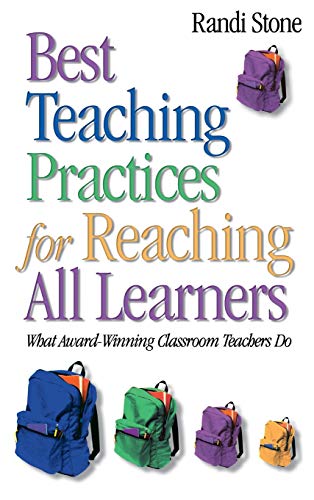

Best teaching practices for reaching all learners what award-winning classroom teachers do Randi Stone [editor].
Detalles de publicación: Thousand Oaks, Calif. Corwin Press 2004.Descripción: xxvi, 154 p. 24 cmISBN:- 0761931813
- 21 371.102
- LB1025.3 .B48 2004
| Imagen de cubierta | Tipo de ítem | Biblioteca actual | Biblioteca de origen | Colección | Ubicación en estantería | Signatura topográfica | Materiales especificados | Info Vol | URL | Copia número | Estado | Notas | Fecha de vencimiento | Código de barras | Reserva de ítems | Prioridad de la cola de reserva de ejemplar | Reservas para cursos | |
|---|---|---|---|---|---|---|---|---|---|---|---|---|---|---|---|---|---|---|
| Libro | Biblioteca de Mayagüez Colección General mb | LB1025.3 .B48 2004 (Navegar estantería(Abre debajo)) | Disponible | 50000002148970 |
Descripciones mejoradas de Syndetics:
How are the best teachers in our nation reaching students?
Educators are always challenged to motivate students to learn, working hard to identify learning standards as well as to find creative and meaningful ways of incorporating them into their classrooms. Best Teaching Practices for Reaching All Learners is your guide to how award-winning teachers reach every child and provide what each learner needs to succeed.
Randi Stone′s newest best-practice collection takes its cue from the No Child Left Behind legislation, using its theme to create a one-of-a-kind educational resource that provides exciting, insightful classroom strategies from 43 of the best teachers in the country! These ideas cover all areas of your curriculum and all of your learners. You will find:
Content strategies for differentiating social studies, reaching reluctant readers, and teaching mathphobic learners and the "scientifically challenged" Innovative methods for reaching at-risk and special learners coping with autism, Asperger′s syndrome, ADHD, shyness, poverty, and other challenges Teaching with technology, rubrics, culminating activities, and service learning Using multiple intelligences, learning styles, affinity groups, and reflection in the classroom Reaching students through fine arts, physical movement, humor, and moreAll students deserve quality instruction focused on individual needs as well as on the academic standards to which educators are held accountable. Help change your students′ attitudes about themselves and their abilities!
Includes bibliographical references and index.
Tabla de contenidos provista por Syndetics
- Preface
- About the Author
- About the Contributors
- 1 Language Arts to Reach All Learners
- Hometown Hero
- Reading the First Day
- Using Technology With Struggling Readers and Writers
- Using Physical Movement to Motivate At-Risk Students to Read
- Educating One Child at a Time
- Using Assessment to Drive Instruction
- Motivating Middle Schoolers
- Inspiring a Reluctant Reader
- The Four-Block Literacy Model: Reaching All Learners
- Planning for Differentiated Instruction at the High School Level
- 2 Math Techniques to Reach Students
- Techniques and Strategies to Help Low Achievers in Mathematics
- Convincing Mathphobics That They Can Be Successful in Math
- Empowering Students to Accept Challenges
- 3 Teaching with Technology
- Technology and ADHD
- Technology and Shyness
- Using Technology to Reach At-Risk Students
- 4 Teaching Techniques
- Reaching a Child With Asperger Syndrome
- For Autism, Consistency Is Essential
- Magic Happens Here
- High-End Learners: Providing Support
- Catching a Student Being Good
- 5 Science to Reach All Learners
- The Big Hole River Education Program
- Where Does Your Burger Come From?
- Enhancing Curriculum Through a Student Space Program
- Bringing the Outside Into Your Classroom to Reach Students of All Levels
- Reaching All Learners: One Approach
- Teaching Chemistry-Challenged Students
- Using Culminating Activities to Reach All Learners
- The Middle School Means Success Program
- An Out of this World Experience!
- Addressing Gender Equity Issues Through Alternative Lesson Design Methods
- Using Hands-On Science and Math to Engage All Learners
- Using Checkpoints to Increase Compliane
- Making Science Come Alive
- 6 Teaching With Styles
- Active Introduction to a New Classroom
- Establishing a Schoolwide Club
- Using Multiple Intellligences in the Classroom
- Reaching Special Needs Students Through a Classroom Business
- The Use of Service Learning
- Humor in the Classroom
- Life's Unnerving Little Habits
- Using Affinity Groups to Promote Professional Development and Enhance School Climate
- Raising Citizens
- Weekly Reflections
- My Daily Rubric
- 7 Reaching All Learners With Social Studies
- Differentiated Instruction to Reach All Learners: Geography
- Research-Based Teaching Practices to Reach All Learners
- Differentiated Instruction to Reach All Learners: Economics
- Engaging All Learners in Social Studies
- 8 Reaching Students Through Fine Arts
- When Problems of Poverty Interfere With Schooling: Music as a Path to Success
- Project Van Go: An Art Outreach to Remote and Rural Schools
- Index
Reseñas proporcionadas por Syndetics
CHOICE Review
This collection of more than 50 teaching ideas covers instructional techniques designed to effectively teach children in language arts, mathematics, science, social studies, fine arts, and others. The descriptions of these teaching techniques are very brief; some are less than a single page in length. Each entry is written by an award-winning teacher, and the author provides some information about each contributor, including their school, their e-mail address, and their school's telephone number, thus suggesting that readers are encouraged to contact the contributors for additional information. The particular awards of each contributing teacher are also noted. In some cases, the awards are well known among educators (e.g., Milken Family Foundation Award), but in other cases, it is impossible to know what the award really was and how competitive it was (e.g., Seed Developer Award). Although the author suggests that each of the ideas in the book is an example of a "best practice," virtually no data are provided to support that assertion. The ideas worked for at least one teacher at least one time, but beyond that, there is no assurance that they are supported empirically. ^BSumming Up: Not recommended. S. H. Minner Truman State UniversityNotas de autor provistas por Syndetics
Randi Stone is the author of nine Corwin Press books: Best Practices for Teaching Reading: What Award-Winning Classroom Teachers Do, Best Practices for Teaching Social Studies: What Award-Winning Classroom Teachers Do, Best Practices for Teaching Writing: What Award-Winning Classroom Teachers Do, Best Practices for Teaching Mathematics: What Award-Winning Classroom Teachers Do, and Best Practices for Teaching Science: What Award-Winning Classroom Teachers Do. She is a graduate of Clark University, Boston University, and Salem State College. She completed her doctorate in education at the University of Massachusetts, Lowell.