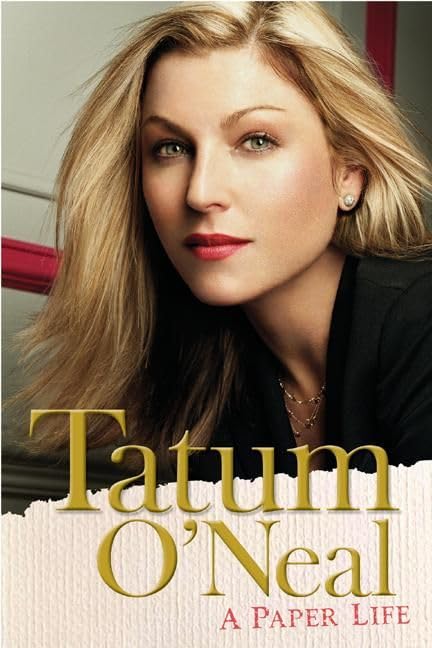
Imagen de portada de Amazon
Imagen de Amazon.com
Imagen de cubierta Syndetics
Portada de Syndetics
Imagen de OpenLibrary

A paper life Tatum O'Neal.

Por: Detalles de publicación: New York HarperEntertainment c2004.Edición: 1st edDescripción: xii, 285 p., [32] p. of plates ill. 24 cmISBN:
  • 0060540974 (alk. paper)
Tema(s): Clasificación CDD:
  • 791.4302/8/092 B 22
Clasificación LoC:
  • PN2287.O545 A3 2004
Valoración
    Valoración media: 0.0 (0 votos)
Existencias
Imagen de cubierta Tipo de ítem Biblioteca actual Biblioteca de origen Colección Ubicación en estantería Signatura topográfica Materiales especificados Info Vol URL Copia número Estado Notas Fecha de vencimiento Código de barras Reserva de ítems Prioridad de la cola de reserva de ejemplar Reservas para cursos
Libro Biblioteca Encarnación Valdés Colección General bev 791.4302 O5858p (Navegar estantería(Abre debajo)) Disponible 80000002227877
Total de reservas: 0

Descripciones mejoradas de Syndetics:

Filled with stunning revelations, here is the sensational memoir of one of Hollywood's most talented and troubled stars--an inspirational true tale of survival and triumph against all odds

Though she has shunned the media spotlight, Academy Award-winning actress Tatum O'Neal at last goes on the record to tell her story-a tale of personal turmoil and ultimate triumph that is part Hollywood tell-all, part Greek tragedy, and part Shakespearean drama.

In her trademark no-holds-barred style, she names names as she chronicles the ups and downs of being Hollywood royalty, including

* her nearly fatal addiction to drugs

* her destructive relationships with mother, the late actress Joanna Moore; her famously overbearing and flamboyant father, Ryan O'Neal and his former longtime live-in love, Farrah Fawcett; and her wildly explosive ex-husband, international tennis pro John McEnroe

* her early years-a time of tubulence, loneliness, and abuse-as a virtual orphan forced to raise herself and her "Irish twin," younger brother, Griffin

* her explosive, untold stories of the top figures in pop culture and sports

Ultimately, we see the emergence of an extremely gifted, spirited, and intelligent woman--the ultimate survivor who is a role model to all women.

Tabla de contenidos provista por Syndetics

  • Acknowledgments(p. viii)
  • Prologue: Ryan's Daughter(p. xiv)
  • 1 Dorothy, aka Joanna(p. 9)
  • 2 The Ranch(p. 22)
  • 3 The Good Life(p. 34)
  • 4 Paper Moon(p. 42)
  • 5 The Oscar(p. 53)
  • 6 The Bet(p. 66)
  • 7 Dear Fanny(p. 76)
  • 8 A Bridge Too Far(p. 88)
  • 9 9897 Beverly Grove Drive(p. 98)
  • 10 Circle of One(p. 112)
  • 11 A Certain Fury(p. 121)
  • 12 Johnny Mac(p. 135)
  • 13 John's Cure(p. 146)
  • 14 The Wedding(p. 157)
  • 15 Two for the Road(p. 167)
  • 16 The Colony(p. 181)
  • 17 R-e-s-p-e-c-t(p. 193)
  • 18 Coming Undone(p. 207)
  • 19 The Last Party(p. 220)
  • 20 Woman on the Run(p. 230)
  • 21 The Rabbit Hole(p. 240)
  • 22 Getting Straight(p. 250)
  • 23 Free Fall(p. 262)
  • 24 The Comeback(p. 271)
  • Epilogue: Tatum's Time(p. 282)

Extracto provisto por Syndetics

A Paper Life The story of paper moon reflects my childhood, but it also closely parallels my mother's and strangely foreshadows my daughter's. Three generations of women: we all lost our mothers early in life -- the first literally, to death; the second virtually, to addiction; and the third, my daughter, temporarily, when I succumbed to familiar demons. It is a cycle that I'm determined to break. My mother was born, like Addie, in the heart of the Great Depression, not in Kansas but in Americus, Georgia. The elder of two daughters of Henry and Dorothy English Cook, she was named for her mother but later christened herself Joanna. A letter from her cousin Libba that I discovered after her death depicts her early childhood as cozy: rocking on the old porch swing, sitting by the potbellied stove, sliding down the banister at her grandmother's. She was the only one not in the car when her father swerved off the road because her mom fell asleep on his shoulder, plunging down a sandy embankment into a ravine. Both her mother and her baby sister, Virginia, died instantly. Libba's letter recalls, in haunting detail, how she got the news: "We were on the playground. . . . My ma had come to school. You had all visited the day before. And Momma kept saying, 'The pillow I put in my stroller for the baby to sit in had an imprint of the little body in it.'" Henry, my mother's father, was badly hurt but lingered for a year before dying of a ruptured spleen-or, she always believed, of a broken heart. So, at age six, my mother became an orphan. For a time she was farmed out to live with her maternal grandmother, who was confined to a wheelchair with an osteoporosis-like condition. She was also addicted to morphine, prescribed by the town doctor, making her the first known link in my family's chain of drug dependence. Even in that environment, my mother managed to bloom. She was pretty and vivacious, with a million-dollar smile, and so talented at singing and playing the piano that she became a star at church. By the time my mother reached her early teens, however, her grandmother had grown too feeble and impoverished to raise her. She was adopted by a wealthy local family, who saw her through high school then sent her off to Agnes Scott College near Atlanta, which was one of the top women's schools in the South. I've heard rumors that she was molested by a member of her adoptive family, but my mother never spoke of it. She rarely mentioned her teenage marriage to Willis Moore, of which her lifelong last name was the only trace. Southern women of her era were bred to smooth over unpleasantness, but denial in my mother ran as deep as her love for amphetamines. So I came to know her through a scrim of pictures and letters, lies and secrets. She was extraordinarily beautiful, with blond hair, a perfect heart-shaped face, huge green eyes, and lush full lips. She had a smoky, seductive voice (which Emily and I both inherited) warmed by her southern lilt. Winning a beauty contest brought my mother to Hollywood in the mid-1950s, where she was discovered at a cocktail party and signed to Universal. A flood of contract assignments followed, in films ranging from such minor classics as The Last Angry Man and Walk on the Wild Side to teen screamers like Monster on Campus. Among them was A Touch of Evil, the last Hollywood film directed by Orson Welles, which has been hailed as "the greatest B movie ever made." It opens with one of the most famous shots in movie history-nearly three and a half minutes long-tracking a car with a bomb in its trunk through a seedy Mexican border town. Finally the car explodes, killing the driver; and a corrupt, drunken sheriff (played by Orson Welles) tries to pin the crime on bystanders Charlton Heston and Janet Leigh. Though my mother is on screen only for a short time in the film, she is masterful as the victim's daughter. My father always said that my mother was the best actor in the family, but it was only after she died that I came to recognize her power. In A Touch of Evil my mother had to darken her hair to avoid out-blonding Janet Leigh. After hours, she had to dodge Charlton Heston, who once lured her to his room, seemingly to seduce her. Later Elvis Presley hit on her with even less finesse. While making Follow That Dream in 1962, he actually tried to break down her door. But my mother had no use for the idol of millions of teenagers, telling an interviewer, "He's a bore." After the mid-1960s, she worked mainly in television. She was featured in most of the major series of the day: Gunsmoke, The Rifleman, Bat Masterson, Wagon Train, Maverick, and The Virginian-westerns dominated the top twenty -- as well as The Fugitive, Perry Mason, Route 66, 77 Sunset Strip, Bewitched, and The Man from U.N.C.L.E. She became a semiregular on Alfred Hitchcock Presents, usually cast as a southern belle, and had a recurring role on the Andy Griffith Show as Peggy McMillan, the sheriff's girlfriend. On one of those shows, she met my father, then just a struggling actor. He wasn't a dream-chasing migrant like she was but a native Angeleno, with a mother hellbent on propelling her two sons to stardom. My grandmother even pushed her youngest, my uncle Kevin, to study ballet and take growth hormones to groom him for the screen. Patricia Callaghan, my grandmother, had sacrificed her own acting career to raise her children. She can still be seen in Three Came Home, the true story of a woman's survival in a Japanese prison camp, starring Claudette Colbert. Born of a Russian mother (who was named Devonovitch and rumored to be Jewish) and an Irish father, she was raised in Toronto and San Francisco and instilled with a gloves-wearing, hair-ina- bun propriety that made her the polar -- and harshly disapproving -- opposite of my mother. My dad's father, Charles O'Neal, was more accepting and shared my mother's southern roots and jolly temperament. Born in North Carolina, he attended the University of Iowa, where thanks to his accent, classmates dubbed him "Blackie," and the nickname stuck. He met my grandmother in a San Diego theater troupe but discovered a new vocation -- screenwriting -- after publishing a short story in Esquire. My grandpa achieved modest success with screenplays for such movies as The Seventh Victim, Cry of the Werewolf, The Missing Juror, and Montana in the 1940s and 1950s; then he moved on to writing for TV series, including The Untouchables, The Californians, and Lassie. Also the author of two novels, he developed one into the 1952 musical Three Wishes for Jamie, which starred John Raitt (Bonnie's father) and Anne Jeffreys and ran for several months on Broadway. A Paper Life . Copyright © by Tatum O'Neal. Reprinted by permission of HarperCollins Publishers, Inc. All rights reserved. Available now wherever books are sold. Excerpted from A Paper Life by Tatum O'Neal All rights reserved by the original copyright owners. Excerpts are provided for display purposes only and may not be reproduced, reprinted or distributed without the written permission of the publisher.

Reseñas proporcionadas por Syndetics

Library Journal Review

All the Hollywood horrors are here, with a hopeful ending. (c) Copyright 2010. Library Journals LLC, a wholly owned subsidiary of Media Source, Inc. No redistribution permitted.

Publishers Weekly Review

At age 10, O'Neal became the youngest Oscar winner in history for her performance in Paper Moon. In this honest, disturbing memoir, O'Neal, now 41, reveals the behind-the-scenes story of her lonely, chaotic life-one dominated by struggles with drugs and damaging relationships. O'Neal portrays her divorced parents (actors Joanna Moore and Ryan O'Neal) as neglectful and abusive, with drug problems of their own. Though O'Neal appeared in such kid-fodder movies as The Bad News Bears and Little Darlings, she says that during the '70s and early '80s she battled depression and attempted suicide. "I found that coke made me feel so much better," she recounts in the straightforward though unoriginal language that characterizes the narrative. Much of the book's second half covers her fraught marriage to volatile tennis champ John McEnroe; these passages alternate between recollections of the pleasure of being in love and having children and the pain of living with McEnroe, whom she depicts as controlling and demeaning. Ten years and three children later, O'Neal and McEnroe divorced. She resumed using drugs, fought child custody battles and watched her mother die of cancer. Although O'Neal speeds through the details, she addresses her addictions: "I wanted to take my own life but... instead... I started doing drugs 24/7. I couldn't stop." She also zips through her recovery, abruptly claiming "rebirth" in the final chapter. Writing this memoir seems to have been cathartic for O'Neal. Perhaps reading it will provide inspiration to other abuse victims and addicts. (Oct. 12) Forecast: A publicity blitz (Oprah, Today, Dateline, Live with Regis & Kelly, Larry King Live), a serial in People and a push from book clubs will put O'Neal in the spotlight. (c) Copyright PWxyz, LLC. All rights reserved

Notas de autor provistas por Syndetics

Tatum O'Neal made her screen debut as a pint-size con artist in the 1973 film Paper Moon, costarring with her father, Ryan O'Neal, and winning that year's Academy Award for best supporting actress. She has been acting on and off ever since, notably in such memorable movies as The Bad News Bears (1976) and Basquiat (1996). Married at age twenty-two to John McEnroe, she is the mother of three children. She lives in New York City
Compartir
logopucpr-y-vive

Contáctanos

¡Queremos saber de ti!

Tel. 787.841.2000 Ext. 1801

bibliotecavaldes@pucpr.edu

⁣Búscanos en las redes

© 2026 Desarrollado por Ignite Online • All Rights Reserved • Powered by Koha.