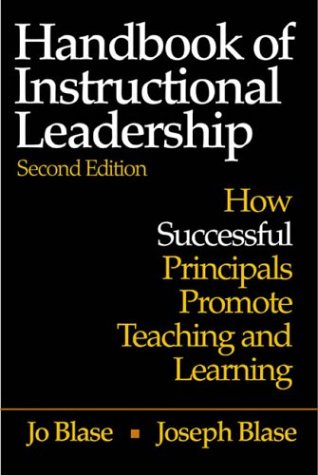

Handbook of instructional leadership how successful principals promote teaching and learning Jo Blase, Joseph Blase.
Detalles de publicación: Thousand Oaks, Calif. Corwin Press c2004.Edición: 2nd edDescripción: xx, 228 p. 24 cmISBN:- 0761931147 (Cloth : alk. paper)
- 0761931155 (Paper)
- 371.203 B6442h2 22
- LB2806.4 .B63 2004
| Imagen de cubierta | Tipo de ítem | Biblioteca actual | Biblioteca de origen | Colección | Ubicación en estantería | Signatura topográfica | Materiales especificados | Info Vol | URL | Copia número | Estado | Notas | Fecha de vencimiento | Código de barras | Reserva de ítems | Prioridad de la cola de reserva de ejemplar | Reservas para cursos | |
|---|---|---|---|---|---|---|---|---|---|---|---|---|---|---|---|---|---|---|
| Libro | Biblioteca Encarnación Valdés Colección General bev | 371.203 B6442h2 (Navegar estantería(Abre debajo)) | Disponible | 80000002228420 |
Descripciones mejoradas de Syndetics:
Updated Edition of Bestseller!
Build a learning community of teachers and students through mastering the art of effective leadership!
The first edition of this classic text was based on a landmark study in which the authors surveyed over 800 K-12 teachers to find how the best principals encourage teacher growth and professionalism. The answers provided conclusive evidence that the most successful principals act as instructional leaders who advocate teacher development that enhances students′ learning. The updated and expanded second edition presents new research by the Blases, along with the most recent research and insights to support the text′s groundbreaking theory.
Successful instructional leaders inspire their staff to develop "professional learning communities" dedicated to effective teaching practices. New to the second edition is an in-depth analysis that shows principals how to achieve this goal. Also new are additional figures, models, and reading lists that enrich the text′s original findings.
Time-tested practices of instructional leadership are still central features. Principals can use these keys to success to:
Build teachers′ trust through continual communication Encourage teachers to continue their self-improvement efforts Motivate teachers with constructive feedback Promote and participate in reflective practices Support and encourage teachers′ professional developmentEncourage your teachers to be their best through supportive collaboration and communication. Practice real instructional leadership and develop a "professional learning community" in which effective teaching promotes continued learning.
Includes bibliographical references (p. 205-219) and index.
The craft of teacher supervision -- The conference : heart of instructional supervision -- Staff development : promoting professional growth -- Reflection : encouraging critical study -- Being visible versus interrupting and abandoning -- Praising versus criticizing -- Extending autonomy versus maintaining control -- The successful instructional leader -- Instructional leadership : a bridge to the development of a professional learning community -- Resource : research method and procedures.
Tabla de contenidos provista por Syndetics
- Foreword
- Preface
- Acknowledgments
- About the Authors
- Dedication
- Part I The Art and Science of Instructional Leadership
- 1 The Craft of Teacher Supervision
- Our Study
- The Instructional Supervision Legacy: From Control to Collaboration
- Research on Instructional Supervision
- Current Issues in the Field
- 2 The Conference: Heart of Instructional Supervision
- Successful Approaches
- Research on Instructional Conferences
- Our Findings
- Summary
- 3 Staff Development: Promoting Professional Growth
- Research on Teaching and Learning
- How Do Teachers Learn? Principles That Shape Staff Development
- Our Findings: The Lifelong Study of Teaching and Learning
- PSSSSST! Redesign
- Tips for Leaders
- Summary
- 4 Reflection: Encouraging Critical Study
- The Need for Reflective Practice
- Related Research and the Development of Frameworks for Reflective Thinking
- Approaches to Reflective Supervision
- Our Study: Characteristics of Teacher Reflection
- Principal Behaviors Fostering Reflection in Teachers and the Benefits to Teachers
- Cognitive Coaching: Bridge to Reflection
- Encouraging Reflection: Helpful Reminders
- Portrait of a Facilitator for Reflective Practice
- Part II How Supervisors' Behaviors - Positive and Negative - Affect Teachers
- 5 Being Visible Versus Interrupting and Abandoning
- Visibility by Wandering Around
- Interruption of Class Instruction
- Abandonment
- 6 Praising Versus Criticizing
- Praise
- Criticism: More About Control
- 7 Extending Autonomy Versus Maintaining Control
- Extending Autonomy
- The Control Orientation and Instructional Leadership
- Other Aspects of Control
- Goals of Principals' Control Orientation
- The Abusive Control Orientation: The Worst of All
- Summary
- 8 Conclusion: The Successful Instructional Leader
- What, Then, Is Successful Instructional Leadership or Supervision?
- Successful Leadership Vis-Ã -vis Instruction
- Tips for Principals
- Linking Instructional Leadership to the Development of a Professional Learning Community
- 9 Instructional Leadership: A Bridge to the Development of a Professional Learning Community
- Recruiting for a Professional Learning Community
- Professional Learning Communities: Findings From Research
- Suggestions for Expanding Successful Instructional Leadership to Develop a Professional Learning Community
- Everyone an Academic Leader
- More to Learn: A Final Word
- Resource: Research Method and Procedures
- References
- Index
Notas de autor provistas por Syndetics
Jo Blase is a professor of educational administration at the University of Georgia, and a former public school teacher, high school and middle school principal, and director of staff development. She received a Ph.D. in educational administration, curriculum, and supervision in 1983 from the University of Colorado at Boulder, and her research has focused on instructional and transformational leadership, school reform, staff development, and principal-teacher relationships. Through work with the Beginning Principal Study National Research Team, the Georgia League of Professional Schools, and public and private school educators with whom she consults throughout the United States and abroad, she has pursued her interest in preparation for and entry to educational and instructional leadership as it relates to supervisory discourse.
Winner of the W. G. Walker 2000 Award for Excellence for her coauthored article published in the Journal of Educational Administration, the University of Georgia College of Education Teacher Educator Award, the University of Colorado School of Education Researcher/Teacher of the Year, and the American Association of School Administrators Outstanding Research Award, Blase has published in international handbooks and journals such as The Journal of Staff Development, The Journal of Curriculum and Supervision, Educational Administration Quarterly , and The Alberta Journal of Educational Research; her eight book editions include Empowering Teachers (1994, 2000), Democratic Principals in Action (1995), The Fire Is Back (1997), Handbook of Instructional Leadership (1998, 2004), Breaking the Silence (2003), and Teachers Bringing Out the Best in Teachers (2006).
Blase has authored chapters on becoming a principal, school renewal, supervision, and organizational development; her recent research examines the problem of teacher mistreatment. She has published over 90 academic articles, chapters, and books, and she also conducts research on supervisory discourse among physicians as medical educators and consults with physicians in US hospitals and medical centers.
Joseph Blase is a professor of educational administration at the University of Georgia. Since receiving his Ph.D. in 1980 from Syracuse University, his research has focused on school reform, transformational leadership, the micropolitics of education, principal-teacher relationships, and the work lives of teachers. His work concentrating on school-level micropolitics received the 1988 Davis Memorial Award given by the University Council for Educational Administration, and his coauthored article published in the Journal of Educational Administration won the W. G. Walker 2000 Award for Excellence. In 1999 he was recognized as an elite scholar, one of the 50 Most Productive and Influential Scholars of Educational Administration in the world. Blase's books include The Politics of Life in Schools: Power, Conflict, and Cooperation (winner of the 1994 Critic's Choice Award sponsored by the American Education Studies Association), Bringing Out the Best in Teachers (1994, 2000, 2008); The Micropolitics of Educational Leadership (1995), Empowering Teachers (1994, 2000), Democratic Principals in Action (1995), The Fire Is Back (1997), Handbook of Instructional Leadership (1998, 2004), Breaking the Silence (2003), and Teachers Bringing Out the Best in Teachers (2006). His recent research (coauthored with Jo Blase and Du Fengning, 2008), a national study of principal mistreatment of teachers, appeared in The Journal of Educational Administration. Professor Blase has published over 120 academic articles, chapters, and books.