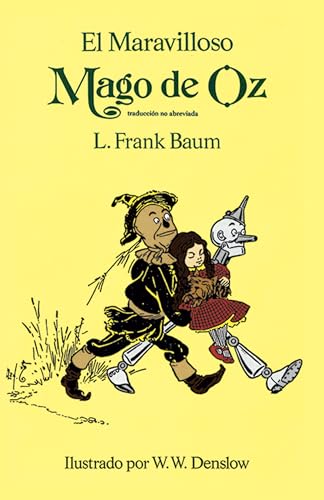

El maravilloso mago de Oz L. Frank Baum ; ilustrado por W.W. Denslow.
Idioma: Español Lenguaje original: Inglés Detalles de publicación: New York Dover Publications 1996.Descripción: v, 120 p. ill. 22 cmISBN:- 0486289680 (pbk.)
- 813 B347wi E 20
- PZ73 .B377 1996
| Imagen de cubierta | Tipo de ítem | Biblioteca actual | Biblioteca de origen | Colección | Ubicación en estantería | Signatura topográfica | Materiales especificados | Info Vol | URL | Copia número | Estado | Notas | Fecha de vencimiento | Código de barras | Reserva de ítems | Prioridad de la cola de reserva de ejemplar | Reservas para cursos | |
|---|---|---|---|---|---|---|---|---|---|---|---|---|---|---|---|---|---|---|
| Libro | Biblioteca Encarnación Valdés Colección General bev | 813 B347wi E (Navegar estantería(Abre debajo)) | Disponible | 80000002227612 |
Descripciones mejoradas de Syndetics:
Por generaciones, El Maravilloso Mago de Oz ha cautivado a jóvenes y adultos con su incomparable fantasia y sus personajes inolvidables. Esta nueva, excelente y complete traducción no abreviada al español retiene toda la aventura y magia del original -- la encantadora historia de una niña de Kansas y su fantástico viaje a la Tierra de Oz.
Los niños hispanohablantes y todos aquéllos que estudian el español se deleitarán con las aventuras de Dorothy, el Hombre de Hojalata, el León Cobarde, el Espantapájaros y otros seres fantásticos. Todos ellos cobran vida en este maravilloso relato, realzado por 26 de las ilustraciones originales de W. W. Denslowe.
After a cyclone transports her to the land of Oz, Dorothy must seek out the great Wizard in order to return to Kansas.
Reseñas proporcionadas por Syndetics
School Library Journal Review
Gr 3-8-If you are going to purchase just one Spanish-language edition of The Wonderful Wizard of Oz, this is the one to acquire. Why? First, it is an example of quality bookmaking, printed on heavy paper stock and beautifully bound. Ingpen's illustrations for this iconic story make readers think about the familiar happenings in an entirely different way. I love the quiet authenticity with which he portrays Uncle Henry and Aunt Em. The Emerald City becomes something quite magical and mystical, and the Wizard himself appears in several marvelously grotesque guises. There is a great deal of variety in the integration of the text with the illustrations, from full spreads to spot drawings, and it is clear that a great deal of attention has been paid to the design. And of course, the translation is excellent. This is one for the ages. (c) Copyright 2013. Library Journals LLC, a wholly owned subsidiary of Media Source, Inc. No redistribution permitted.Notas de autor provistas por Syndetics
Best known as the author of the Wizard of Oz series, Lyman Frank Baum was born on May 15, 1856, in New York. When Baum was a young man, his father, who had made a fortune in oil, gave him several theaters in New York and Pennsylvania to manage. Eventually, Baum had his first taste of success as a writer when he staged The Maid of Arran, a melodrama he had written and scored.Married in 1882 to Maud Gage, whose mother was an influential suffragette, the two had four sons. Baum often entertained his children with nursery rhymes and in 1897 published a compilation titled Mother Goose in Prose, which was illustrated by Maxfield Parrish. The project was followed by three other picture books of rhymes, illustrated by William Wallace Denslow.
The success of the nursery rhymes persuaded Baum to craft a novel out of one of the stories, which he titled The Wonderful Wizard of Oz. Some critics have suggested that Baum modeled the character of the Wizard on himself. Other books for children followed the original Oz book, and Baum continued to produce the popular Oz books until his death in 1919. The series was so popular that after Baum's death and by special arrangement, Oz books continued to be written for the series by other authors. Glinda of Oz, the last Oz book that Baum wrote, was published in 1920.
(Bowker Author Biography)