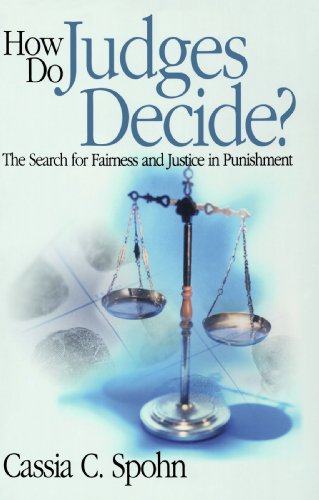

How do judges decide? the search for fairness and justice in punishment Cassia C. Spohn.
Detalles de publicación: Thousand Oaks, Calif. Sage Publications c2002.Descripción: xii, 340 p. 23 cmISBN:- 0761987606 (alk. paper)
- 345.73077 S762h 21
- KF9685 .S68 2002
| Imagen de cubierta | Tipo de ítem | Biblioteca actual | Biblioteca de origen | Colección | Ubicación en estantería | Signatura topográfica | Materiales especificados | Info Vol | URL | Copia número | Estado | Notas | Fecha de vencimiento | Código de barras | Reserva de ítems | Prioridad de la cola de reserva de ejemplar | Reservas para cursos | |
|---|---|---|---|---|---|---|---|---|---|---|---|---|---|---|---|---|---|---|
| Libro | Biblioteca Encarnación Valdés Colección General bev | 345.73077 S762h (Navegar estantería(Abre debajo)) | Disponible | 80000002249418 |
Descripciones mejoradas de Syndetics:
The appropriate amount of punishment for a given crime is an issue that has been debated by scholars, philosophers and legal professionals since the beginning of civilizations. This book seeks to address this issue in all of its complexity by providing a comprehensive overview of the sentencing process in the United States.
The book begins by discussing the overall concept of punishment and then proceeds to dissect individual aspects of punishment. Topics include: the sentencing process; responsibility of the judge; disparity and discrimination in sentencing; and sentencing reform.
This book is an ideal text for introductory courses on the judicial system, criminal law, law and society. It can be an essential resource to help students understand patterns in the wide discretion and latitude given to judges when determining punishments within the framework of the United States judicial system.
nbsp;
Includes bibliographical references (p. 311-329) and index.
The goals of sentencing -- Sentencing options and the sentencing process -- How do judges decide? -- Sentencing disparity and discrimination -- Sentencing disparity and discrimination -- 30 years of sentencing reform -- The impact of the sentencing reform movement.
Tabla de contenidos provista por Syndetics
- Acknowledgments
- Preface
- 1 The Goals of Sentencing
- Why Punish?
- How Much to Punish?
- Theories of Punishment and Judges' Sentencing Decisions
- Conclusion
- 2 Sentencing Options and the Sentencing Process
- The Judge's Options at Sentencing
- Sentencing as a Collaborative Exercise
- The Sentencing Process
- 3 How do Judges Decide
- Modeling the Sentencing Process
- How Do Judges Decide?
- 4 Sentencing Disparity and Discrimination
- Disparity and Discrimination
- Gender and Sentencing
- Focus on an Issue: Should Men and Women Be Treated the Same
- Disparity and Discrimination in Sentencing
- 5 Sentencing Disparity and Discrimination:
- Racial Disparity in Sentencing
- Race and Imprisonment: Evidence of Disproportionality
- Race and Judges' Sentencing Decisions
- Focus on an Issue: Race and Sentencing for Drug Offenses: Punishment and Prejudice?
- Race and the Death Penalty: A Failed Experiment?
- Justice From the Bench?
- 6 Thirty Years of Sentencing Reform
- The Sentencing Reform Movement
- Structured Sentencing Reforms
- Mandatory Minimum Sentencing Statutes
- Focus on an Issue: Sentencing Drug Offenders: Incarceration or Treatment--What Works?
- Three-Strikes-and-You're-Out Laws
- Truth-In-Sentencing Laws
- Three Decades of Reform
- 7 The Impact of the Sentencing Reform Movement
- Have Sentencing Reforms Led to More Punitive Sentences?
- Have Sentencing Reforms Led to a Reduction in Crime?
- Have Sentencing Reforms Reduced Disparity and Discrimination?
- Assessing the Impact of the Sentencing Reform Movement
- References
- Index
- About the Author