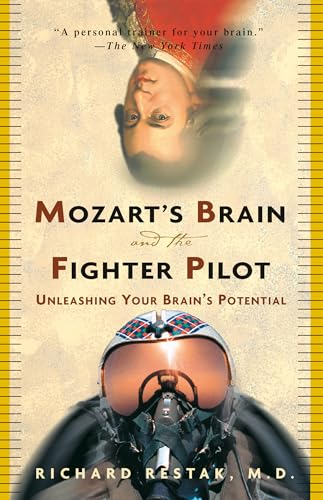

Mozart's brain and the fighter pilot unleashing your brain's potential Richard Restak.
Detalles de publicación: New York Three Rivers Press c2001.Edición: 1st paperback edDescripción: 220 p. ill. 20 cmISBN:- 0609810057
- 612.82 R4361m
- QP376 .R4728 2001
| Imagen de cubierta | Tipo de ítem | Biblioteca actual | Biblioteca de origen | Colección | Ubicación en estantería | Signatura topográfica | Materiales especificados | Info Vol | URL | Copia número | Estado | Notas | Fecha de vencimiento | Código de barras | Reserva de ítems | Prioridad de la cola de reserva de ejemplar | Reservas para cursos | |
|---|---|---|---|---|---|---|---|---|---|---|---|---|---|---|---|---|---|---|
| Libro | Biblioteca Encarnación Valdés Colección General bev | 612.82 R4361m (Navegar estantería(Abre debajo)) | Disponible | 80000002249574 |
Descripciones mejoradas de Syndetics:
In Mozart's Brain and the Fighter Pilot , eminent neuropsychiatrist and bestselling author Richard Restak, M.D., combines the latest research in neurology and psychology to show us how to get our brain up to speed for managing every aspect of our busy lives.
Everything we think and everything we choose to do alters our brain and fundamentally changes who we are, a process that continues until the end of our lives. Few people think of the brain as being susceptible to change in its actual structure, but in fact we can preselect the kind of brain we will have by continually exposing ourselves to rich and varied life experiences. Unlike other organs that eventually wear out with repeated and sustained use, the brain actually improves the more we challenge it.
Most of us incorporate some kind of physical exercise into our daily lives. We do this to improve our bodies and health and generally make us feel better. Why not do the same for the brain? The more we exercise it, the better it performs and the better we feel. Think of Restak as a personal trainer for your brain-he will help you assess your mental strengths and weaknesses, and his entertaining book will set you to thinking about the world and the people around you in a new light, providing you with improved and varied skills and capabilities. From interacting with colleagues to recognizing your own psychological makeup, from understanding the way you see something to why you're looking at it in the first place, from explaining the cause of panic attacks to warding off performance anxiety, this book will tell you the whys and hows of the brain's workings.
Packed with practical advice and fascinating examples drawn from history, literature, and science, Mozart's Brain and the Fighter Pilot provides twenty-eight informative and realistic steps that we can all take to improve our brainpower.
Includes bibliographical references (p. [219]-220).
Extracto provisto por Syndetics
Reseñas proporcionadas por Syndetics
Library Journal Review
Neuropsychiatrist Restak (neurology, George Washington Univ. Medical Ctr.) has written numerous books on the human brain, including the very engaging The Brain Has a Mind of Its Own. In his latest work, he offers 28 ways to improve mental fitness, including exercises to enhance memory, concentration, creativity, and analytical ability. The proposed exercises are designed to increase neuronal linkages that will, in turn, improve overall mental functioning. Some of Restak's suggestions require a hefty time expenditure, adequate financial resources (a laptop computer), strong joints and flexibility (tai chi exercises), and a private office equipped with a couch (napping during the work day!). But his point is well taken: practicing simple mind games, listening to music, reading widely, keeping a journal, etc., can greatly enhance the brain's performance. Restak's upbeat and enlightening guide will certainly be a popular addition to public libraries. Laurie Bartolini, Illinois State Lib., Springfield (c) Copyright 2010. Library Journals LLC, a wholly owned subsidiary of Media Source, Inc. No redistribution permitted.Publishers Weekly Review
"Most of us would like to be smarter," asserts Restak (The Brain, companion to PBS's series by the same name), neuropsychiatrist and clinical professor of neurology at George Washington University Medical Center. Restak claims that improving cognition is the answer. In accessible science-teacher style, Restak delineates the brain's attributes, from its weight (three pounds) to the number of nerve cells (100 billion) and its infinity of synapses, explaining what aids communication, informs memory and so forth. Knowing how the brain works is important to building its power, says Restak, and in this high-tech age, we need as much cognition as we can get. He proposes a comprehensive and handy plan to improve one's mind, literally as well as literarily. If one stops learning, one's overall mental capacity diminishes because the synaptic links shrink. Brain stimulation has been declared protection against Alzheimer's. The brain does not age; keeping it "fit" is no more difficult than keeping one's cholesterol under control. In outlining a plan including everything from exercise to learning to play a musical instrument, Restak explains how interconnections between the brain's functions keep it growing. Train your brain through logic problems, complicated games like chess, difficult jigsaw puzzles and widely varied reading. Not surprisingly, watching TV, a passive act, does exactly what your mother always said it did makes you stupid. The extraordinary range of references to literature, science, gamesmanship and even cryptograms makes it apparent that Restak practices what he preaches. This unusual, intriguing book will appeal to the health diligent and the senior contingent. (Nov.) (c) Copyright PWxyz, LLC. All rights reservedBooklist Review
Three quite different books offer insights into how the brain and mind function. What's a "synesthete" ? It's a person in whom more than one sense responds when a single sense is stimulated. Research suggests that one in 2,000 people experience synesthesia; for Duffy, letters (and the words they combine to produce) have color (hence, Blue Cats and Chartreuse Kittens). It took technology like PET scans to confirm the unusual brain patterns of synesthesia, but some artists of the past--Liszt, Rimbaud, and Nabokov, for example--seem to have experienced it. Duffy describes her own experience and that of several contemporary artists in examining this phenomenon as a special case of the "personal coding" scientists now recognize as a vital aspect of brain development. Brain development--and maintenance--is the subject of the latest work by Restak, who also authored The Brain (1984), the best-selling companion volume to the eponymous PBS series. Restak, a neuropsychiatrist and neurology professor, here combines explanation and exhortation. Brain function, he argues, is a "use it or lose it" proposition; Mozart's Brain aims to enlighten readers about how the brain works, so they'll be able to keep it working effectively throughout their lives. Each of the 28 chapters focuses on a specific aspect of the brain's operations, introducing the science and then suggesting how one might take advantage of this new understanding. Think of Mozart's Brain as an exercise video for one's mental faculties. Journalist Sherman has written about mental health issues for 10 years in a number of national magazines. His accessible overview of the options faced by individuals who are considering therapy should be quite helpful. Sherman opens with general issues ("Do You Need Therapy?" "Who Can Help?" "What Can You Expect?" ). He discusses research on therapy's effectiveness and outlines the theoretical basics of psychoanalysis and psychodynamic therapy. Perhaps most useful are Sherman's sketches of different types of therapy: cognitive and behavioral approaches, group therapy, family therapy, humanistic therapy, pharmacotherapy, and other possibilities. Closing chapters describe the course of therapy, ways to pay for treatment, and recognizing when therapy should end. A "Brief Guide to Diagnosis" is appended. --Mary CarrollNotas de autor provistas por Syndetics
He is a neuropsychiatrist and clinical professor of neurology at George Washington University Medical Center. Author of the bestselling The Brain, a companion to the PBS series of the same name, as well as The Mind and The Brain Has a Mind of Its Own, he lives in Washington, D.C.(Bowker Author Biography)