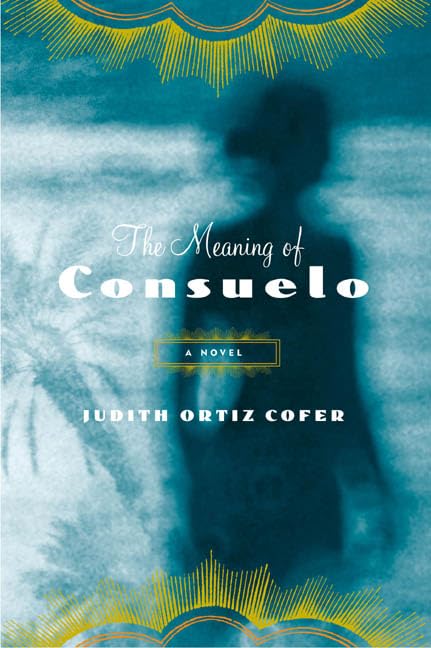

The meaning of Consuelo Judith Ortiz Cofer.
Detalles de publicación: New York Farrar, Straus, and Giroux 2003.Edición: 1st edDescripción: 185 p. 22 cmISBN:- 0374205094 (hc : alk. paper)
- 813.54 O775m 21
- PS3565.R7737 M43 2003
| Imagen de cubierta | Tipo de ítem | Biblioteca actual | Biblioteca de origen | Colección | Ubicación en estantería | Signatura topográfica | Materiales especificados | Info Vol | URL | Copia número | Estado | Notas | Fecha de vencimiento | Código de barras | Reserva de ítems | Prioridad de la cola de reserva de ejemplar | Reservas para cursos | |
|---|---|---|---|---|---|---|---|---|---|---|---|---|---|---|---|---|---|---|
| Libro | Biblioteca Encarnación Valdés Colección General bev | 813.54 O775m (Navegar estantería(Abre debajo)) | Disponible | 80000002203902 |
Descripciones mejoradas de Syndetics:
La nina seria , the serious child. That's how Consuelo's mother has cast her pensive, book-loving daughter, while Consuelo's younger sister Mili, is seen as vivacious--a ray of tropical sunshine. Two daughters: one dark, one light; one to offer comfort and consolation, the other to charm and delight. But something is not right in this Puerto Rican family.
Set in the 1950s, a time when American influence is diluting Puerto Rico's rich island culture, Consuelo watches her own family's downward spiral. It is Consuelo who notices as her beautiful sister Mili's vivaciousness turns into mysterious bouts of hysteria and her playful invented language shift into an incomprehensible and chilling "language of birds." Ultimately Consuelo must choose: Will she fulfill the expectations of her family--offering consolation as their tragedy unfolds? Or will she risk becoming la fulana , the outsider, like the harlequin figure of her neighbor, Mario/Maria Sereno, who flaunts his tight red pedal pushers and empty brassiere as he refuses the traditional macho role of his culture.
This affecting novel is a lively celebration of Puerto Rico as well as an archetypal story of loss, the loss each of us experiences on our journey from the island of childhood to the uncharted territory of adulthood.
Extracto provisto por Syndetics
Reseñas proporcionadas por Syndetics
Library Journal Review
A poet, essayist, and novelist (e.g., The Latin Deli), Ortiz Cofer here crafts a story at once grim and humorous. Consuelo lives with her family in 1950s San Juan, Puerto Rico, a time of expanding American influence. As her name suggests, bookish Consuelo is expected to offer consolation to others (younger sister Mili is always the center of attention). The older she gets, the more responsibility she must shoulder, first for her sister, tragically afflicted with schizophrenia, and then for her parents' shattered marriage. Her only solace is her best friend, gay cousin Patricio, who teaches her the value of imagination before escaping the confines of family for New York. Eventually, Consuelo follows, but the reader doesn't breathe a sigh of relief-there has been too much tragedy. Throughout, the beautiful language makes it clear that Ortiz Cofer is a poet; the descriptions of her native Puerto Rico are rich and layered. Unfortunately, the plot drags a bit, and Mili works less well as a character than Consuelo, whose growth is interesting to watch. The best parts are perhaps the lighter, more humorous details-e.g., the father's obsession with modern American inventions. Recommended for larger public libraries.-Mary Margaret Benson, Linfield Coll. Lib., McMinnville, OR (c) Copyright 2010. Library Journals LLC, a wholly owned subsidiary of Media Source, Inc. No redistribution permitted.Publishers Weekly Review
Puerto Rican novelist, essayist and poet Cofer (The Latin Deli, etc.) chronicles the childhood and young adulthood of Consuelo, a bookish girl growing up in a San Juan suburb in the 1950s. Cofer's novel is richly descriptive of the shifting mores of Puerto Rican culture and the historical particularities of the era (especially the growing American presence on the Caribbean island), but its deeper elements-Consuelo's growth into maturity; her sister's developing schizophrenia; and the demise of her parents' marriage-lack originality and are plagued by an overabundance of foreshadowing. Consuelo, her name signifying comfort and consolation, looks out for her younger sister, Mili, whose name derives from the word for miracle. The novel begins on a foreboding note: the local transvestite, Maria Sereno, interrupts a casual game of catch between the girls. They scamper into the house, scolded by their mother: "We do not associate in public with people like Maria Sereno." Life grows steadily gloomier for Consuelo: she botches her one high school romance; her beloved gay cousin, Patricio, moves to Nueva York; Mili starts acting strangely, singing to herself and speaking in tongues; and her father has an affair with a lounge singer at the hotel where he works. Cofer relies heavily on signposting, with lines like "It would be a while before we came to understand the true meaning of the word tragedia," which slow the narrative. Precise, near-sociological glimpses of island life in the 1950s-the introduction of mahones, or jeans; GI loans and new housing developments; the reassuring taste of sugar cane-add substance, but this is a plodding, overly deliberate effort. Agent, Liz Darhansoff. (Nov.) (c) Copyright PWxyz, LLC. All rights reservedBooklist Review
The eldest of two daughters in a 1950s Puerto Rican family, Consuelo is a perceptive, book-loving girl who knows that she's expected to emulate her name, which means comfort and consolation, and look after her prettier sister, Milagros (miracle). Given her parents' epic battle over her father's infidelity and enthusiasm for all things American and her mother's fury and love of traditional island life, it's no surprise that Consuelo is the first to realize that all is not well with Mili. As Consuelo tries to protect her increasingly unbalanced sister and navigate her entry into womanhood and the cult of self-sacrifice (Cofer's insights into the art of female suffering are as devastatingly accurate as they are scathingly funny), celebrated poet, essayist, and novelist Cofer combines the timeless clarity and moral imperative of folktales with the timely wit of keen social criticism in an absorbing portrait of a smart and compassionate young woman whose coming-of-age saga subtly parallels Puerto Rico's struggle to retain its cultural identity and natural bounty. But when Consuelo declares, I belong to myself and Words were the key to power and freedom, she speaks for all who learn that they must take control of their lives and write their own scripts. --Donna Seaman Copyright 2003 BooklistNotas de autor provistas por Syndetics
Judith Ortiz Cofer was born in Puerto Rico in 1952. She was a Franklin Professor of English and creative writing at the University of Georgia from 1984 until she retired in 2013. She was also a poet and author. Her collections of poetry include Terms of Survival, Reaching for the Mainland, and A Love Story Beginning in Spanish: Poems. Her novels include Call Me Maria, The Meaning of Consuelo, and The Line of the Sun. She won an O. Henry Prize for the story A Latin Deli, which appeared in The Latin Deli: Prose and Poetry. Her other books include Silent Dancing: A Partial Remembrance of a Puerto Rican Childhood, An Island Like You: Stories of the Barrio, If I Could Fly, and Woman in Front of the Sun: On Becoming a Writer. She died from cancer on December 30, 2016 at the age of 64.(Bowker Author Biography)