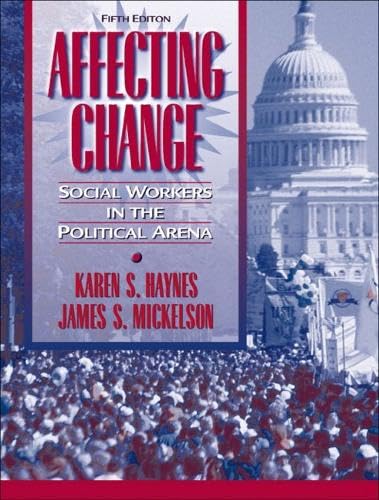

Affecting change social workers in the political arena Karen S. Haynes, James S. Mickelson ; foreword by Barbara A. Mikulski.
Detalles de publicación: Boston Allyn and Bacon c2003.Edición: 5th edDescripción: xvii, 238 p. 24 cmISBN:- 0205360106
| Imagen de cubierta | Tipo de ítem | Biblioteca actual | Biblioteca de origen | Colección | Ubicación en estantería | Signatura topográfica | Materiales especificados | Info Vol | URL | Copia número | Estado | Notas | Fecha de vencimiento | Código de barras | Reserva de ítems | Prioridad de la cola de reserva de ejemplar | Reservas para cursos | |
|---|---|---|---|---|---|---|---|---|---|---|---|---|---|---|---|---|---|---|
| Libro | Biblioteca Encarnación Valdés Colección General bev | 361.32 H4241a5 (Navegar estantería(Abre debajo)) | Disponible | 80000002209230 |
Descripciones mejoradas de Syndetics:
An action-oriented text, the Fifth Edition of Affecting Change continues to provide new ideas and strategies to help students become better advocates for their future clients. Updated to reflect advances in technology and changes in social welfare policy, this revision shows students how to develop political action skills. This practical, step-by-step guide focuses on advocacy as the central mission of social work practice. New material and personal scenarios involving social workers who have made a difference-senators, representatives, and officials in the political arena-serve to inspire students. Revised and expanded chapters show how social work skills can be most effective, whether by impacting the political arena as a social worker or running for office.
Includes bibliographical references and index.
Tabla de contenidos provista por Syndetics
- Foreword(p. xi)
- Preface(p. xiii)
- About the Authors(p. xix)
- 1 The Emergence of a Social Work Polity(p. 1)
- The Reform Period(p. 7)
- The New Deal and Beyond(p. 8)
- The War on Poverty(p. 9)
- Social Action Models(p. 10)
- Federalism(p. 12)
- The New Federalism(p. 14)
- The 1990s(p. 16)
- Conclusion(p. 17)
- Assignments(p. 20)
- Suggested Readings(p. 20)
- References(p. 21)
- 2 The Debate(p. 23)
- Some Perspectives(p. 25)
- When Karen Met Harry: Unfaithful Angels Disputed(p. 26)
- Conclusion(p. 38)
- Assignments(p. 39)
- Suggested Readings(p. 39)
- References(p. 39)
- 3 Social Work Values versus Politics(p. 40)
- The Professional Code of Ethics(p. 42)
- Primary Principles: Social Justice and Empowerment(p. 44)
- Specialization versus Systemic Solutions(p. 45)
- Self-Determination versus Compromise(p. 47)
- Emotional Neutrality versus Client Self-Interest(p. 50)
- Impartiality versus Partisan Politics(p. 51)
- Conclusion(p. 52)
- Assignments(p. 54)
- Suggested Readings(p. 54)
- References(p. 54)
- 4 Policy Models for Political Advocacy(p. 55)
- Models Defined(p. 59)
- Institutional Model(p. 60)
- Process Model(p. 60)
- Group Theory Model(p. 61)
- Elite Theory Model(p. 63)
- Rational Model(p. 64)
- Incremental Model(p. 64)
- A Proactive Approach to Policy Development(p. 65)
- Policy Analysis(p. 67)
- Policy Evaluation(p. 68)
- Effort(p. 68)
- Quality(p. 69)
- Effectiveness(p. 69)
- Efficiency(p. 70)
- Conclusion(p. 70)
- Assignments(p. 72)
- Suggested Readings(p. 72)
- References(p. 72)
- 5 The Practitioner's Influence on Policy(p. 74)
- Information Dissemination(p. 75)
- Documentation(p. 75)
- Testimony(p. 76)
- Expert Witness(p. 77)
- Written Communication(p. 78)
- Client Empowerment(p. 78)
- Enabler/Advocate Role(p. 78)
- Evaluator/Consultant Role(p. 79)
- Voter Registration(p. 79)
- Hatch Act(p. 80)
- The Executive's Role in Influencing Policy(p. 81)
- Influencing Policy: An Illustration(p. 83)
- Conclusion(p. 86)
- Assignments(p. 86)
- Suggested Readings(p. 86)
- References(p. 86)
- 6 Influence through Lobbying(p. 88)
- Social Work Skills in the Political Process(p. 90)
- The Political Process(p. 92)
- The Politician(p. 94)
- The Informal Political Process(p. 95)
- Lobbying Groundwork(p. 95)
- Goal Setting(p. 95)
- Strategy Setting(p. 96)
- Lobbying Methods(p. 97)
- Letter Writing(p. 98)
- Email(p. 100)
- Telephoning(p. 101)
- Face-to-Face Lobbying(p. 101)
- Testifying(p. 103)
- Lobbying and Nonprofits(p. 105)
- Conclusion(p. 106)
- Assignments(p. 107)
- Suggested Readings(p. 107)
- References(p. 107)
- 7 Tools to Influence and Organize Others(p. 109)
- Ten Phases of a Social Movement(p. 110)
- Strategy(p. 111)
- Influencing Others(p. 112)
- Coalition Building(p. 112)
- Technology Used to Organize Others(p. 113)
- Cable Television(p. 114)
- The Internet(p. 116)
- Email(p. 117)
- Gimmicks(p. 118)
- Using the Media(p. 119)
- Newspapers(p. 119)
- Radio(p. 120)
- Television(p. 122)
- Examples of Organizing Others(p. 123)
- Conclusion(p. 127)
- Assignments(p. 128)
- Suggested Readings(p. 128)
- References(p. 128)
- 8 Monitoring the Bureaucracy(p. 129)
- Promulgating the Rules(p. 130)
- Rule Implementation and Agency Compliance(p. 132)
- Budget Allocations(p. 134)
- Administrative Changes or Executive Orders(p. 136)
- Social Work Skills(p. 136)
- Conclusion(p. 140)
- Assignments(p. 140)
- Suggested Readings(p. 140)
- References(p. 141)
- 9 Political Action Committees(p. 142)
- Why Is a PAC Organized?(p. 143)
- Process of Selection(p. 145)
- Candidate Endorsements(p. 148)
- Targeting(p. 149)
- Fall Out(p. 150)
- Idealism versus Winning(p. 152)
- Conclusion(p. 153)
- Assignments(p. 153)
- Suggested Readings(p. 154)
- References(p. 154)
- 10 The Campaign(p. 155)
- Components of the Campaign(p. 156)
- Time(p. 157)
- Money(p. 158)
- People(p. 158)
- Campaign Management(p. 159)
- The Campaign Manager: Who Really Runs the Campaign?(p. 160)
- Voter Contact(p. 161)
- Targeting(p. 162)
- Issues(p. 163)
- Social Workers and Campaigns(p. 164)
- What to Expect When Volunteering(p. 165)
- How to Volunteer for a Campaign(p. 168)
- Conclusion(p. 168)
- Assignments(p. 169)
- Suggested Readings(p. 169)
- References(p. 169)
- 11 Social Workers as Politicians(p. 171)
- Respondents Characteristics(p. 173)
- Deciding to Run(p. 173)
- Building a Constituent Base(p. 175)
- Campaigning(p. 176)
- Realities of Office(p. 178)
- Recommendations(p. 182)
- Conclusion(p. 183)
- Assignments(p. 187)
- Suggested Readings(p. 187)
- References(p. 188)
- 12 All Social Work Is Political(p. 189)
- Where to Start(p. 190)
- Just Do It(p. 191)
- People Influence People(p. 191)
- You Can Make a Difference(p. 192)
- Advocacy Is Not for Wimps(p. 193)
- Speak Out(p. 196)
- Just Say No(p. 196)
- Conclusion(p. 197)
- Assignments(p. 198)
- Suggested Reading(p. 198)
- References(p. 198)
- Glossary of Legislative Terms(p. 199)
- Web Sites(p. 208)
- Index(p. 215)