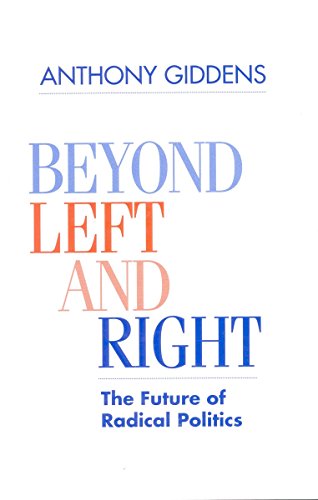

Beyond left and right the future of radical politics Anthony Giddens.
Detalles de publicación: Stanford, Calif. Stanford University Press 1994.Descripción: vii, 276 p. 24 cmISBN:- 0804724504
- 0804724512 (pbk.)
- 320.53 G4532b E 20
- JC573 .G53 1994
| Imagen de cubierta | Tipo de ítem | Biblioteca actual | Biblioteca de origen | Colección | Ubicación en estantería | Signatura topográfica | Materiales especificados | Info Vol | URL | Copia número | Estado | Notas | Fecha de vencimiento | Código de barras | Reserva de ítems | Prioridad de la cola de reserva de ejemplar | Reservas para cursos | |
|---|---|---|---|---|---|---|---|---|---|---|---|---|---|---|---|---|---|---|
| Libro | Biblioteca Encarnación Valdés Colección General bev | 320.53 G4532b E (Navegar estantería(Abre debajo)) | Disponible | 80000002165663 |
Descripciones mejoradas de Syndetics:
In the wake of the cataclysmic changes that have transformed the Soviet Union and Eastern European countries since 1989, what can it mean to be politically radical today? In this conceptually powerful work, the author applies his well-known and influential body of ideas about modernity to the present state and future of radical politics.
Includes bibliographical references (p. [254]-262) and index.
Conservatism : radicalism embraced -- Socialism : the retreat from radicalism -- The social revolutions of our time -- Two theories of democratization -- Contradictions of the welfare state -- Generative politics and positive welfare -- Positive welfare, poverty and life values -- Modernity under a negative sign : ecological issues and life politics -- Political theory and the problem of violence -- Questions of agency and values.
Reseñas proporcionadas por Syndetics
CHOICE Review
The author, a noted sociologist at Cambridge University, begins by critiquing the relevance of socialism, neoliberalism (free market liberalism), and conservatism for a world characterized by globalization, the abandonment of tradition, and pervasive uncertainty stemming from socially manufactured risk. He concludes that socialism has been eclipsed and that neoliberalism and conservatism are seriously limited as explanations for today's socioeconomic conditions. He offers instead an ideology of regenerative politics based on the local life politics of individuals. If the fundamentalist threat is to be overcome, democracy must become dialogic, that is, it should facilitate dialogue based on a mutual trust that will replace the reflexive relativism of a traditionless and uncertain society. Essentially, this is an extended argument for a new, more expansive conception of the political. Although it is rather loosely organized, the book contains useful insights into the difficulties of the welfare state and interesting suggestions as to how to reframe problems posed by poverty, the environment, violence, and economic change. General; graduate; faculty.Notas de autor provistas por Syndetics
Anthony Giddens, a British sociologist, was educated at Hull, the London School of Economics, and Cambridge, and is a fellow of King's College, Cambridge. His interests have been varied, but they tend to focus on questions related to the macro-order. Much of his theoretical writing deals with stratification, class, and modernity. Although he has concentrated on dynamic issues of social structure, he has also examined how social psychological concerns are part of this broader order of human relations.(Bowker Author Biography)