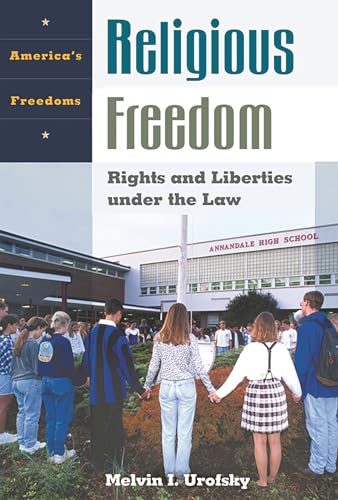

Religious Freedom rights and liberties under the law Melvin I. Urofsky.
Series America's freedomsDetalles de publicación: Santa Barbara, California ABC-CLIO 2002.Descripción: xxiii, 411 p. 24 cmISBN:- 1576073122
- KF4783 .U76 2002
| Imagen de cubierta | Tipo de ítem | Biblioteca actual | Biblioteca de origen | Colección | Ubicación en estantería | Signatura topográfica | Materiales especificados | Info Vol | URL | Copia número | Estado | Notas | Fecha de vencimiento | Código de barras | Reserva de ítems | Prioridad de la cola de reserva de ejemplar | Reservas para cursos | |
|---|---|---|---|---|---|---|---|---|---|---|---|---|---|---|---|---|---|---|
| Libro | Biblioteca de Mayagüez Colección General mb | KF4783 .U76 2002 (Navegar estantería(Abre debajo)) | Disponible | 50000002121191 |
Descripciones mejoradas de Syndetics:
This volume provides in a single source a thorough grounding in the origin, development, and current controversies surrounding the free practice of religion.
The first boatloads of European settlers did not come to America advocating religious tolerance. They came seeking the freedom to practice their own religion. Other sects, they believed, were wrong at best and, at worst, not to be tolerated.
The question of what constitutes "legitimate," constitutionally protected religious practice has been debated ever since. Does it include the use of peyote? Polygamy? Refusing medical care for a sick child? Freedom of Religion follows the evolving understanding of the concept of religious freedom from Great Britain to the New World, through hundreds of U.S. courtrooms, to the volatile modern-day issues of school prayer and faith-based initiatives. The thorough, responsible, and cool-headed analysis presented here offers readers a solid grounding in the constitutional issues behind the headlines.
Includes bibliographical references ( p. 377-390) and index.
Tabla de contenidos provista por Syndetics
- Series Foreword(p. xi)
- Preface and Acknowledgments(p. xxi)
- 1 Introduction(p. 1)
- Conclusion(p. 16)
- References(p. 16)
- 2 Origins and Development(p. 19)
- Origins(p. 20)
- History(p. 24)
- Founding Principles(p. 28)
- The Constitution(p. 31)
- Development(p. 34)
- References(p. 50)
- 3 The Establishment Clause(p. 53)
- Historical Origins(p. 54)
- School Prayers(p. 65)
- Evolution and Creationism(p. 74)
- Aid to Parochial Schools(p. 78)
- The Lemon Test(p. 83)
- The Burger Court and School Aid(p. 86)
- A Resurgence of Fundamentalism(p. 91)
- Another Effort to Reinstate School Prayer(p. 97)
- The Rehnquist Court and Accommodation(p. 101)
- Conclusion(p. 110)
- References(p. 111)
- 4 The Free Exercise Clause(p. 113)
- The Mormons and Polygamy(p. 118)
- Jehovah's Witnesses and the Flag Salute(p. 127)
- Finding an Accommodation for Religion(p. 140)
- Conscientious Objectors(p. 145)
- Protecting the Amish(p. 148)
- Native Americans in the Court(p. 151)
- The Religious Freedom Restoration Act(p. 153)
- Conclusion(p. 158)
- Notes(p. 159)
- References(p. 159)
- 5 Key People, Cases, and Events(p. 163)
- 6 Documents(p. 197)
- Virginia Rules on Conduct and Religion (1619)(p. 197)
- Roger Williams, The Bloudy Tenent of Persecution (1644)(p. 200)
- Excerpts from Revolutionary-Era State Constitutions (1776-1784)(p. 203)
- James Madison, "Memorial and Remonstrance" (1785)(p. 212)
- Virginia Statute for Religious Freedom (1786)(p. 220)
- Northwest Ordinance (1787)(p. 223)
- Argument of Counsel in Defense of Seal of Confession (1813)(p. 224)
- Thomas Kennedy Seeking Equal Rights for Jews in Maryland (1818)(p. 227)
- Joseph Story, "The Religion Clauses of the First Amendment" (1833)(p. 229)
- John Tyler on the Know-Nothings (1854)(p. 233)
- Reynolds v. United States (1879)(p. 234)
- Alfred E. Smith on Catholicism and Patriotism (1927)(p. 241)
- Minersville School District v. Gobitis (1940)(p. 245)
- West Virginia Board of Education v. Barnette (1943)(p. 253)
- Everson v. Board of Education (1947)(p. 263)
- Zorach v. Clauson (1952)(p. 266)
- John F. Kennedy on Church and State (1960)(p. 271)
- Engel v. Vitale (1962)(p. 276)
- Sherbert v. Verner (1963)(p. 282)
- Epperson v. Arkansas (1968)(p. 291)
- Lemon v. Kurtzman (1971)(p. 295)
- Wisconsin v. Yoder (1972)(p. 301)
- Wallace v. Jaffree (1985)(p. 312)
- Edwards v. Aguillard (1987)(p. 316)
- Employment Division, Oregon Department of Human Resources v. Smith (1990)(p. 324)
- Lee v. Weisman (1992)(p. 330)
- Religious Freedom Restoration Act (1993)(p. 340)
- Rosenberger v. Rector and Visitors of the University of Virginia (1995)(p. 343)
- City of Boerne v. Flores (1997)(p. 354)
- Agostini v. Felton (1997)(p. 359)
- Chronology(p. 371)
- Table of Cases(p. 373)
- Annotated Bibliography(p. 377)
- Index(p. 391)
- About the Author(p. 411)