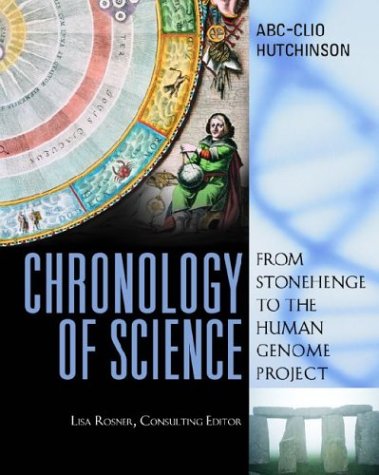

Chronology of science from stonehenge to the human genome project Lisa Rosner.
Detalles de publicación: Santa Barbara, California ABC-CLIO 2002.Descripción: x, 566 p. ill. 26 cmISBN:- 1576079546
- Q125 .C482 2002
| Imagen de cubierta | Tipo de ítem | Biblioteca actual | Biblioteca de origen | Colección | Ubicación en estantería | Signatura topográfica | Materiales especificados | Info Vol | URL | Copia número | Estado | Notas | Fecha de vencimiento | Código de barras | Reserva de ítems | Prioridad de la cola de reserva de ejemplar | Reservas para cursos | |
|---|---|---|---|---|---|---|---|---|---|---|---|---|---|---|---|---|---|---|
| Libro | Biblioteca de Mayagüez Colección General mb | Q125 .C482 2002 (Navegar estantería(Abre debajo)) | Disponible | 50000002121050 |
Descripciones mejoradas de Syndetics:
From the Stone Age to the Information Age, this one-volume reference work puts the basic road map of scientific progress at the reader's fingertips.
The cavemen did it. The ancient Mayans did it. The folks at Cal Tech, the Sorbonne, and Beijing University are still doing it. Science. Want the whole story? Here it is. The Chronology of Science offers the entire fascinating drama of exploration, discovery, invention, experimentation, hypothesis, and proof. How did the ancient Celts use Stonehenge to map the skies? When did the Arabs come up with the concept of zero? Who first observed the destructive power of germs? Where did the Internet come from?
This handy, one-volume reference offers the reader multiple ways to access the thousands of years of science history: chronologies divided into subject areas, including astronomy, biology, chemistry, ecology, mathematics, and physics; 16 feature essays on critical scientific discoveries; hundreds of biographies of key scientists from every age and continent; an extensive glossary of scientific terms; lists of the winners of major scientific prizes; a list of the most up-to-date science websites; and a lengthy bibliography.
* Chronologies divided into subject areas including astronomy, biology, chemistry, ecology, mathematics, and physics
* 16 feature essays on critical scientific achievements such as the origins of mathematics, the discovery of X-rays, and the discovery of the structure of DNA
* Hundreds of illustrations, diagrams such as molecular structures and polymerization, and photographs of key scientists such as John Muir, Rachel Carson, and James Lovelock
* Over 800 brief bibliographies of key scientists from every age and continent
Includes bibliographical references (p. 397-402) and index.
Tabla de contenidos provista por Syndetics
- Contributors(p. vii)
- Acknowledgements(p. vii)
- Preface(p. viii)
- Introduction(p. ix)
- Chronologies(p. 1)
- Earliest Discoveries (30,000 BC-AD 499)(p. 1)
- The Medieval World (500-1449)(p. 28)
- The Scientific Revolution (1450-1749)(p. 43)
- The Industrializing World (1750-1899)(p. 95)
- The 20th Century (1900-2000)(p. 197)
- Feature Essays
- The Origins of Mathematics(p. 10)
- Some Thoughts About Nought(p. 32)
- Investigating the Solar System(p. 58)
- The Discovery of Boyle's Law(p. 79)
- Experiments to Determine the Nature of Light(p. 85)
- Pioneering Experiments on the Digestive System(p. 124)
- Discovering the Interior of the Earth(p. 130)
- The Discovery of X-rays(p. 195)
- The History of Plastics(p. 206)
- A Brief Chronology of Quantum Physics(p. 218)
- The Discovery of the Structure of DNA(p. 270)
- The Discovery of Pulsars(p. 284)
- Shades of Green: Ethics and Value in Ecology(p. 294)
- The Discovery of Carbon Fullerenes(p. 318)
- The Quest for the Red Planet(p. 330)
- The Human Genome Project(p. 334)
- Biographies(p. 353)
- Further Reading(p. 397)
- Weblinks(p. 403)
- Appendices
- Nobel Prize for Chemistry(p. 415)
- Nobel Prize for Physics(p. 420)
- Nobel Prize for Physiology or Medicine(p. 425)
- Fields Medal for Mathematics(p. 430)
- Discovery of the Elements(p. 431)
- Glossary(p. 435)
- Index(p. 529)