Reseñas proporcionadas por Syndetics
Library Journal Review
Focusing on foods that have the richest body of myths, Andrews (Legends of the Earth, Sea, and Sky: An Encyclopedia of Nature Myths) explores the mythical and magical properties different world cultures assigned to various plants, game animals, beverages, spices, and foods. Arranged alphabetically, most entries vary from one to three pages in length and provide the reader with a quick overview of the fabled roles that particular food played in assorted parts of the world. A number of different cultures are represented, including Native American, European, African, and Asian as well as ancient civilizations such as Greece and Rome. Two appendixes provide lists of food myths by culture and function such as aphrodisiacs. The nearly exclusive focus on food folklore and legend sets this book apart from standard culinary references like The Oxford Companion to Food (LJ 10/15/99) and Larousse Gastronomique (Crown, 1988. reprint) and folklore references like Funk and Wagnalls Standard Dictionary of Folklore, Mythology, and Legend (1972; HarperCollins, 1984. pap.), which covers fewer food items than Andrews does. Recommended for academic and large public library reference collections.DJohn Charles, Scottsdale P.L., AZ (c) Copyright 2010. Library Journals LLC, a wholly owned subsidiary of Media Source, Inc. No redistribution permitted.
CHOICE Review
"Nectar" and "ambrosia" are apt terms to describe this encyclopedia of foods, consumed by mortals and immortals, that have played an important role in ancient mythology. The book consists of an alphabetical listing of foods in all major food groups as well as some beverages and edible herbs and spices. Some historical lore is included to explain the rationale for a particular belief or ritual. At the end of each entry, references cite additional sources of information, and these are collected in the bibliography at the end. Foods richest in mythological association are emphasized, but attention is given to food myths in all major world areas. The volume includes a detailed subject index and two appendixes that help tie together the major concepts; one lists food myths by specific world cultures and the other lists food functions and refers readers to relevant entries. This encyclopedia brings together and explains the magical properties and uses of food in the world's myths and legends. Recommended for all collections. M. A. Kascus; Newbury College
Booklist Review
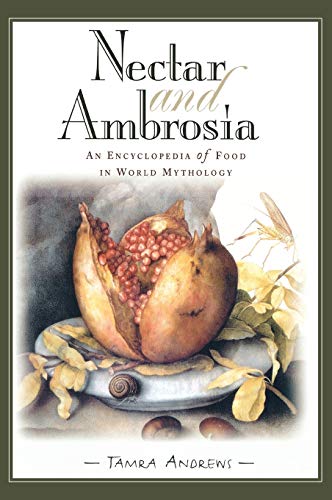
Andrews' overview of food in mythology greets the reader with a lush cover drawing of a pomegranate, the seeded globe that was Persephone's undoing. The writing reaches out to the reader from the first line of the preface, which establishes a sustaining tether between human identity and diet. Parameters encompass foods eaten by mortals and immortals. Frequently consulted sources include Sir James G. Frazer's The Golden Bough and the works of cultural geographer Frederick J. Simoons, author of texts on food lore in India and China. Andrews' alphabetized entries begin with Acorns and their importance in the stories of both Romans and Native Americans and cover bananas, bread, cactus, dog, honey, maple syrup, milk, reindeer and caribou, and salmon, as well as less-familiar New World foodstuffs such as amaranth, chica, pulque, and quinoa. Under Water she extols the restorative and purifying powers of natural reservoirs, sacred springs, and streams and their link to deity. Her sensitivity to Native Americans broadens the book's scope with information on the magical properties of the Haida whale hunt and the puzzling nature of cannibalism among pre-Columbian Aztecs. Cross-referencing is generous. Black-and-white illustrations range from a pre-Raphaelite portrait of Persephone to a drawing of a Japanese harvest god, a photo of English brides decked in orange blossoms, a Siberian map of the universe, and a stone carving of the bodhi tree, revered by Buddhists and Hindus. Back matter begins with a list of food myths by culture and concludes with a list of Christian lore, but no other world religions are represented here, even though they figure heavily in the text. The second appendix, which details food functions (for example, "Elixirs of Life and Immortality," "Poisons"), is a brief but valuable source for teachers, researchers, and writers. The bibliography cites books and articles by experts on food and mythology, including Apicius, Sabine Baring-Gould, Robert Graves, Pliny the Elder, and Reay Tannahill, but omits, among others, Athenaeus, Thomas Bulfinch, Columella, and Edith Hamilton, as well as any mention of Internet sites. Andrews produces flowing, absorbing prose, as found in her story of how Kaldi the Ethiopian goatherd discovered the coffee berry. Her research taps the less-familiar corners of world lore but excludes the importance of Mano the shark to Polynesian and Hawaiian mythos. A surprising flaw in the bibliographic references is the absence of citations from poetry, scripture, and folklore. Too many of the entries lack meat, as is the case with the commentary on artichokes and generalized statements about nightshades. Andrews' work suits the general reader and students and would be a good addition to public and high-school libraries. For the specialist and researcher, libraries should stick to Tannahill's Food in History (1973), Don and Patricia Brothwell's Food in Antiquity (1969), Molly Harrison's The Kitchen in History (1972), and Food: A Culinary History from Antiquity to the Present (1999), edited by Jean-Louis Flandris, Massimo Montanari, and Albert Sonnenfeld.