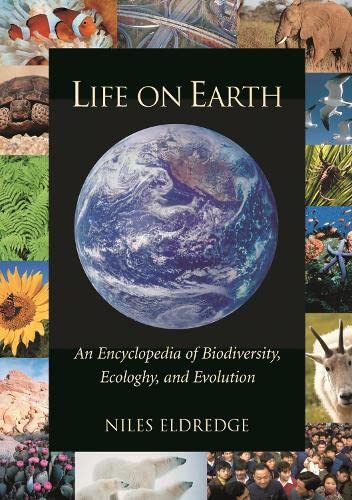

Life on earth : an encyclopedia of biodiversity, ecology, and evolution / Niles Eldredge.
Detalles de publicación: Santa Barbara, California ; ABC-CLIO c2002.Descripción: 2 v. ill. 26 cmTipo de contenido:- 157607286X
| Imagen de cubierta | Tipo de ítem | Biblioteca actual | Biblioteca de origen | Colección | Ubicación en estantería | Signatura topográfica | Materiales especificados | Info Vol | URL | Copia número | Estado | Notas | Fecha de vencimiento | Código de barras | Reserva de ítems | Prioridad de la cola de reserva de ejemplar | Reservas para cursos | |
|---|---|---|---|---|---|---|---|---|---|---|---|---|---|---|---|---|---|---|
| Libro mb | Biblioteca de Mayagüez Sala de Referencia mb | QH541.15 .B56 L54 2002 (Navegar estantería(Abre debajo)) | v.1 | Disponible | 50000002177052 | |||||||||||||
| Libro mb | Biblioteca de Mayagüez Sala de Referencia mb | QH541.15 .B56 L54 2002 (Navegar estantería(Abre debajo)) | v.2 | Disponible | 50000002177060 |
Descripciones mejoradas de Syndetics:
An examination of nature's extraordinary biological diversity and the human activities that threaten it.
Life on Earth: An Encyclopedia of Biodiversity, Ecology, and Evolution tackles the critical issue for humanity in the 21st century--our ever more menacing impact on the environment. This two-volume, illustrated set, edited by American Museum of Natural History curator Niles Eldredge, begins with biodiversity, the complex planetary web of life that has emerged through three billion years of evolution. How does it work? And why is its continued health critical to the planet and to ourselves?
More than 50 top scholars examine every form of life from amoebae to elephants, from plankton to whales. But Life on Earth is more than a catalog of species. An A-Z survey explores the myriad ways humanity is diminishing that biodiversity, from industrialization to natural habitat destruction, from overpopulation in the developing world to an unsustainable consumer lifestyle in the West. Life on Earth is the essential reference work for anyone curious about our planet's extraordinary diversity of life and the unprecedented threats it faces.
Includes bibliographical references and index.
v. 1. A-G -- v. 2. H-Z.
Tabla de contenidos provista por Syndetics
- Volume 1
- Contributors(p. ix)
- Introduction(p. xiii)
- What Is Biodiversity?(p. 1)
- Why Is Biodiversity Important?(p. 31)
- Threats to Biodiversity(p. 49)
- Stemming the Tide of the Sixth Global Extinction Event: What We Can Do(p. 73)
- Abyssal Floor(p. 87)
- Adaptation(p. 87)
- Adaptive Radiation(p. 91)
- Agricultural Ecology(p. 93)
- Agriculture and Biodiversity Loss: Genetic Engineering and the Second Agricultural Revolution(p. 96)
- Agriculture and Biodiversity Loss: Industrial Agriculture(p. 99)
- Agriculture: Benefits of Biodiversity to(p. 105)
- Agriculture, Origin of(p. 107)
- Alien Species(p. 114)
- Amphibians(p. 118)
- Angiosperms(p. 126)
- Annelida--The Segmented Worms(p. 132)
- Anthropology(p. 135)
- Archaebacteria(p. 140)
- Archaeology and Sustainable Development(p. 142)
- Arthropods, Marine(p. 144)
- Arthropods, Terrestrial(p. 149)
- Artiodactyls(p. 157)
- Atmosphere(p. 160)
- Atmospheric Cycles(p. 162)
- Atolls(p. 163)
- Avian Malaria and the Extinction of Hawaiian Birds(p. 164)
- Bacteria(p. 167)
- Barrier Islands(p. 171)
- Beaches(p. 173)
- Beauty of Nature, Biophilia and Ethics(p. 174)
- Benthos(p. 178)
- Biogeography(p. 178)
- Birds(p. 181)
- Birds of Guam and the Brown Tree Snake(p. 188)
- Black Rhinoceros(p. 190)
- Bluebuck(p. 191)
- Bony Fishes(p. 192)
- Botany(p. 197)
- Brachiopods(p. 200)
- Bryophytes(p. 202)
- Bryozoa(p. 205)
- Carbon Cycle(p. 207)
- Carnivora(p. 208)
- Carolina Parakeet(p. 212)
- Cetacea (Whales, Dolphins, Porpoises)(p. 216)
- Chiroptera (Bats)(p. 219)
- Chondrichthyes (Sharks, Rays, Chimaeras)(p. 220)
- Chordates (Nonvertebrate)(p. 224)
- Classification, Biological(p. 226)
- Climatology(p. 229)
- Cnidarians (Sea Anemones, Corals, and Jellyfish)(p. 232)
- Coastal Wetlands(p. 234)
- Coevolution(p. 235)
- Coloniality(p. 237)
- Communities(p. 238)
- Conservation Biology(p. 243)
- Conservation, Definition and History(p. 246)
- Continental Shelf(p. 249)
- Continental Slope and Rise(p. 250)
- Convergence and Parallelism(p. 251)
- Coral Reefs(p. 252)
- Cretaceous-Tertiary Extinction(p. 259)
- Cultural Survival, Revival, and Preservation(p. 263)
- Dams(p. 267)
- Darwin, Charles(p. 269)
- Deep-Sea Hydrothermal Vent Faunas(p. 273)
- Deposition(p. 274)
- Deserts and Semiarid Scrublands(p. 276)
- Draining of Wetlands(p. 278)
- Earthquakes(p. 281)
- Echinoderms(p. 282)
- Ecological Niches(p. 287)
- Ecological Status of Modern Humans(p. 291)
- Ecology(p. 292)
- Economics(p. 299)
- Ecosystems(p. 300)
- Embryology(p. 308)
- Endangered Species(p. 312)
- Erosion(p. 315)
- Estuaries(p. 318)
- Ethics of Conservation(p. 320)
- Ethnology(p. 324)
- Ethnoscience(p. 329)
- Evolution(p. 335)
- Evolutionary Biodiversity(p. 342)
- Evolutionary Genetics(p. 347)
- Extinction, Direct Causes of(p. 352)
- Five Kingdoms of Nature(p. 357)
- Flabellidium Spinosum(p. 361)
- Food Webs and Food Pyramids(p. 362)
- Freshwater(p. 365)
- Fungi(p. 367)
- Galapagos Islands and Darwin's Finches(p. 373)
- Geological Time Scale(p. 378)
- Geology, Geomorphology, and Geography(p. 382)
- Giant, Flightless Island Birds(p. 385)
- Giant Ground Sloth(p. 388)
- Glaciation(p. 390)
- Global Climate Change(p. 393)
- Great Apes(p. 397)
- Gymnosperms(p. 399)
- Volume 2
- Habitat Tracking(p. 405)
- Haplochromine Cichlids of Lake Victoria(p. 407)
- Herbivory(p. 411)
- Hole in the Ozone Layer(p. 412)
- Holocene(p. 413)
- Homo Sapiens(p. 416)
- Human Evolution(p. 418)
- Humans and Biodiversity: Examples from the Hoofed Mammals(p. 424)
- Hutton, James(p. 430)
- Hydrologic Cycle(p. 432)
- Ice Caps and Glaciers(p. 433)
- Indigenous Conservation(p. 436)
- Industrial Revolution/Industrialization(p. 439)
- Interior Wetlands(p. 443)
- International Trade and Biodiversity(p. 448)
- Intertidal Zone(p. 449)
- Lagomorpha(p. 451)
- Lagoons(p. 453)
- Lakes(p. 454)
- Land Use(p. 456)
- Late Devonian Extinction(p. 459)
- Late Ordovician Extinction(p. 462)
- Late Triassic Extinction(p. 465)
- Lemurs and Other Lower Primates(p. 467)
- Lichens(p. 469)
- Linguistic Diversity(p. 471)
- Linnaean Hierarchy(p. 475)
- Lyell, Charles(p. 479)
- Mammalia(p. 483)
- Mass Extinction(p. 486)
- Medicine, The Benefits of Biodiversity to(p. 488)
- Meteorology(p. 493)
- Microbiology(p. 496)
- Mining(p. 498)
- Molecular Biology and Biodiversity(p. 500)
- Mollusca(p. 502)
- Monkeys(p. 507)
- Mountains(p. 511)
- Museums and Biodiversity(p. 514)
- Natural Selection(p. 519)
- Nitrogen Cycle(p. 522)
- Nurseries(p. 523)
- Nutrient/Energy Cycling(p. 524)
- Oceanic Trenches(p. 527)
- Oceans(p. 528)
- Order Uranotheria(p. 531)
- Organizations in Biodiversity, The Role of(p. 535)
- Oxygen, History of Presence in the Atmosphere(p. 543)
- Paleontology(p. 545)
- Palestinian Painted Frog(p. 549)
- Perissodactyls(p. 551)
- Permo-Triassic Extinction(p. 553)
- Phylogeny(p. 556)
- Physical Anthropology(p. 558)
- Plankton(p. 561)
- Plate Tectonics(p. 569)
- Pleistocene Epoch(p. 571)
- Pollination(p. 574)
- Pollution(p. 577)
- Population Growth, Human(p. 582)
- Population, Human, Curbs to Growth(p. 586)
- Positive Interactions(p. 591)
- Preservation of Habitats(p. 594)
- Preservation of Species(p. 601)
- Primates(p. 607)
- Protoctists(p. 610)
- Pteridophytes(p. 617)
- Punctuated Equilibria(p. 620)
- Reptiles(p. 625)
- Rivers and Streams(p. 636)
- Rodents(p. 640)
- Sandalwood Tree(p. 645)
- Seamounts(p. 646)
- Sixth Extinction(p. 648)
- Smallpox(p. 650)
- Snowball Earth(p. 652)
- Soil(p. 654)
- Speciation(p. 657)
- Species(p. 659)
- Sponges(p. 664)
- Subsistence(p. 667)
- Succession and Successionlike Processes(p. 671)
- Sustainable Development(p. 677)
- Systematics(p. 681)
- Thylacine(p. 689)
- Tides(p. 691)
- Topsoil Formation(p. 692)
- Topsoil, Loss of(p. 693)
- Tourism, Ecotourism, and Biodiversity(p. 695)
- Tropical Rain Forests(p. 701)
- Urbanization(p. 707)
- Valuing Biodiversity(p. 711)
- Viruses(p. 714)
- Volcanoes(p. 717)
- Wallace, Alfred Russel(p. 719)
- Xenarthrans (Edentates)(p. 723)
- Zoology(p. 727)
- Selected Bibliography(p. 729)
- Index(p. 749)
- About the Editor(p. 793)