Reseñas proporcionadas por Syndetics
Library Journal Review
Arranged alphabetically to include case histories of individual serial killers and essays on general topics, this reference work would appear to be the perfect companion to Jay Robert Nash's Encyclopedia of World Crime: Criminal Justice, Criminology and Law Enforcement (1989. o.p.). However, close examination reveals several flaws. The first is that Newton (Serial Slaughter) never explains his criteria for inclusion--a serious problem, in that he includes people like Josef Mengele (generally considered not a serial but a mass murderer). The second, related problem concerns the way he defines serial killer. By FBI standards, a serial killer is a person who murders three or more people. But Newton doesn't define his terms until two-thirds of the way into the book--and then he uses the National Institute of Justice's definition (that is, a person who murders two or more people) and argues that this should be the accepted one. Unfortunately, until someone else writes a better book on this topic, Newton's will have to do. Purchase cautiously.--Michael Sawyer, Northwestern Regional Lib., Elkin, NC (c) Copyright 2010. Library Journals LLC, a wholly owned subsidiary of Media Source, Inc. No redistribution permitted.
CHOICE Review
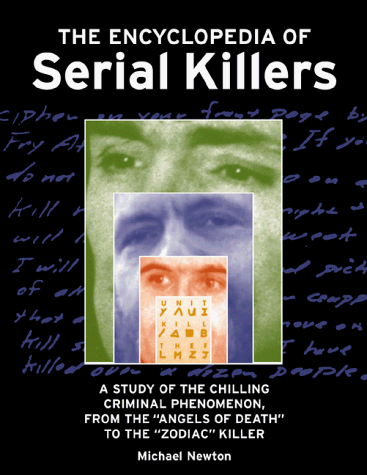
This unhappy book reminds readers of the atrocities committed at Dachau and Auschwitz during the Nazi era: lampshades made of human skin, gold teeth pulled. Newton's book (he has published 146 since 1977, according to the book's back cover) recounts in stomach-turning detail this chilling criminal phenomenon from Angels of Death to the Zodiac serial killer of the 1960s and '70s (still unsolved). The book is arranged alphabetically and includes, besides individual serial killers, groups like the "Wanna-Be's" and topical essays (e.g., fiction and film portrayals of serial murder, cannibalism, capital punishment). In addition to US and British serialists, this variorum of multicultural and multinational serial killers includes Russian (Chikatilo), Chinese (Bai Baoshan), Hungarian (Erzsebet, 16th-century royalty), French and German, South African, Indian, Polish. Even as we speak, recent newspaper articles list two serial killer stories: "Spokane Father of Five Suspected Killer" and "Mass Murderer May have Killed Dozens" (South Manchester, UK). With that kind of currency, Newton contends, "the large number of serial killers--1,500 at the writing of this book--renders comprehensive coverage of each and every case unfeasible in any single volume." In addition to the alphabetically arranged body of the book, three appendixes list solo, team killers, and unsolved cases. For public and academic audiences with strong stomachs. A. C. Vara; Temple University
Booklist Review
The American reading public is fascinated by serial killers--their lives, motives, and minds. Countless books have been written that chronicle the crimes of David Berkowitz (Son of Sam), the Hillside Strangler, Ted Bundy and others of their ilk. The Encyclopedia of Serial Killers details the histories of some of the world's most infamous murderers. Newton's purpose is to "demystify, as far as possible, those predators in human form who have been with us since the dawn of history, their numbers multiplying exponentially within the past four decades." Entries cover a broad range of countries and time periods, but the majority of cases occurred within the last 50 years. In addition, the majority of killers profiled are American, as Newton asserts that "Americans account for five percent of the world's population and 84 percent of all serial killers," though there are some notable exceptions, such as the well-known Jack the Ripper. Entries are arranged alphabetically by the killer's last name, if available. Though varying in length, they usually begin with biographical information on the killer, a description of the crimes and victims, and the results of the subsequent police investigation. Brief information on the trial and its outcome is included. Interspersed with the profiles of the killers are entries on general topics, such as Fiction and film portrayals of serial murder, Modus operandi of serial killers, and Trophies and souvenirs kept by serial killers. Profiles of noted law enforcement officials may also be found in this volume. As there are more than 1,500 serial killers on record, Newton has chosen to profile those men and women who serve as examples of "specific serial killer types, motivations, nationalities, and so forth." Cross-references to related entries appear at the end of an article or in the body of the text. There are three appendixes. The first is a list of solo killers, and the second is a list of team killers. These short entries include name, sex, race, type, motive, dates, venue, number of victims, modus operandi, and disposition of the case. The third appendix is a list of unsolved cases and includes as much of the information listed above as is known. The Encyclopedia of Serial Killers is a good source of general information on the topic from a reputable publisher. It is an excellent choice for public and academic libraries needing this information, although its reference value would be strengthened if the sources used for biographical entries were identified.