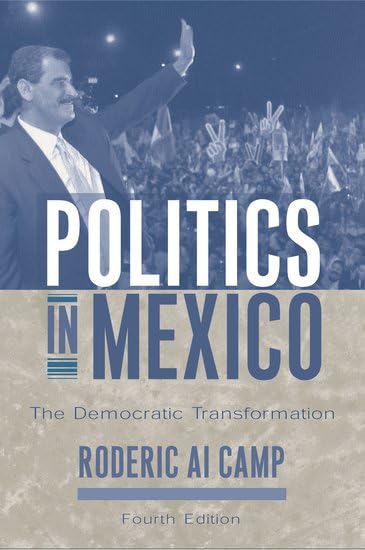

Politics in Mexico the democratic transformation Roderic Ai Camp.
Detalles de publicación: New York Oxford Oxford University Press 2002.Edición: 4th edDescripción: x, 294 p. 21 cmISBN:- 0195150309
- 320.972 C1861p4 21
| Imagen de cubierta | Tipo de ítem | Biblioteca actual | Biblioteca de origen | Colección | Ubicación en estantería | Signatura topográfica | Materiales especificados | Info Vol | URL | Copia número | Estado | Notas | Fecha de vencimiento | Código de barras | Reserva de ítems | Prioridad de la cola de reserva de ejemplar | Reservas para cursos | |
|---|---|---|---|---|---|---|---|---|---|---|---|---|---|---|---|---|---|---|
| Libro | Biblioteca Encarnación Valdés Colección General bev | 320.972 C1861p4 (Navegar estantería(Abre debajo)) | Disponible | 80000002120585 |
Descripciones mejoradas de Syndetics:
Thoroughly grounded in Mexican history and based on extensive field research, this introduction examines the roots of Mexico's contemporary political culture. Now in its fourth edition, Politics in Mexico has been completely updated and revised to cover the 2000 election of Vicente Fox to the presidency of Mexico. Featuring data from two recent major research projects, the book discusses the historical background and evolution of voter behavior responsible for sweeping Mr. Fox into office. It analyzes the important role of Congress and the special relationship between presidents Fox and Bush, and it provides previously unpublished survey research on Mexican beliefs about democracy. This edition also features new data and tables based on original research that strengthen existing coverage of women, religion, decision-making, political participation, citizen socialization, and electoral politics. Engagingly written by one of the top scholars in the field, Politics in Mexico is essential reading for students of Mexican or Latin American politics, comparative politics, and Mexican history.
Previous ed.: 1999.
Includes bibliographic essay and index.
Tabla de contenidos provista por Syndetics
- Acknowledgments(p. ix)
- 1 Mexico in Comparative Context(p. 1)
- Why Compare Political Cultures?(p. 2)
- Some Interpretations of the Mexican System(p. 9)
- Mexico's Significance in a Comparative Context(p. 15)
- Conclusion(p. 18)
- 2 Political-Historical Roots: The Impact of Time and Place(p. 23)
- The Spanish Heritage(p. 23)
- Nineteenth-Century Political Heritage(p. 31)
- The Revolutionary Heritage: Social Violence and Reform(p. 40)
- The Politics of Place: Interface with the United States(p. 45)
- Conclusion(p. 47)
- 3 Contemporary Political Culture: What Mexicans Believe(p. 54)
- Legitimacy: Support for the Political System and Society(p. 55)
- Participation: Activating the Electorate(p. 60)
- Democracy: What Does it Mean?(p. 68)
- Conclusion(p. 70)
- 4 Political Attitudes and Their Origins: Partisanship, Alienation, and Tolerance(p. 75)
- Income and Politics(p. 78)
- Education and Politics(p. 82)
- Religion and Politics(p. 84)
- Gender and Politics(p. 89)
- Region and Politics(p. 92)
- Age and Politics(p. 95)
- Conclusion(p. 97)
- 5 Rising to the Top: The Recruitment of Political Leadership(p. 102)
- The Formal Rules(p. 103)
- The Informal Rules: What Is Necessary to Rise to the Top(p. 106)
- The Rise of Women(p. 113)
- The Camarilla: Group Politics in Mexico(p. 117)
- The Rise and Decline of the Technocrat(p. 122)
- Conclusion(p. 126)
- 6 Groups and the State: What Is the Relationship?(p. 130)
- The Residue of Corporatism(p. 130)
- Institutional Voices(p. 132)
- The Military(p. 133)
- The Church(p. 137)
- Business(p. 142)
- Organized Labor(p. 145)
- Intellectuals and the Media(p. 149)
- Voices of Dissent(p. 153)
- Nongovernmental Organizations(p. 154)
- Guerrillas(p. 156)
- Conclusion(p. 158)
- 7 Who Governs? The Structure of Decision-Making(p. 167)
- The Executive Branch(p. 168)
- The Legislative Branch(p. 174)
- The Judicial Branch(p. 179)
- Federalism(p. 180)
- Conclusion(p. 182)
- 8 Expanding Participation: The Electoral Process(p. 186)
- Electoral Reforms(p. 187)
- The 1988 and 1994 Presidential Elections(p. 191)
- The 2000 Presidential Election, a Political Landmark(p. 197)
- Parties: Their Origins and Future(p. 205)
- Conclusion(p. 211)
- 9 External Politics: Relations with the United States(p. 217)
- National Security Issues(p. 219)
- Cultural Interface(p. 225)
- Economic Linkages(p. 230)
- Conclusion(p. 236)
- 10 Political and Economic Modernization: A Revolution?(p. 242)
- Bases for Economic Modernization(p. 242)
- Economic Liberalization(p. 245)
- Democratization(p. 253)
- Mexico's Future(p. 258)
- Bibliographic Essay(p. 267)
- Index(p. 281)