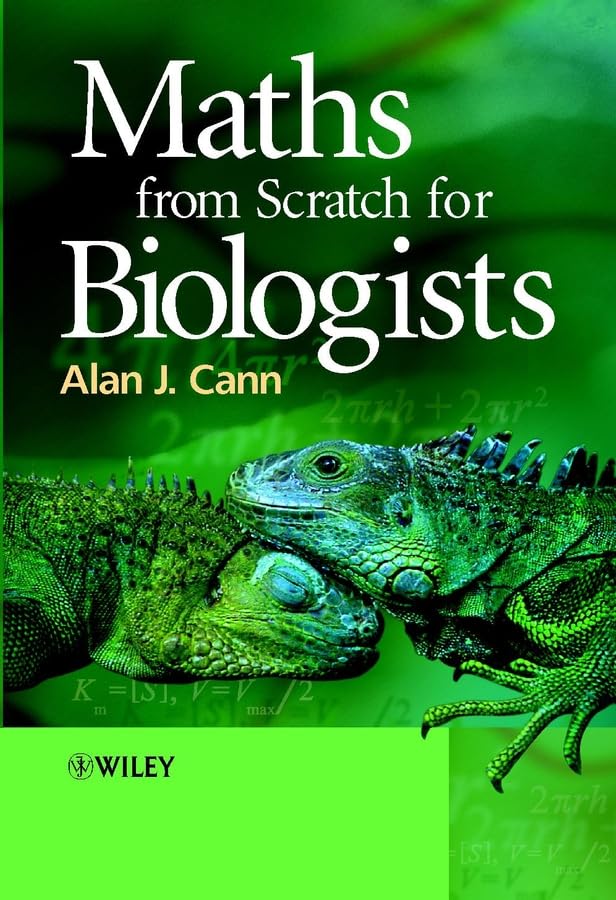

Maths from scratch for biologists Alan Cann
Detalles de publicación: New York : Wiley 2003Descripción: xii, 228 p. ill. 25 cmISBN:- 0471498343
- 570.151 C224m
- QH323.5 .C363 2003
| Imagen de cubierta | Tipo de ítem | Biblioteca actual | Biblioteca de origen | Colección | Ubicación en estantería | Signatura topográfica | Materiales especificados | Info Vol | URL | Copia número | Estado | Notas | Fecha de vencimiento | Código de barras | Reserva de ítems | Prioridad de la cola de reserva de ejemplar | Reservas para cursos | |
|---|---|---|---|---|---|---|---|---|---|---|---|---|---|---|---|---|---|---|
| Libro | Biblioteca de Mayagüez Colección General mb | QH323.5 .C363 2003 (Navegar estantería(Abre debajo)) | Disponible | 50000002138773 |
Descripciones mejoradas de Syndetics:
Numerical ability is an essential skill for everyone studying the biological sciences but many students are frightened by the 'perceived' difficulty of mathematics, and are nervous about applying mathematical skills in their chosen field of study. Having taught introductory maths and statistics for many years, Alan Cann understands these challenges and just how invaluable an accessible, confidence building textbook could be to the fearful student. Unable to find a book pitched at the right level, that concentrated on why numerical skills are useful to biologists, he wrote his own. The result is Maths from Scratch for Biologists , a highly instructive, informal text that explains step by step how and why you need to tackle maths within the biological sciences.
Features:
* An accessible, jargon-busting approach to help readers master basic mathematical, statistical and data handling techniques in biology
* Numerous end of chapter problems to reinforce key concepts and encourage students to test their newly acquired skills through practise
* A handy, time-saving glossary
* A supplementary website with numerous problems and self-test exercises
Includes bibliographical references and index
Tabla de contenidos provista por Syndetics
- Preface(p. xi)
- 1 Maths in Biology(p. 1)
- 1.1 What can go wrong?(p. 1)
- 1.2 Estimating(p. 5)
- 1.3 How to use this book(p. 6)
- 1.4 Mathematical conventions used in this book(p. 6)
- 2 Manipulating Numbers(p. 7)
- 2.1 Manipulating numbers(p. 8)
- 2.2 Solving equations(p. 9)
- 2.3 Why do you need to know all this?(p. 12)
- 2.4 Fractions(p. 14)
- 2.5 The number 1(p. 15)
- 2.6 Lowest common multiple and greatest common factor(p. 16)
- 2.7 Adding and subtracting fractions(p. 17)
- 2.8 Multiplying fractions(p. 18)
- 2.9 Dividing fractions(p. 18)
- 2.10 Fractions, decimals and percentages(p. 19)
- 2.11 Ratios and proportions(p. 20)
- 3 Units and Conversions(p. 25)
- 3.1 The SI system of units(p. 25)
- 3.2 SI prefixes(p. 27)
- 3.3 SI usage(p. 28)
- 3.4 Measuring energy(p. 29)
- 3.5 Temperature(p. 31)
- 4 Molarities and Dilutions(p. 35)
- 4.1 Avogadro's number(p. 35)
- 4.2 Molecular weight(p. 36)
- 4.3 Solutions(p. 37)
- 4.4 Spectroscopy(p. 40)
- 4.5 Dilutions(p. 42)
- 5 Areas and Volumes(p. 49)
- 5.1 Geometry(p. 49)
- 5.2 Calculating areas and volumes(p. 49)
- 6 Exponents and Logs(p. 57)
- 6.1 Exponents(p. 57)
- 6.2 Exponential functions(p. 60)
- 6.3 Logarithms(p. 62)
- 7 Introduction to Statistics(p. 69)
- 7.1 What is statistics?(p. 69)
- 7.2 Statistical variables(p. 70)
- 7.3 Statistical methods(p. 71)
- 7.4 Frequency distributions(p. 73)
- 7.5 Frequency distribution graphs(p. 76)
- 8 Descriptive Statistics(p. 83)
- 8.1 Populations and samples(p. 83)
- 8.2 The central tendency(p. 84)
- 8.3 Variability(p. 85)
- 8.4 Standard error(p. 88)
- 8.5 Confidence intervals(p. 88)
- 8.6 Parametric and non-parametric statistics(p. 90)
- 8.7 Choosing an appropriate statistical test(p. 91)
- 8.8 Exploratory data analysis(p. 92)
- 9 Probability(p. 99)
- 9.1 Probability theory(p. 99)
- 9.2 Replacing vs not replacing selections(p. 100)
- 9.3 Calculating the probability of multiple events(p. 101)
- 9.4 The binomial distribution(p. 103)
- 9.5 Coincidences(p. 106)
- 10 Inferential Statistics(p. 111)
- 10.1 Statistical inference(p. 111)
- 10.2 Procedure for hypothesis testing(p. 113)
- 10.3 Standard scores (z-scores)(p. 114)
- 10.4 Student's t-test (t-test)(p. 115)
- 10.5 Analysis of variance (ANOVA)(p. 121)
- 10.6 x[superscript 2]-test(p. 125)
- 10.7 Fisher's exact test(p. 131)
- 11 Correlation and Regression(p. 135)
- 11.1 Regression or correlation?(p. 135)
- 11.2 Correlation(p. 136)
- 11.3 Regression(p. 141)
- Appendix 1 Answers to Problems(p. 147)
- Appendix 2 Software for Biologists(p. 195)
- E-mail(p. 195)
- Word processors(p. 197)
- Presentation and graphics(p. 198)
- Internet resources(p. 198)
- Statistics software(p. 200)
- Appendix 3 Statistical Formulae and Tables(p. 203)
- Critical values of the x[superscript 2] distribution(p. 206)
- Critical values of student's t-Test(p. 207)
- Table of critical values of the F-statistic(p. 208)
- Table of critical values of the correlation coefficient, r(p. 213)
- Table of binomial probabilities(p. 214)
- Appendix 4 Glossary(p. 221)
- Index(p. 227)