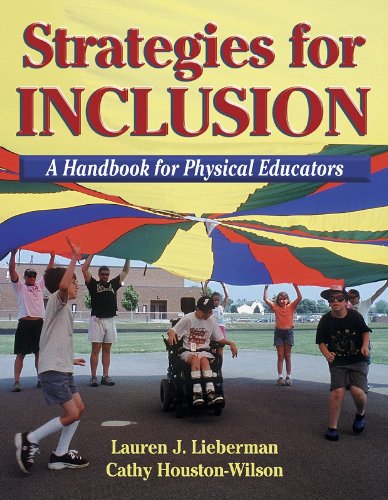

Strategies for Inclusion a handbook for physical educators Lauren Lieberman, Cathy Houston-Wilson.
Detalles de publicación: Champaign, IL Human Kinetics 2002.Edición: 1 st edDescripción: xvi, 255 p. ill. 28 cmISBN:- 073600324X
- 371.9044 L716s
- GV445 .L54 2002
| Imagen de cubierta | Tipo de ítem | Biblioteca actual | Biblioteca de origen | Colección | Ubicación en estantería | Signatura topográfica | Materiales especificados | Info Vol | URL | Copia número | Estado | Notas | Fecha de vencimiento | Código de barras | Reserva de ítems | Prioridad de la cola de reserva de ejemplar | Reservas para cursos | |
|---|---|---|---|---|---|---|---|---|---|---|---|---|---|---|---|---|---|---|
| Libro | Biblioteca de Mayagüez Colección General mb | GV445 .L54 2002 (Navegar estantería(Abre debajo)) | Disponible | 50000002137882 | ||||||||||||||
| Libro | Biblioteca Mons. Iñaki Mallona (Arecibo) Colección General ab | 371.904486 L7163s (Navegar estantería(Abre debajo)) | Disponible | 60000002995386 |
Descripciones mejoradas de Syndetics:
Get up to date on the latest and most useful strategies for successfully integrating children with disabilities in physical education. Strategies for Inclusion: A Handbook for Physical Educators dispels myths about instructing children with disabilities and provides guidelines for appropriate inclusion in the least restrictive environment.
Strategies for Inclusion: A Handbook for Physical Educators sets the stage with a clear discussion of current disabilities legislation and its impact on K-12 teachers. Next, using real-life examples to illustrate each point, it provides solid advice on these issues:
-Making placement decisions
-Developing and implementing a physical education Individual Education Plan (IEP)
-Assessing students using traditional methods or creating functional rubrics for any unit
-Adapting activities sports and recreation to meet unique needs
-Overcoming blanket medical excuses
-introducing disability/ability awareness activities
-training peer tutors
-using support personnel
-using homework in physical education
-using the community to facilitate inclusion
The authors present ready-to-use skill-related rubrics for the quantitative and qualitative assessment of children both with and without disabilities. The 38 units of instruction include
-16 elementary units,
-11 sports units,
-8 recreation units, and
-5 fitness units.
In each unit you'll also find flexible and creative tips to make inclusion easier, including adapting the teaching environment, using rule changes, modifying equipment, and adjusting your teaching style and methods.
The book includes these useful teaching tools:
-Case studies with helpful questions and answers
-Teaching tips that give hands-on solutions for teachers
-Discussion and comparison of assessment tools
-A Unit Finder that makes it easy to locate units according to the sport or activity involved
-Resource indexes with a myriad of additional tools, including a glossary of disabilities in kid terms, a peer tutor training guide, disability awareness activities, a list of organizations, equipment companies, and a list of state directors of special education
Strategies for Inclusion: A Handbook for Physical Educators empowers current and future teachers to create inclusive classrooms where every child can fully participate in fun and health-building physical education.
Includes bibliographical references and index.
Tabla de contenidos provista por Syndetics
- Unit Finder
- Part I Understanding Inclusion
- Grasp the current trends in inclusion and understand the importance of making inclusion a priority in the physical education setting
- Chapter 1 Defining Inclusion in Today's Classroom
- Gain valuable perspective on the history of the inclusion movement and its impact on physical education programming
- Influential legislation is explained and pre-inclusion planning is introduced
- Chapter 2 Preparing for Inclusion
- Understand how accurate assessment in adapted physical education directly affects inclusion planning
- This chapter provides insight into both traditional assessment techniques and authentic assessment techniques and their strengths and weaknesses
- Chapter 3 Planning for Success
- Learn how effective Individualized Education Plans (IEPs) set the stage for successful inclusion
- Components of the IEP, the IEP meeting process, and the IEP team members and their roles are discussed and defined in detail
- Chapter 4 Adapting the Curriculum to Fit Special Needs
- Discover new theoretical constructs that drive the adapted physical education field
- Concrete examples are provided to help bring these theories to life
- Basic principles of adapting games and activities as well as instructions on implementing the adaptations suggested are also included in this chapter
- Chapter 5 Creating an Atmosphere for Achievement
- Identify support personnel and services that can help to create an open atmosphere for student achievement
- Learn the strategies and techniques needed to develop disability awareness and peer tutoring programs
- This chapter also covers how to overcome blanket medical excuses, how to utilize homework, how to work with teacher assistants, and how to use community support personnel, including grandparents and university students
- Part II Strategies for Inclusion
- Put into action the theories and techniques explained in part I
- Specifically, chapters 6, 7, 8, and 9 contain thematic, adaptable instructional units
- Each unit includes adaptation checklists and rubrics for easy implementation
- Chapter 6 Basic Skills
- Fundamental motor skills such as balance, coordination, and body awareness are the foundation for future physical education success
- In addition to the basics, units cover specific activities such as parachute, scooterboard, and jumprope
- Chapter 7 Sport Skills and Teamwork
- Sport and teamwork skills can help any child feel accomplished and accepted
- Fundamental sport concepts and cooperative teamwork through units including baseball, football, golf, and gymnastics are reinforced in this chapter
- Chapter 8 Health and Fitness
- Health and fitness skills cannot be overlooked at any age
- This chapter pairs units of basic fitness skills with health knowledge essential for successful performance throughout life
- Units include fitness activities such as aerobics, aquatics and swimming, and weight training
- Chapter 9 Recreation and Life Skills
- Recreation and life skills improve quality of life
- Recreation skills in particular can be adapted to meet most children's needs
- A few of the units included within this chapter are backpacking and hiking, bowling, canoeing, fishing, and in-line skating.
- Appendix A Disabilities in Kid Terms
- Appendix B Peer Tutor Training Program
- Appendix C Disability Awareness Activities
- Appendix D Aquatics Checklist
- Appendix E Organizations in Adapted Physical Education and Disability Sport
- Appendix F Equipment Companies
- Appendix G Additional Resources
- Appendix H State Directors of Special Education
- References
- Index
- About the Authors
Notas de autor provistas por Syndetics
Lauren Lieberman, PhD , is an associate professor in the department of physical education and sport at the State University of New York (SUNY) at Brockport. She teaches graduate and undergraduate courses in adapted physical education and coordinates five practicum programs, including Camp Abilities, a developmental sports camp for children who are blind. She conducts research in inclusion and physical activity for people with sensory impairments. She coauthored the books Games for People With Sensory Impairments (Human Kinetics) and Case Studies in Adapted Physical Education .
In 1995, Lieberman earned her PhD from Oregon State University in human performance with a minor in movement studies and disabilities. While there, she taught classes in adapted physical education and coordinated a play-based program for infants and toddlers. Her research at Oregon State focused on inclusion of deaf children in physical education.
Cathy Houston-Wilson, PhD , is an associate professor in the department of physical education and sport at the State University of New York at Brockport, where she coordinates the physical education teacher education concentration. She earned her PhD in adapted physical education from Oregon State University in 1993.
Houston-Wilson has taught general and adapted physical education, and she developed the early childhood inclusive motor program at SUNY Brockport. Currently, she advises school districts on appropriate inclusion of students with disabilities into general physical education.