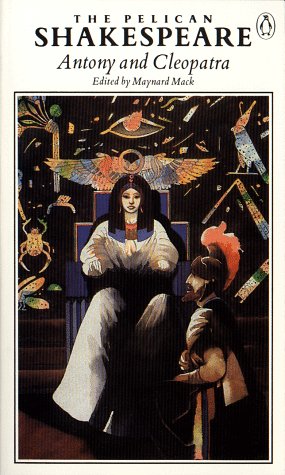
Imagen de portada de Amazon
Imagen de Amazon.com
Imagen de cubierta Syndetics
Portada de Syndetics
Imagen de OpenLibrary

Antony and Cleopatra William Shakespeare ; edited by Maynard Mack.

Por: Colaborador(es): Detalles de publicación: England Penguin Books 1970 rep., 1981Descripción: 159 p. 18 cmISBN:
  • 0140714200
Tema(s):
Valoración
    Valoración media: 0.0 (0 votos)
Existencias
Imagen de cubierta Tipo de ítem Biblioteca actual Biblioteca de origen Colección Ubicación en estantería Signatura topográfica Materiales especificados Info Vol URL Copia número Estado Notas Fecha de vencimiento Código de barras Reserva de ítems Prioridad de la cola de reserva de ejemplar Reservas para cursos
Libro Biblioteca Mons. Iñaki Mallona (Arecibo) Colección General ab 822.33 S5272a (Navegar estantería(Abre debajo)) Disponible 60000001982278
Total de reservas: 0

Descripciones mejoradas de Syndetics:

Legendary lovers come to dramatic life in Shakespeare's gripping tragedy about the conflict of love and duty. Brilliant characterizations, fast-paced action in exotic locales, and matchless poetry make this tale timeless.

Cover title: The Pelican Shakespeare, Antony and Cleopatra.

Tabla de contenidos provista por Syndetics

  • Foreword(p. vii)
  • Introduction(p. xvii)
  • Antony and Cleopatra in Performance(p. xxv)
  • The Playhouse(p. xxxiv)
  • Antony and Cleopatra(p. 1)
  • Date and Text(p. 140)
  • Textual Notes(p. 141)
  • Shakespeare's Sources(p. 144)
  • Further Reading(p. 178)
  • Memorable Lines(p. 184)

Extracto provisto por Syndetics

Introduction Shakespeare probably wrote Antony and Cleopatra in 1606 or 1607; it was registered for publication on May 20, 1608, and apparently influenced a revision of Samuel Daniel's Cleopatra that was published "newly altered" in 1607. Antony and Cleopatra was thus roughly contemporary with King Lear and Macbeth . Yet the contrast between those two tragedies and Antony and Cleopatra is immense. Unlike Macbeth , with its taut focus on a murderer and his wife, Antony and Cleopatra moves back and forth across the Mediterranean in its epic survey of characters and events, bringing together the fates of Pompey, Octavius Caesar, Octavia, and Lepidus with those of the protagonists. King Lear gives proper names to fourteen characters, Macbeth to eighteen, Antony and Cleopatra to thirty-four. The Roman play requires no fewer than forty-two separate scenes, of which most occur in what modern editors label Acts 3 and 4, although no play is less suited to the classical rigors of five-act structure, and these divisions are not found in the reliable Folio text of 1623. Indeed, it is as though Shakespeare resolved at the height of his career to show that he could dispense entirely with the classical "rules," which had never taken serious hold of the English popular stage in any case. The flouting of the unities is so extreme that John Dryden, in his All for Love, or The World Well Lost (1678), undertook not so much to revise Shakespeare as to start afresh on the same subject. Dryden's play is restricted to the last few hours of the protagonists' lives, at Cleopatra's tomb in Alexandria, with a severely limited cast of characters and much of the narrative revealed through recollection. Although a substantial achievement in its own right, All for Love surely demonstrates that Shakespeare knew what he was doing, for Dryden has excised a good deal of the panorama, the excitement, and the "infinite variety" (2.2.246). Shakespeare departs also from the somber tone of his tragedies of evil. He creates, instead, a world that bears affinities to the ambiguous conflicts of the other Roman plays, to the varying humorous perspectives of the comedies, and to the imaginative reconstructions of the late romances. As protagonists, Antony and Cleopatra lack tragic stature, or so it first appears: she is a tawny gypsy temptress and he a "strumpet's fool," a once-great general now bound in "strong Egyptian fetters" and lost in "dotage" (1.1.13; 1.2.122--3). Several scenes, especially those set in Egypt, are comic and delightfully bawdy: Charmian learning her fortune from the soothsayer, Cleopatra practicing her charms in vain to keep Antony from leaving Egypt or raunchily daydreaming of being Antony's horse "to bear the weight of Antony" (1.5.22), Cleopatra flying into a magnificent rage at the news of Antony's marriage to Octavia and then consoling herself with catty reflections on Octavia's reported low voice and shortness of stature ("I think so, Charmian. Dull of tongue, and dwarfish," 3.3.17). In its comic texture, the play somewhat resembles Romeo and Juliet , an earlier play about a younger pair of lovers, although there the bawdry is used chiefly to characterize the lovers' companions and confidants, whereas in Antony and Cleopatra it is central to our vision of Cleopatra especially. In any case, the later play is a tragedy about lovers who, despite their quarrels and uncertainties and betrayals of self, are reconciled in a vision of the greatness of their love. In its depiction of two contrasting worlds, also, Antony and Cleopatra recalls the movement of several earlier comedies from the realistic world of political conniving to a dream-world of the romantic and the unexpected. We can endorse neither world fully in Antony and Cleopatra , and, accordingly, the vision of life presented is often ambivalent and ironic as much as it is tragic. The contrast of values separating Egypt and Rome underscores the paradox of humanity's quest for seemingly irreconcilable goals. The ending is neither a triumph nor a defeat for the lovers but something of both. If Antony and Cleopatra seem in one way too small to be tragic protagonists, in another way they seem too large, creating imaginative visions of themselves and their union that escape the realm of tragedy altogether. Our attention is focused less on the way in which the protagonists come to understand some meaningful relationship between their character and the fate required of them by a tragic universe than on the almost comic way in which the absurdities of Roman worldly striving and Egyptian dissipation are transfigured in the world of the imagination. The Roman point of view opens the play and never entirely loses its force. At first, it may seem superior to that of Egypt. Demetrius and Philo, who invite us to view the play's first encounter between Antony and Cleopatra (1.1) from the perspective of the professional Roman soldier, lament the decline of Antony into Circean enslavement. Their tragic concept is of the Fall of Princes, all the more soberly edifying because of the height from which Antony has toppled. "You shall see in him / The triple pillar of the world transformed / Into a strumpet's fool" (1.1.11--13). Egypt is enchanting but clearly enervating-a bizarre assemblage of soothsayers, eunuchs, and waiting- gentlewomen who wish to be "married to three kings in a forenoon and widow them all" (1.2.28--9). Their mirth is all bawdry, tinged with practices, such as transvestitism, that Roman custom views as licentious. The prevailing images are of procreation in various shapes, sleep (mandragora, Lethe), the oriental opulence of Cleopatra's barge (a golden poop, purple sails, silver oars, divers-colored fans), Epicurean feasting, and drinking. As Enobarbus says, "Mine, and most of our fortunes tonight, shall be-drunk to bed" (1.2.47--8). Antony, for all his reckless defiance of Rome, agrees in his more reflective moments with what Demetrius and Philo have said. "A Roman thought hath struck him," Cleopatra observantly remarks, and Antony has indeed determined that "I must from this enchanting queen break off" (1.2.88, 135). His later return to Cleopatra is at least in part a surrender, a betrayal of his marriage vows to Octavia and his political assurances to Caesar. In the ensuing battles, Antony submits himself dangerously to Cleopatra's governance, and this inversion of dominance in sexual roles, as conventionally understood by the Roman patriarchal world, is emblematic of a deeper disorder within Antony. As Enobarbus concludes bitterly, Antony "would make his will / Lord of his reason" and so has subverted his "judgment" (3.13.3--4, 37) to passion. From the beginning, Cleopatra has sought dominance over Antony in the war of the sexes. When Antony first came to her on the River Cydnus, we learn, he was so overcome in all his senses that he was "barbered ten times o'er" (2.2.234). Cleopatra boasts that she "angled" for Antony on many occasions, catching him the way fishermen "betray" fish, and that, when she had "drunk him to his bed," she "put my tires and mantles on him, whilst / I wore his sword Philippan" (2.5.10--23). Caesar, affronted by such transvestite debauchery, charges that Antony "is not more manlike / Than Cleopatra, nor the queen of Ptolemy / More womanly than he" (1.4.5--7). During the battle scenes, Antony's followers complain that "Photinus, an eunuch" (probably Mardian), and Cleopatra's maids manage the war: "So our leader's led, / And we are women's men" (3.7.14--15, 70--1). Antony confesses too late that they were right. He becomes a "doting mallard," one whose heart is "tied by th' strings" to Cleopatra's rudder when her ships retreat in the first naval engagement (3.10.20; 3.11.56). In the mythic images used to raise their relationship to heroic proportions, Antony is like Mars to Cleopatra's Venus (1.5.19), in both a positive and a negative sense. The image has positive connotations of the way in which, as Milton puts it, the "two great sexes animate the world," the masterful soldier and his attractive consort complementing one another in a right relationship of martial prowess and beauty, bravery and love, reason and will; however, to the Renaissance, the myth of Mars and Venus could also be read in a destructive sense, as an adulterous relationship in which reason is subverted to appetite. In another mythic comparison, Antony is like Hercules, not in his prime, but with the shirt of Nessus on his back-a poisoned shirt given to Hercules by his wife in a mistaken hope of thereby assuring his love for her (4.12.43). Antony's soldiers understandably believe that the god Hercules has deserted his reputed descendant and onetime champion (4.3.21--2). Despite Antony's shameful violation of manhood, honor, attention to duty, self-knowledge, and all that Rome stands for, however, the end of his story is anything but a one-sided endorsement for the Roman point of view. The actual Rome, disfigured by political conniving, falls far short of the ideal. Antony has a point when he protests that "Kingdoms are clay" (1.1.37). Alliances are unstable and are governed by mere political expediency. At first, Antony's wife Fulvia and his brother Lucius have fought one another until forced to unite against the greater threat of Octavius Caesar. Similarly, Antony and Caesar come together only because Pompey has become dangerously powerful at sea and has won the favor of the fickle mob, "Our slippery people" (1.2.192). This détente is not meant to last. As Enobarbus bluntly puts it, "if you borrow one another's love for the instant, you may, when you hear no more words of Pompey, return it again" (2.2.109--11). Enobarbus is rebuked for his unstatesmanlike tone, but no one denies the validity of what he says. In this cynical negotiation, Octavia is a pawn between husband and brother, shabbily treated by both. Caesar coldly bargains away the happiness of the one person of whom he protests that "no brother / Did ever love so dearly" (2.2.159--60). Antony, although hating false promises and resolving to be loyal to Octavia, knows within himself that it won't work. To make matters worse for the fair-minded Antony, he has received great favors from Pompey that he must now uncharitably repudiate in the interests of politics. Pompey does not miss the opportunity to remind Antony of his ingratitude, but the prevailing mood is not so much of bitterness as of ironic futility. Old friendships must be sacrificed; no one seems wholly to blame, and no one can stop the game. Pompey is as much in the wrong as anyone and as powerless. Despite his idealistic hope of restoring republican government to Rome, he has had to ally himself with pirates who offer him sinister temptations. He could be "lord of all the world" (2.7.62) if he would only murder on occasion, but Pompey is destined to be trapped between lofty ends and ignoble means. Lepidus is still another dismaying victim of political callousness, used condescendingly by Caesar and permitted to drink himself into oblivion, until he is cashiered on a trumped-up charge and imprisoned for life. Octavius Caesar embodies most of all the ironic limits of political ambition. He has avoided enslavement to passion at the very real cost of enslaving himself to his public career as general, triumvir, and future emperor. His ideal warrior is one who, driven by military necessity, would "drink / The stale [urine] of horses and the gilded puddle / Which beasts would cough at" (1.4.62--4). As a general, he is Antony's opposite in every way. He attacks only when he has the advantage and places those who have deserted Antony in his own front lines so "That Antony may seem to spend his fury / Upon himself" (4.6.10--11). He controls his supplies cannily, believing it a "waste" to feast his army (4.1.17). He, of course, declines Antony's offers of single combat. Antony meantime recklessly accepts Caesar's challenge to fight at sea, feasts debauchingly in one "gaudy night" after another (3.13.186), and generously refuses to blame or penalize those who leave him. His sending Enobarbus's belongings after him into Caesar's camp convinces that honest soldier he has made a fatal error, for, however imprudent Antony's chivalry may be, it is unquestionably noble and great-hearted. Caesar is a superb general and political genius, but he is also a military automaton, a logistical reckoner, a Machiavellian pragmatist. In his personal life, he is no less austere and puritanical. He deplores loosening his tongue with alcohol. About women, he is deeply cynical, believing that "want will perjure / The ne'er-touched vestal" (3.12.30--1). Between him and Cleopatra, there is a profound antipathy, based in part on his revulsion at her earlier affair with his namesake and adoptive father, Julius Caesar (3.6.6). Cleopatra may entertain briefly the notion of trying to seduce this new Caesar (3.13.46 ff.), for like Charmian she loves long life "better than figs" (1.2.34), but, if so, she soon discovers that she and Caesar are not compatible. All that he represents she must instead grandly repudiate, choosing death and the fantasy of an eternity with Antony as her way to "call great Caesar ass / Unpolicied" (5.2.307--8). Excerpted from Antony and Cleopatra by William Shakespeare All rights reserved by the original copyright owners. Excerpts are provided for display purposes only and may not be reproduced, reprinted or distributed without the written permission of the publisher.

Reseñas proporcionadas por Syndetics

Library Journal Review

The three individual plays launch the third edition of the venerable "Arden Shakespeare" series, which will see the entire canon reproduced in superior scholarly editions by the year 2000. The First Folio is a facsimile edition of the original 1623 publication of the bard's works. (c) Copyright 2010. Library Journals LLC, a wholly owned subsidiary of Media Source, Inc. No redistribution permitted.

School Library Journal Review

Gr 3-5-In each of these slim volumes, one of William Shakespeare's tragedies is retold. The prose is straightforward and easy to read and tells each basic story. The color and black-and-white cartoons support the texts and there is a pictorial character list at the beginning of each book. With so much happening in so few pages, these are action-packed retellings. While they may be useful as an introduction to Shakespeare, it's questionable whether they translate into an interest in reading the rich and profound drama of the originals.-Carol Schene, Taunton Public Schools, MA (c) Copyright 2010. Library Journals LLC, a wholly owned subsidiary of Media Source, Inc. No redistribution permitted.

Notas de autor provistas por Syndetics

William Shakespeare, 1564 - 1616 Although there are many myths and mysteries surrounding William Shakespeare, a great deal is actually known about his life. He was born in Stratford-Upon-Avon, son of John Shakespeare, a prosperous merchant and local politician and Mary Arden, who had the wealth to send their oldest son to Stratford Grammar School.

At 18, Shakespeare married Anne Hathaway, the 27-year-old daughter of a local farmer, and they had their first daughter six months later. He probably developed an interest in theatre by watching plays performed by traveling players in Stratford while still in his youth. Some time before 1592, he left his family to take up residence in London, where he began acting and writing plays and poetry.

By 1594 Shakespeare had become a member and part owner of an acting company called The Lord Chamberlain's Men, where he soon became the company's principal playwright. His plays enjoyed great popularity and high critical acclaim in the newly built Globe Theatre. It was through his popularity that the troupe gained the attention of the new king, James I, who appointed them the King's Players in 1603. Before retiring to Stratford in 1613, after the Globe burned down, he wrote more than three dozen plays (that we are sure of) and more than 150 sonnets. He was celebrated by Ben Jonson, one of the leading playwrights of the day, as a writer who would be "not for an age, but for all time," a prediction that has proved to be true.

Today, Shakespeare towers over all other English writers and has few rivals in any language. His genius and creativity continue to astound scholars, and his plays continue to delight audiences. Many have served as the basis for operas, ballets, musical compositions, and films. While Jonson and other writers labored over their plays, Shakespeare seems to have had the ability to turn out work of exceptionally high caliber at an amazing speed. At the height of his career, he wrote an average of two plays a year as well as dozens of poems, songs, and possibly even verses for tombstones and heraldic shields, all while he continued to act in the plays performed by the Lord Chamberlain's Men. This staggering output is even more impressive when one considers its variety. Except for the English history plays, he never wrote the same kind of play twice. He seems to have had a good deal of fun in trying his hand at every kind of play.

Shakespeare wrote 154 sonnets, all published on 1609, most of which were dedicated to his patron Henry Wriothsley, The Earl of Southhampton. He also wrote 13 comedies, 13 histories, 6 tragedies, and 4 tragecomedies. He died at Stratford-upon-Avon April 23, 1616, and was buried two days later on the grounds of Holy Trinity Church in Stratford. His cause of death was unknown, but it is surmised that he knew he was dying.

(Bowker Author Biography)

Compartir
logopucpr-y-vive

Contáctanos

¡Queremos saber de ti!

Tel. 787.841.2000 Ext. 1801

bibliotecavaldes@pucpr.edu

⁣Búscanos en las redes

© 2026 Desarrollado por Ignite Online • All Rights Reserved • Powered by Koha.