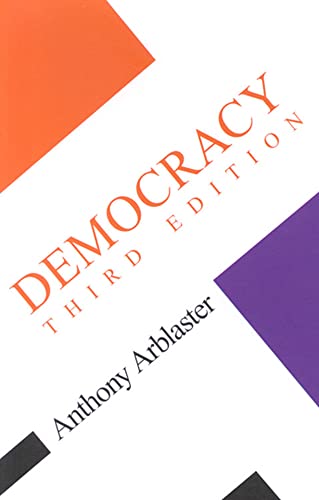

Democracy Anthony Arblaster.
Series Concepts in the social sciencesDetalles de publicación: Philadelphia, PA Open University Press 2002.Edición: 3rd edDescripción: ix, 122 p. 22 cmISBN:- 0335209696(pbk.)
- 321.8 A665d3 21
- JC423 .A685 2002
| Imagen de cubierta | Tipo de ítem | Biblioteca actual | Biblioteca de origen | Colección | Ubicación en estantería | Signatura topográfica | Materiales especificados | Info Vol | URL | Copia número | Estado | Notas | Fecha de vencimiento | Código de barras | Reserva de ítems | Prioridad de la cola de reserva de ejemplar | Reservas para cursos | |
|---|---|---|---|---|---|---|---|---|---|---|---|---|---|---|---|---|---|---|
| Libro | Biblioteca Encarnación Valdés Colección General bev | 321.8 A665d3 (Navegar estantería(Abre debajo)) | Disponible | 80000002159336 |
Descripciones mejoradas de Syndetics:
In praise of previous editions:
"...brilliant introduction." - New Statesman and Society
"From start to finish, Arblaster's book is stimulating and highly readable." - Times Higher Educational Supplement
"...an ideal first book to place in the hands of a student embarking on the study of democracy." - Journal of Commonwealth and Comparative Politics
What is the meaning of democracy? Why has democracy provoked hostility in the past? Has the hostility entirely vanished? * How democratic are contemporary Western societies in reality and how might they be made more democratic? The revised and updated edition of this widely acclaimed survey takes account of the very different global context in which any discussion of democracy must now take place, including the mighty power of the multinationals vis-a-vis elected governments, the resurgence of the idea of an Islamic alternative to the Western democratic ideal, and the suggestion that unelected but powerful international bodies are effectively eroding the authority of the democratic state.Anthony Arblaster looks first at the history of both the theory and practice of democracy, and the fierce opposition it has often provoked, showing how the representative version of democracy we are now familiar with was a relatively late arrival on the scene. He finds the core of the idea of democracy in the notion of popular power, and in the second part of the book he explores the meaning of this and the problems it involves.
Drawing on the classic writings of Rousseau, Paine and John Stuart Mill, he shows how wide the gap is between their vision of a fully democratic society and the limited realities of the Western democracies of today. Democracy, he argues, remains a relevant ideal and a challenge to much conventional political thinking, as well as to the centralizing tendencies of global power.
Includes bibliographical references and index.
Tabla de contenidos provista por Syndetics
- Preface and Acknowledgements(p. vii)
- Preface to the Third Edition(p. viii)
- 1 Introduction: Defining Democracy(p. 1)
- Part 1 History
- 2 The Invention of Democracy(p. 15)
- 3 The Re-emergence of Democracy(p. 26)
- 4 Popular Politics(p. 37)
- Part 2 Ideas
- 5 Government by the People(p. 59)
- 6 Majority Rule and its Problems(p. 66)
- 7 Equality and the General Interest(p. 72)
- 8 Representation and 'Direct' Democracy(p. 79)
- 9 Consent, Freedom and Debate(p. 86)
- 10 Conclusion: Creating Democracy(p. 95)
- Notes(p. 109)
- Bibliography(p. 116)
- Index(p. 120)