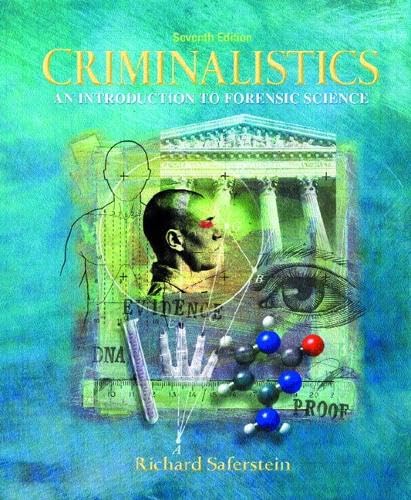

Criminalistics an introduction to forensic science Richard Saferstein.
Detalles de publicación: Englewood Cliffs, N.J. London Prentice Hall 2000.Edición: 7th edDescripción: 656 pISBN:- 0130138274
- 363.25 S1283c7 21
| Imagen de cubierta | Tipo de ítem | Biblioteca actual | Biblioteca de origen | Colección | Ubicación en estantería | Signatura topográfica | Materiales especificados | Info Vol | URL | Copia número | Estado | Notas | Fecha de vencimiento | Código de barras | Reserva de ítems | Prioridad de la cola de reserva de ejemplar | Reservas para cursos | |
|---|---|---|---|---|---|---|---|---|---|---|---|---|---|---|---|---|---|---|
| Libro | Biblioteca Encarnación Valdés Colección General bev | 363.25 S1283c7 (Navegar estantería(Abre debajo)) | Disponible | 80000002158668 |
Descripciones mejoradas de Syndetics:
Introduces the non-scientific student to the field of forensic science through an exploration of its applications to criminal investigations. The book also contains explanations of the techniniques, abilities and limitations of the modern crime laboratory.
Includes index.
Tabla de contenidos provista por Syndetics
- 1 Introduction
- Definition and Scope of Forensic Science
- History and Development of Forensic Science
- The Organization of a Crime Laboratory
- The Functions of the Forensic Scientist
- Other Forensic Science Services
- 2 The Crime Scene
- Processing the Crime Scene
- Legal Considerations at the Crime Scene
- 3 Physical Evidence
- Common Types of Physical Evidence
- The Significance of Physical Evidence
- 4 Physical Properties: Glass and Soil
- The Metric System
- Physical Properties
- Comparing Glass Fragments
- Glass Fractures
- Collection and Preservation of Glass Evidence
- Forensic Characteristics of Soil
- Collection and Preservation of Soil Evidence
- 5 Organic Analysis
- Elements and Compounds
- Selecting an Analytical Technique
- Chromatography
- Spectrometry
- Mass Spectrometry (MS)
- 6 Inorganic Analysis
- Evidence in the Assassination of President Kennedy
- The Emission Spectrum of Elements
- Atomic Absorption Spectrophotometry
- The Origin of Emission and Absorption Spectra
- Neutron Activation Analysis
- X-Ray Diffraction
- 7 The Microscope
- The Compound Microscope
- The Comparison Microscope
- The Stereoscopic Microscope
- The Polarizing Microscope
- The Microspectrophotometer
- The Scanning Electron Microscope (SEM)
- 8 Hairs, Fibers, and Paint
- Morphology of Hair
- Identification and Comparison of Hair
- Collection of Hair Evidence
- Types of Fibers
- Identification and Comparison of Man-Made Fibers
- Collection of Fiber Evidence
- Forensic Examination of Paint
- Collection and Preservation of Paint Evidence
- 9 Drugs
- Drug Dependence
- Narcotic Drugs
- Hallucinogens
- Depressants
- Stimulants
- Anabolic Steroids
- Drug-Control Laws
- Drug Identification
- Collection and Preservation of Drug Evidence
- 10 Forensic Toxicology
- Toxicology of Alcohol
- The Role of the Toxicologist
- Techniques Used in Toxicology
- The Significance of Toxicological Findings
- The Drug Recognition Expert
- 11 Forensic Aspects of Arson and Explosion Investigations
- The Chemistry of Fire
- Searching the Fire Scene
- Collection and Preservation of Arson Evidence
- Analysis of Flammable Residues
- Types of Explosives
- Collection and Analysis of Explosives
- 12 Forensic Serology
- The Nature of Blood
- Forensic Characterization of Bloodstains
- Stain Patterns of Blood
- Principles of Heredity
- Forensic Characterization of Semen
- Collection of Rape Evidence
- 13 DNA: A New Forensic Science Tool
- What Is DNA? DNA at Work
- Replication of DNA
- Recombinant DNA: Cutting and Splicing DNA
- DNA Typing
- Mitochondria DNA
- The Combined DNA Index System
- The Collection and Preservation of Biological Evidence for DNA Analysis
- 14 Fingerprints
- History of Fingerprinting
- Fundamental Principles of Fingerprinting Classification of Fingerprints
- Classification of Fingerprint Identification Systems
- Methods of Detection Fingerprints
- Preservation of Developed Prints
- Digital Imaging of Fingerprint Enhancement
- 15 Firearms, Tool Marks, and Other Impressions
- Bullet Comparisons
- Cartridge Cases
- Automated Firearm Search Systems
- Gunpowder Residues on the Hands
- Serial Number Restoration
- Collection and Preservation of Firearm Evidence
- Tool Marks
- Other Impressions
- Other Impressions
- 16 Document and Voice Examination
- Handwriting Comparisons
- Collection of Handwriting Exemplars
- Typewriting Comparisons
- Photocopier, Printer, and Fax Examination
- Alterations, Erasures, and Obliterations
- Other Document Problems
- Voice Examinations
- 17 Forensic Science of the Internet
- What Is the Internet? Where to Go on the Internet
- Exploring Forensic Science on the WWW
- Websites You May Wish to Explore
- 18 The Future
- Case Readings
- Appendices
- Guides to the Collection of Physical Evidence FBI
- Instructions for Collection Gunshot Residue (GSR)
- FBI Policy for Submitting DNA Evidence
- Chromatographic and Spectrophotometric Parameters for Figures Contained Within the Text
- Chemical Formulas for Latent Fingerprint Development
- Chemical Formulas for Development of Footwear Impressions in Blood
- Answers
- Index
Notas de autor provistas por Syndetics
RICHARD SAFERSTEIN, Ph.D., retired in 1991 after serving 21 years as the Chief Forensic Scientist of the New Jersey State Police Laboratory, one of the largest crime laboratories in the United States. He currently acts as a consultant for attorneys and the media in the area of forensic science. During the O.J. Simpson criminal trial, Dr. Saferstein provided extensive commentary on forensic aspects of the case for the Rivera Live show, the E! television network, ABC radio, and various radio talk shows. Dr. Saferstein holds degrees from the City College of New York and earned his doctorate degree in chemistry in 1970 from the City University of New York. From 1972 to 1991, he taught an introductory forensic science course in the criminal justice programs at the College of New Jersey and Ocean County College. These teaching experiences played an influential role in Dr. Saferstein's authorship in 1977 of the widely used introductory textbook Criminalistics: An Introduction to Forensic Science, currently in this seventh edition. Saferstein's basic philosophy in writing Criminalistics is to make forensic science understandable and meaningful to the nonscience reader, while giving the reader an appreciation for the scientific principles that underlie the subject.
Dr. Saferstein presently teaches a course on the role of the expert witness in the courtroom at the law school of Widener University in Wilmington, Delaware. He has authored or co-authored more than 30 technical papers covering a variety of forensic topics. He has also edited the widely used professional reference books Forensic Science Handbook, Volumes I-III (Prentice Hall, 1982, 1988, 1993) dealing with important forensic science topics. Dr. Saferstein is a member of the American Chemical Society, the American Academy of Forensic Sciences, the Forensic Science Society of England, the Canadian Society of Forensic Scientists, the International Association for Identification, the Mid-Atlantic Association of Forensic Scientists, the Northeastern Association of Forensic Scientists, the Northwestern Association of Forensic Scientists, and the Society of Forensic Toxicologists.