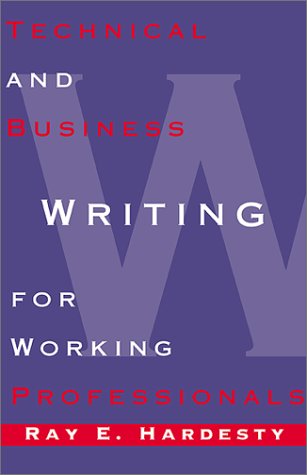

Technical and business writing for working professionals Ray E. Hardesty.
Detalles de publicación: [S.l.] R. E. Hardesty c2000.Descripción: 229 p. ill. 22 cmISBN:- 0738837369 (hbk.)
- 0738837377 (softcover)
- 808.0666 H2598t 21
| Imagen de cubierta | Tipo de ítem | Biblioteca actual | Biblioteca de origen | Colección | Ubicación en estantería | Signatura topográfica | Materiales especificados | Info Vol | URL | Copia número | Estado | Notas | Fecha de vencimiento | Código de barras | Reserva de ítems | Prioridad de la cola de reserva de ejemplar | Reservas para cursos | |
|---|---|---|---|---|---|---|---|---|---|---|---|---|---|---|---|---|---|---|
| Libro | Biblioteca Encarnación Valdés Colección General bev | 808.0666 H2598t (Navegar estantería(Abre debajo)) | Disponible | 80000002159427 |
Descripciones mejoradas de Syndetics:
In terms of writing support, working professionals have been left in the lurch during the past decade, as corporations and other organizations have downsized their writing staffs or eliminated them altogether. More and more, the writing tasks are falling on technical staff members and managers. Unfortunately, many such professionals feel ill-equipped to carry out these writing responsibilities. If you find yourself in that situation, Technical and Business Writing for Working Professionals by Ray E. Hardesty is the book to get you through.
Mr. Hardesty's broad knowledge of technical and business communication comes from more than thirty years of experience as a newspaper and trade magazine journalist and as a technical writer and editor in several industries. He has experience in the petroleum industry, the semiconductor equipment industry, the electronics industry, and the aerospace industry, including both aircraft component manufacturing and the U.S. space program. He has presented papers at international technical communications conferences, and he has taught technical and business writing at the post-secondary level and in corporate environments. Currently, he is a writer with the distance-learning company Quisic, located in Hollywood, California.
The book stresses two vital aspects of technical and business communication: (1) the mechanics of the English language, and (2) the techniques of writing and communicating well in technical and business environments. The emphasis on these two areas comes from Mr. Hardesty's concept that language "is nothing less than the organizational structure we use to understand the world and express that understanding to others."
The first part of the book provides the reader with a rigorous re-acquaintance with the structure of the English language, including parts of speech and sentence structure. In the second part, the author discusses technical writing topics, including short forms, nomenclature, technical writing style, formats, and the writing process. The last part, on business writing, covers background topics such as "identifying the audience," "business writing tone," and "the importance of brevity" and then examines the types of business writing facing modern professionals, including e-mail correspondence, interoffice memorandums, formal business letters, internal reports, external proposals, and presentations. On all of these topics, Mr. Hardesty brings to bear his extensive experience in working with professionals of all types in business, industry, and academia.
Includes index.
Tabla de contenidos provista por Syndetics
- Introduction(p. 11)
- Part 1 Basics of English
- Parts of Speech: Nouns(p. 19)
- Parts of Speech: Pronouns(p. 26)
- Parts of Speech: Verbs(p. 35)
- Parts of Speech: Adjectives(p. 48)
- Parts of Speech: Adverbs(p. 55)
- Parts of Speech: Prepositions(p. 61)
- Parts of Speech: Conjunctions(p. 66)
- Sentence Structure(p. 73)
- Part 2 Technical Writing
- Introduction(p. 89)
- The First Two Laws of Good Technical Writing(p. 91)
- Short Forms(p. 92)
- Grammar and Punctuation: Syntax and Usage(p. 96)
- Grammar and Punctuation: Syntax and Usage(p. 96)
- Grammar and Punctuation: Punctuation(p. 102)
- Nomenclature(p. 107)
- Technical Writing Style(p. 111)
- Format(p. 116)
- The Writing Process(p. 123)
- Part 3 Business Writing
- Identifying the Audience(p. 133)
- Business Writing "Tone"(p. 138)
- The Importance of Brevity(p. 150)
- E-Mail Correspondence and Interoffice Memorandums(p. 154)
- The Formal Business Letter(p. 168)
- The Internal Report(p. 179)
- The External Proposal(p. 192)
- Presentations(p. 205)
- Index(p. 221)