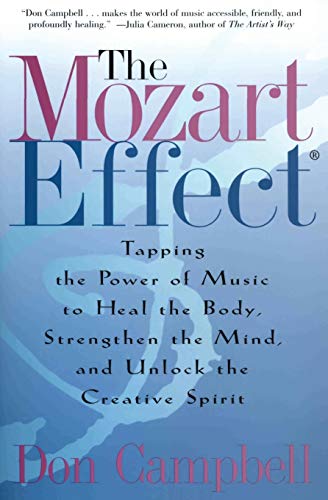

The Mozart effect tapping the power of music to heal the body, strengthen the mind, and unlock the creative spirit Don Campbell.
Detalles de publicación: (New York) Quill (2001).Descripción: xv, 334 p. 21 cmISBN:- 0060937203 (pbk.)
| Imagen de cubierta | Tipo de ítem | Biblioteca actual | Biblioteca de origen | Colección | Ubicación en estantería | Signatura topográfica | Materiales especificados | Info Vol | URL | Copia número | Estado | Notas | Fecha de vencimiento | Código de barras | Reserva de ítems | Prioridad de la cola de reserva de ejemplar | Reservas para cursos | |
|---|---|---|---|---|---|---|---|---|---|---|---|---|---|---|---|---|---|---|
| Libro | Biblioteca Encarnación Valdés Sala de Música | SM 615.85154 C1876m (Navegar estantería(Abre debajo)) | Disponible | 80000002147547 |
Descripciones mejoradas de Syndetics:
Anyone who has ever seen a two-year-old start bouncing to a beat knows that music speaks to us on a very deep level. But it took celebrated teacher and music visionary Don Campbell to show us just how deep, with his landmark book The Mozart Effect.
Stimulating, authoritative, and often lyrical, The Mozart Effect has a simple but life-changing message: music is medicine for the body, the mind, and the soul. Campbell shows how modern science has begun to confirm this ancient wisdom, finding evidence that listening to certain types of music can improve the quality of life in almost every respect. Here are dramatic accounts of how music is used to deal with everything from anxiety to cancer, high blood pressure, chronic pain, dyslexia, and even mental illness.
Always clear and compelling, Campbell recommends more than two dozen specific, easy-to-follow exercises to raise your spatial IQ, "sound away" pain, boost creativity, and make the spirit sing!
A hardcover edition of this book was published in 1997 by Avon Books, Inc.
Includes bibliographical references and index.
Tabla de contenidos provista por Syndetics
- Preface: Looking Back ... and Gazing Foward: A Few Words from Don Campbell(p. xiii)
- Overture: The Speech of Angels and Atoms(p. 1)
- Introduction: A Healing Breeze of Sound(p. 3)
- Chapter 1 Sound Beginnings: The Mozart Effect(p. 13)
- Chapter 2 Sound Listening: The Anatomy of Sound, Hearing, and Listening(p. 31)
- Chapter 3 Sound Healing: The Healing Properties of Sound and Music(p. 60)
- Chapter 4 Sound Voice: Your Original Healing Instrument(p. 86)
- Chapter 5 Sound Medicine: Using Music for Therapy and Rehabilitation(p. 121)
- Chapter 6 Sound Images: Orchestrating the Mind and Body(p. 154)
- Chapter 7 Sound Intellect: Enhancing Learning and Creativity with Music(p. 175)
- Chapter 8 Sound Spirit: The Bridge Between Life and Death(p. 208)
- Coda: The Eternal Song(p. 218)
- Postlude: Miracle Stories of Treatment and Cure(p. 220)
- Sound Resources(p. 284)
- Recommended Reading(p. 295)
- Notes(p. 302)
- Index(p. 324)