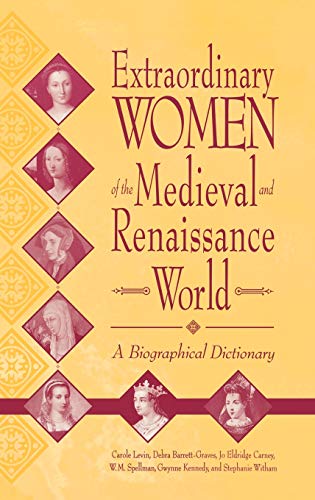

Extraordinary women of the Medieval and Renaissance world a biographical dictionary Carole Levin ... [et al.].
Detalles de publicación: Westport, Conn. Greenwood Press 2000.Descripción: xviii, 327 p. ill. 24 cmISBN:- 0-313-30659-1 (hardcover : alk. paper)
- HQ1143 .E93 2000
| Imagen de cubierta | Tipo de ítem | Biblioteca actual | Biblioteca de origen | Colección | Ubicación en estantería | Signatura topográfica | Materiales especificados | Info Vol | URL | Copia número | Estado | Notas | Fecha de vencimiento | Código de barras | Reserva de ítems | Prioridad de la cola de reserva de ejemplar | Reservas para cursos | |
|---|---|---|---|---|---|---|---|---|---|---|---|---|---|---|---|---|---|---|
| Libro | Biblioteca Encarnación Valdés Sala de Referencia bev | 920.7203 E9697 (Navegar estantería(Abre debajo)) | Disponible | 80000002147109 |
Descripciones mejoradas de Syndetics:
Aside from a few famous queens, warriors and religious leaders, little information is available about the many extraordinary women of the medieval and Renaissance world. This resource brings together engagingly written biographical profiles of 70 women, most of whom are unsung, but all of whom are remarkable for their courage, initiative, and accomplishments in a world where the conventional wisdom was for women to be chaste, silent, and obedient. The women profiled here represent 18 countries and excelled in 19 fields of endeavor. They include artists, builders, mystics, political leaders, religious activists, diarists and dramatists, poets and writers, and scholars.
In a world where women were taught to prefer silence to speech and self-expression, and where an assertive woman was considered an abnormal one, these women did speak out and assert themselves. This often required the courage to refute the moral dictates of the time, to put themselves at risk for their beliefs, or to take political power for themselves. Some women succeeded and some were destroyed in their efforts. These profiles, prepared by specialists in women's history, are based on the latest scholarship and offer a wealth of information not available elsewhere. Each profile features biographical data, an engagingly written biographical essay that discusses the woman's life in the context of her society, and bibliographic sources for further research. This work makes the lives of these extraordinary women accessible to the wide audience of students and interested readers and is ideal for student research.
Includes bibliographical references (p. [313]-314) and index.
Tabla de contenidos provista por Syndetics
- Acknowledgments(p. xi)
- Introduction(p. xiii)
- Note to the Reader(p. xix)
- Akka Mahadevi(p. 1)
- Sofonisba Anguissola(p. 4)
- Anne Askew(p. 9)
- Elizabeth Barton(p. 14)
- Blanche of Castile(p. 17)
- Bridget of Sweden(p. 22)
- Elizabeth Cary(p. 26)
- Catherine of Siena(p. 32)
- Christina of Denmark(p. 37)
- Christina of Markyate(p. 40)
- Margaret Giggs Clement(p. 43)
- Lady Anne Clifford(p. 48)
- Vittoria Colonna(p. 52)
- The Cooke Sisters(p. 57)
- Margherita Datini(p. 60)
- Marie Dentiere(p. 63)
- Jane Dormer(p. 66)
- Elisabeth of Schonau(p. 71)
- Elizabeth of Braunschweig(p. 75)
- Isabella d'Este(p. 78)
- Jacqueline Felicie(p. 84)
- Lavinia Fontana(p. 87)
- Veronica Franco(p. 91)
- Veronica Gambara(p. 95)
- Artemisia Gentileschi(p. 98)
- Giulia Gonzaga(p. 103)
- Argula von Grumbach(p. 107)
- Anne Halkett(p. 111)
- Elizabeth Hardwick(p. 116)
- Helisenne de Crenne(p. 122)
- Hrotsvit of Gandersheim(p. 125)
- Hurrem Sultan(p. 129)
- Esther Inglis(p. 134)
- Izumi Shikibu(p. 138)
- Jadwiga of Poland(p. 142)
- Juana of Castile(p. 147)
- Anna Komnena(p. 153)
- Helene Kottaner(p. 157)
- Louise Labe(p. 160)
- Aemilia Lanyer(p. 164)
- Lucretia de Leon(p. 168)
- Anne Locke(p. 172)
- Katherine Luther(p. 176)
- Malinche(p. 181)
- Margaret of Anjou(p. 185)
- Margaret of Austria(p. 190)
- Marguerite de Valois(p. 194)
- Mary of Hungary(p. 198)
- Mechthild of Magdeburg(p. 202)
- Melisende, Queen of Jerusalem(p. 208)
- Eleanor de Montfort(p. 213)
- Murasaki Shikibu(p. 218)
- Nzinga, Queen of Angola(p. 223)
- Ono no Komachi(p. 228)
- Caritas Pirckheimer(p. 232)
- Diane de Poitiers(p. 238)
- Marguerite Porete(p. 241)
- Raziya, the Sultan(p. 245)
- Renee of Ferrara(p. 249)
- Margaret More Roper(p. 252)
- Maria de Salinas(p. 257)
- Sei Shonagon(p. 261)
- Caterina Sforza(p. 265)
- Gaspara Stampa(p. 270)
- Arbella Stuart(p. 273)
- Levina Teerlinc(p. 278)
- Elizabeth Jane Weston(p. 281)
- Catherine Willoughby(p. 285)
- Mary Wroth(p. 291)
- Katharina Zell(p. 295)
- Appendix A Notable Women by Title, Occupation, or Main Area of Interest(p. 299)
- Appendix B Notable Women by Country or Region(p. 305)
- Timeline of Historical Events(p. 309)
- Selected Bibliography(p. 313)
- Index(p. 315)
Reseñas proporcionadas por Syndetics
CHOICE Review
On first sight, this volume may seem useful. Few biographical sources provide information about such lesser figures as Elizabeth Barton (the Nun of Kent) and Caritas Pirckheimer. But a closer examination reveals some serious flaws. Omission of such noted figures as Hildegard of Bingen and Joan of Arc leaves great holes in coverage. The inclusion of a few women from Mexico (one), India (two) and Japan (four) provides little multicultural depth. The articles, for the most part, are not written for scholarly readers; most seem designed for undergraduates. The result is thin coverage of a period that cries out for more and better study of women, famous and obscurely ordinary. This small selection, roughly alphabetized, with tables of occupation, title, area of interest, and country or region, plus a sketchy chronology, does insufficient justice to the topic. For undergraduate collections. T. M. Izbicki; Johns Hopkins UniversityBooklist Review
Women such as Eleanor of Aquitaine, Joan of Arc, and Elizabeth I of England are known to anyone who has studied history, but a second tier of women also flourished during the Middle Ages and Renaissance and left a mark during their own lifetimes. These women are the focus of this biographical dictionary. According to the introduction, this work is aimed at the "unsung" women who were extraordinary for either their accomplishments or their tragic lives or both. The 70 women covered moved outside what was considered a "woman's sphere" and participated in the religious, political, and social changes that are hallmarks of this period. They lived between the tenth and seventeenth centuries and not all were Western European but also from Eastern Europe, Asia, and Africa. Among them are Indian devotional poet Akka Mahadcvi, Italian painter Sofonisba Anguissola, Polish queen Jadwiga, and Japanese author Murasaki Shikibu. The entries are arranged in alphabetical order, with a brief subheading noting country and occupation. As much information as is known about the person is summarized, including education, family, and achievements. Each article ends with a bibliography of additional sources of information. A number of the articles include portraits. Cross-references to other entries are provided within the text and indicated by bold type. Two useful appendixes, "Notable Women by Title, Occupation, or Main Area of Interest" and "Notable Women by Country or Region," help to locate individuals by categories. A general "Timeline of Historical Events" helps place the women in relation to major events. A bibliography of 21 titles on medieval and Renaissance topics will guide the user to additional information. The articles are well written and signed by the authors. Speculation is labeled clearly as speculation because the records on many women are incomplete. For example, most of the information on French physician Jacqueline Felicie comes from her 1322 trial for practicing medicine without a license. Because it expands the information available on women who are often just mentioned in passing in historical works, this volume is interesting for both browsing and research. Its somewhat narrow scope makes it appropriate for academic and public libraries with collections on women's or medieval and Renaissance studies, although its writing style would appeal to a high-school audience as well.Notas de autor provistas por Syndetics
Carole Levin is professor of history at the University of Nebraska, where her specialties are English history and women's history. Her articles have appeared in such journals as Albion , The Sixteenth Century Journal , Shakespeare Yearbook , and Exemplaria . She is the author of numerous books and essays in edited collections, has held long-term fellowships at the Folger Shakespeare Library and the Newberry Library, and is a Fellow of the Royal Historical Society.
Debra Barrett-Graves is assistant professor of English at the College of Santa Fe where she won the Manuel Lujan Award for Excellence in Teaching. Her articles appear in Shakespeare Yearbook and The Early Drama, Art, and Music Review . She is currently writing a book on servants and service in Shakespearean and Elizabethan drama. She is a member of the Shakespeare Association of America and the North American Branch of the Society for Emblem Studies.
Jo Eldridge Carney is associate professor of English at the College of New Jersey, where she teaches medieval and Renaissance literature. She has published articles in edited collections and journals and is the editor of the biographical dictionary Renaissance and Reformation, 1500-1620 (Greenwood Press, 2000).
W. M. Spellman is professor of history at the University of North Carolina at Asheville where his specialties are English history and European political thought. His articles have appeared in such journals as Anglican and Episcopal History and the Harvard Theological Review . He is the author of numerous books and has held long term fellowships from the National Endowment for the Humanities and from the Tanner Humanities Center at the University of Utah.
Gwynne Kennedy is associate professor of English at the University of Wisconsin-Milwaukee, where she teaches early modern literature and women's studies courses. She has written several articles on women writers in early modern England and has recently published a book on early modern English women's anger.
Stephanie Witham is completing her PhD in English at the University of Nebraska on the topic of Renaissance women writers. She has taught at the College of St. Mary.