
| Imagen de cubierta | Tipo de ítem | Biblioteca actual | Biblioteca de origen | Colección | Ubicación en estantería | Signatura topográfica | Materiales especificados | Info Vol | URL | Copia número | Estado | Notas | Fecha de vencimiento | Código de barras | Reserva de ítems | Prioridad de la cola de reserva de ejemplar | Reservas para cursos | |
|---|---|---|---|---|---|---|---|---|---|---|---|---|---|---|---|---|---|---|
| Referencia | Biblioteca Encarnación Valdés Sala de Referencia bev | 364.03 S1293 (Navegar estantería(Abre debajo)) | Disponible | 80000002134321 |
Descripciones mejoradas de Syndetics:
`The compilers have done criminology a tremendous service. This dictionary is an invaluable resource for students and teachers and I′m certain will be a key reference work for years to come′ - Professor Tim Newburn, Goldsmiths College, University of London
`Great dictionaries inform, intrigue and investigate. McLaughlin and Muncie′s perceptive collection does all three. The SAGE Dictionary of Criminology is wide and accessible enough to interest anyone concerned with crime, the law and the panoply of issues and explanations that surround them. This admirable volume will inform, guide and contribute to debates in the years ahead′ - Ellis Cashmore, Professor of Culture, Media and Sport, Staffordshire University, author of Dictionary of Race and Ethnic Relations and co-editor of Dictionary of Cultural Theorists
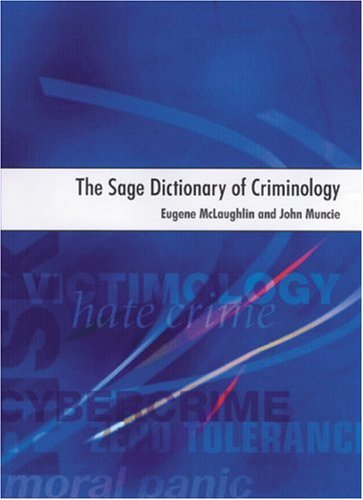
Eugene McLaughlin and John Muncie have brought together, for the first time, the work of some 70 academics and practitioners worldwide to produce the definitive reference and research tool for criminological studies and related fields.
The SAGE Dictionary of Criminology is informed by the principle that criminology is a contested, contradictory and interdisciplinary discourse marked by constant incursion, interactions, translations, deviations and transgressions. It is this diversity that makes the study of crime and criminal justice both complex and challenging. The dictionary sets out and explores traditional and emergent agendas in criminological studies to not only reveal its grounding in a myriad of theoretical and conceptual concerns but also to draw attention to its expansive and developing subject matter.
As a result there is no one conception of criminology to be found in the dictionary but rather a multitude of criminological perspectives which in themselves often depend and draw upon knowledges and concerns generated from elsewhere.
This excellent reference tool concludes with both a subject and a name index to further enhance its accessibility. All of these features establish this work as a leading study guide for introductory courses in the field, as a primary source of reference for advanced study, a necessary supplement to established textbooks and as a state-of-the-art reference guide to the specialized language of theoretical and conceptual criminology.
The SAGE Dictionary of Criminology provides a comprehensive introduction to criminological theory, its diverse frames of reference and its expansive modes of analysis. An up-to-date and accessible resource for students and teachers in the fields of criminology, criminal justice studies, the sociology of crime and deviance, socio-legal studies, social policy, criminal law and social work.
The Entries:
The entries have been compiled from a truly international group of contributors including:
- Jock Young on Left Realism
- Hal Pepinsky on Peacemaking Criminology
- Clive Hollin on Psychologies of crime
- Kathleen Daly on Feminist criminologies
- Barbara Hudson on Justice
- Tony Jefferson on Masculinities
- Jill Radford on Radical Feminism
- Willem de Haan on Redress
- Pat O′Malley on Governmentality
- Colin Sumner on Censure
- Betsy Stanko on Violence
- Jeff Ferrell on Cultural criminology
- Sandra Walklate on Victimisation
- Richard Sparks on Penality
- Robert Agnew on Strain theory
- Gregg Barak on Newsmaking criminology
- Dragan Milovanovic on Postmodernism
- Stuart Henry on Crime
- David Greenberg on Criminal careers
Each entry is either:
central to the field
an intellectual benchmark
a major theoretical position
a key theoretical concept
a central criminological method
a core criminal justice philosophy or practice
an emergent theme in the shifting and expanding field of criminological studies.
Each entry contains:
Definition - which sets out the basic parameters of the concept itself.
Distinctive features - which are encyclopaedic in style and allow for some detailed comment on the concept′s origins, development and general significance.
Evaluation -of those concepts considered to have greatest theoretical weight and lasting legacy in order to encourage critical reflection.
Associated concepts - to cross reference to related concepts included in the dictionary and to facilitate a broader and in-depth study.
Key readings - to reinforce the aim of the dictionary as a learning resource to be built upon by the reader.
Subject and Name index - to further enhance the text book′s accessibility.
The SAGE Dictionary of Criminology:
A leading study guide for introductory courses in the field.
A primary source of reference for advanced study.
A necessary supplement to established textbooks.
A state-of-the-art reference guide to the specialized language of theoretical and conceptual criminology.
International Advisory Board
Pat Carlen , University of Bath, UK
Stuart Henry , Wayne State University, Michigan, USA
Tony Jefferson , University of Keele, UK
Victor Jupp , University of Northumbria, UK
Pat O′Malley , La Trobe University, Melbourne, Australia
Joe Sim , Liverpool John Moores University, UK
Elizabeth Stanko , Royal Holloway University of London, UK
René van Swaaningen , Erasmus University Rotterdam, The Netherlands
Includes bibliographical references and index.
Tabla de contenidos provista por Syndetics
- List of Contributors
- Editors' Introduction
- The Dictionary of Criminology
- Subject Index
- Name Index
Notas de autor provistas por Syndetics
International Advisory BoardPat Carlen , University of Bath, UK
Stuart Henry , Wayne State University, Michigan, USA
Tony Jefferson , University of Keele, UK
Victor Jupp , University of Northumbria, UK
Pat O′Malley , La Trobe University, Melbourne, Australia
Joe Sim , Liverpool John Moores University, UK
Elizabeth Stanko , Royal Holloway University of London, UK
Rene van Swaaningen , Erasmus University Rotterdam, The Netherlands
CONTRIBUTORS′ AFFILIATIONS OUTSIDE NORTH AMERICA:
Benjamin Bowling King′s College London
Jennifer Bradshaw Karori, Wellington New Zealand
Trevor Bradley Victoria University, Wellington
Pat Carlen University of Bath
Eamonn Carrabine University of Essex
Kathryn Chadwick Edge Hill University College
John Clarke Open University
Roy Coleman Liverpool John Moores University
Iain Crow University of Sheffield
Kathleen Daly Griffith University, Brisbane
Julia Davidson Westminster University
Willem de Haan State University Groningen
Anna Duncan Victoria University, Wellington
Paul Ekblom The Home Office, London
Clive Emsley Open University, Bedford
Loraine Gelsthorpe University of Cambridge, UK
Pete Gill Liverpool John Moores University
Nic Groombridge St Mary′s University College
Keith Hayward University of East London
Frances Heidensohn Goldsmiths College
Paddy Hillyard University of Ulster at Jordanstown
Clive Hollin University of Leicester
Barbara Hudson University of Central Lancashire
Gordon Hughes The Open University
Ruth Jamieson Keele University
Tony Jefferson Keele University
Victor Jupp University of Northumbria at Newcastle
Maggy Lee Essex University
Wayne Morrison Queen Mary & Westfield College, London
Karim Murji The Open University
Pat O′Malley La Trobe University, Australia
Ken Pease University of Huddersfield
Mike Presdee University of Sunderland
Jill Radford University of Teesside
Roger Sapsford University of Teesside
Esther Saraga Open University
Phil Scraton Edge Hill College of Higher Education
James Sheptycki University of Durham
Joe Sim Liverpool John Moores University
Richard Sparks Keele University
Betsy Stanko Royal Holloway, University of London
Colin Sumner University of East London
Maggie Sumner Westminster University
Rene van Swaaningen Erasmus Universiteit Rotterdam
Mark Thornton Victoria University, Wellington
Steve Tombs Liverpool John Moores University
Tonia Tzannetakis University of Athens
Claire Valier Lancaster University
Sandra Walklate Manchester Metropolitan University
Reece Walters Victoria University, Wellington
Louise Westmarland Scarman Centre,University of Leicester
Nicole Westmarland University of Stirling
Dick Whitfield Probation Office, Kent
Dave Whyte Liverpool John Moores University
David Wilson University of Central England
Anne Worrall Keele University
Jock Young University of Middlesex