Imagen de Amazon.com

Portada de Syndetics
Imagen de OpenLibrary
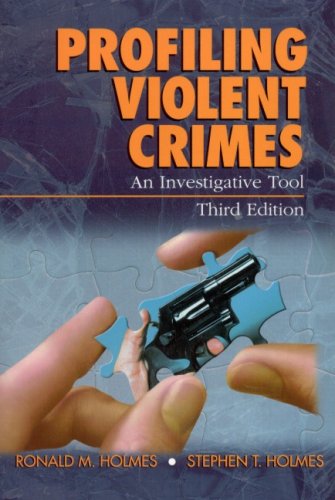
Profiling violent crimes Ronald M. Holmes and Stephen T. Holmes.
Detalles de publicación: Thousand Oaks, Calif. London SAGE 2002.Edición: 3rd edDescripción: 1 vISBN:- 0761925937
- 0761925945 (PBK.)
- 363.25 H7491p3 21
| Imagen de cubierta | Tipo de ítem | Biblioteca actual | Biblioteca de origen | Colección | Ubicación en estantería | Signatura topográfica | Materiales especificados | Info Vol | URL | Copia número | Estado | Notas | Fecha de vencimiento | Código de barras | Reserva de ítems | Prioridad de la cola de reserva de ejemplar | Reservas para cursos | |
|---|---|---|---|---|---|---|---|---|---|---|---|---|---|---|---|---|---|---|
| Libro | Biblioteca Encarnación Valdés Colección General bev | 363.25 H7491p3 (Navegar estantería(Abre debajo)) | Disponible | 80000002134172 |
Total de reservas: 0
Descripciones mejoradas de Syndetics:
The Third Edition is a thorough revision, as is appropriate in such a fast-moving field. New chapters cover criminal behavior theories and psychological profiling; autoerotic deaths; occult crimes; plus two new chapters detailing two infamous unsolved crimes: Jack the Ripper and the Jon Benet Ramsay case. The authors continuing research and activities in the field result in new case studies for the book, often as boxed inserts.
Previous ed.: 1996.
Bibliography.
Includes index.
Tabla de contenidos provista por Syndetics
- Psychological Profiling
- An Introduction
- Profiling in Fantasy and Fact
- Criminal Theories and Psychological Profiling
- The Rationale for Psychological Profiling
- The Analysis of the Crime Scene
- Profiling Serial Murder
- Arson and Psychological Profiling
- Psychological Profiling and Rape
- Pedophilia and Psychological Profiling
- Geography, Profiling, and Predatory Criminals
- Computer Database Construction for Psychological Profiling
- The Victim in Psychological Profiling
- Profiling and the Future
Reseñas proporcionadas por Syndetics
CHOICE Review
Holmes, one of the few academic experts in this field, contends that profiling crime with the assistance of computerized monitoring can become a scientifically sophisticated method for criminal investigation. He draws upon his experience with more than 50 homicide and rape cases and interviews with convicted murderers, framed within concepts from the behavioral sciences (frustration/aggression, the criminal personality, psychopathy, and strain theory) to support his thesis. Arguments for a wider employment of profiling are prefaced with caveats: "Profiles are not as neat as in fiction. . . . There is little empirical data to substantiate a criminal syndrome"; the FBI found profiling useful only 15 of the time. The author notes that profiling is not suitable for all cases, yet he contends that it may be practical in assisting the police in those cases where "motives of normal' killings are absent" and where the "unknown perpetrator has exhibited signs of psychopathy." Despite this flawed assumption (i.e., the validity of psychopathology), the book is well written albeit with fascinating and chilling descriptions of heinous crimes, and it provides models for the analysis of crime scenes--serial murders, rape, satanic murder, and the role of the victim--in criminal investigation. Community college, undergraduate, and public libraries. P. M. Wickman SUNY College at PotsdamNotas de autor provistas por Syndetics
He is Professor of Justice Administration at the University of Louisville. He is Vice President of the National Center for the Study of Unresolved Homicides. He received his doctorate from Indiana University.050