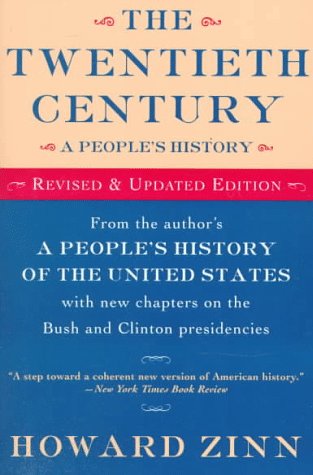
Imagen de portada de Amazon
Imagen de Amazon.com
Imagen de cubierta Syndetics
Portada de Syndetics
Imagen de OpenLibrary

The twentieth century, a people's history Howard Zinn.

Por: Detalles de publicación: New York, NY HarperPerennial 1998.Edición: Rev. and updated edDescripción: xii, 468 p. 21 cmISBN:
  • 0060951982 (pbk.)
Otro título:
  • 20th century, a people's history
Tema(s): Clasificación CDD:
  • 973.9 Z784t 21
Clasificación LoC:
  • E741 .Z55 1998
Valoración
    Valoración media: 0.0 (0 votos)
Existencias
Imagen de cubierta Tipo de ítem Biblioteca actual Biblioteca de origen Colección Ubicación en estantería Signatura topográfica Materiales especificados Info Vol URL Copia número Estado Notas Fecha de vencimiento Código de barras Reserva de ítems Prioridad de la cola de reserva de ejemplar Reservas para cursos
Libro Biblioteca Encarnación Valdés Colección General bev 973.9 Z784t (Navegar estantería(Abre debajo)) Disponible 80000002126624
Total de reservas: 0

Descripciones mejoradas de Syndetics:

Based on the revised 1995 edition of Howard Zinn's landmark alternative history of America, A People's History of the United States, this revised and updated edition of The Twentieth Century (more than 40,000 copies sold) includes a new chapter on Clinton's first term and a new preface. Containing justthe Twentieth-century chapters from Howard Zinn's bestselling A People's History of the United States, this reissue is brought up-to-date with coverage of events and developments since the mid-1980s, analyzing such incidents in modern political history as the Gulf War, the post-Cold War peace divided, and the continuing debate over welfare. Highlighting not just the usual terms of presidential administrations and congressional activities, this book provides readers with a bottom-to-top perspective, giving voice to our nation's minorities and letting the stories of such groups as African American, women, Native Americans, and the laborers of all nationalities be told in their own words. Challenging traditional interpretations of U.S. history, The Twentieth Century is the book for readers interested in gaining a more realistic and complete picture of our world.

Includes bibliographical references (p. [445]-457) and index.

Extracto provisto por Syndetics

Twentieth Century, The A People's History Chapter One The First Decade 1900 - 09 As the twentieth century opened, wars were being fought on two continents: in Africa and in Asia. In South Africa, the Boer War was entering its eleventh week, the Boers, in their two independent republics, the Transvaal and the Orange Free State, having taken on the might of the British Empire in neighbouring Cape Colony and Natal. The first battle of 1900 in South Africa took place on January 6, when Boer forces tried to drive the British from their positions inside the town of Ladysmith, where 20,000 British troops had defended the besieged town for more than two months. Within a month Ladysmith was relieved, 500 British cavalrymen breaking through the Boer ring and galloping through the main street shouting, 'We are here!' Another besieged town, Mafeking, was relieved in May. The rejoicing in London when this news reached the capital was so vociferous and enthusiastic that the verb 'to Maffick' -- to celebrate without inhibition -- entered the language and remained there for several decades. A month later, Pretoria, the capital of the Transvaal, was occupied. Britain had asserted its imperial power. In China, 'Boxer' rebels, their full name meaning 'Righteous harmonious fists', acting in defiance of the Chinese imperial Government, were attacking foreigners and Christian missions wherever they could. In May 1900 they marched towards Peking under the slogan, 'Death and destruction to the foreigner and all his works'. On the last day of that month an international force of 365 marines reached Peking, with troops from the United States, Britain, Russia, Italy, France and Japan. Two weeks later the Boxers entered the city, destroying most of the foreign-owned buildings that were not within the protective zone of the foreign Legations. The city's Roman Catholic Church was burnt to the ground and Chinese Christians living near it were massacred. Austrians at their Legation managed to rescue a Chinese Christian woman who was being burned to death near their Legation wall. After the Third Secretary of the Japanese Legation was set upon and murdered, Japan announced that she could have 'no more communication with China -- except war'. Foreigners who could reach the security of their respective Legations were protected by the marines, and an international naval force was on its way. On July 28 the German Kaiser, William II, was present at the North Sea port of Bremerhaven when 4,000 German soldiers set sail for China. Wishing them good fortune, he declared: 'When you meet the foe you will defeat him. No quarter will be given, no prisoners will be taken. Let all who fall into your hands be at your mercy. Just as the Huns, a thousand years ago, under the leadership of Attila, gained a reputation in virtue in which they will live in historical tradition, so may the name of Germany become known in such a manner in China that no Chinaman will ever again even dare to look askance at a German.' In the European Legations, under siege for three weeks, sixty-two Europeans were killed. Brought to China by sea, a combined force of 36,000 British, Russian, German, French and Japanese troops advanced on Peking. American troops also took part. On August 14, Russian and American troops attacked the central gates of Peking. British Indian troops were the first to reach the besieged Legations. Fighting continued around the Legations for another two days when Japanese troops entered the Forbidden City. The siege of the Legations was over. In the subsequent savage battle for the nearby Roman Catholic Cathedral and the compound around it 400 Europeans were killed, 200 of them children from the orphanage inside the compound. News of the scale of the killings in China took time to reach those who had despatched the expeditionary force. It was not until late in September that it was learned that at one Catholic mission far from Peking, four priests and seven nuns had been killed, and 1,000 Chinese Christians beheaded. The twentieth century opened with working men in all industrialized countries determined to improve their situation by direct participation in the political process. In London on February 27, representatives of all the British working-class organizations founded the Labour Representation Committee. Its aim was to bring about 'the independent representation of working people in Parliament'. A quarter of a century later, the secretary of the committee, Ramsay MacDonald, became Britain's first Labour Prime Minister. At the end of the, century, a sixth Labour government was in power, and with a substantial parliamentary majority. In Austria-Hungary in 1900, the internal divisions of the Habsburg Empire -- with its mixture of Germans, Czechs, Slovaks, Ruthenes, Poles, Hungarians, Roumanians, Serbs, Croats and Italians -- were much in evidence. During a meeting of the Austrian Parliament that summer the Czech opposition members disrupted the proceedings by blowing penny trumpets, beating cymbals, and producing an array of catcalls. After seven hours of disruption the Prime Minister closed the session. In December 1900, after a ten-year absence, the Italian deputies resumed their seats in the Austrian regional Parliament in the Tyrol, having boycotted the assembly on the grounds that they could always be outvoted by the Germanspeaking deputies. On their return they insisted that their speeches and interjections, which they would only make in Italian, should be translated into German, and read out in full. Not only in his Austrian dominions, but also in his Hungarian kingdom -- the twin pillars of his Dual Monarchy -- the Emperor Franz-Josef faced disaffection. Speaking in the Hungarian Parliament in Budapest, the Hungarian Prime Minister said he was prepared to take the necessary measures 'to assert the rights of Hungary and its independence'. Until the time came to do so, he added, 'let us husband our strength and keep our powder dry'. Twentieth Century, The A People's History . Copyright © by Howard Zinn. Reprinted by permission of HarperCollins Publishers, Inc. All rights reserved. Available now wherever books are sold. Excerpted from All rights reserved by the original copyright owners. Excerpts are provided for display purposes only and may not be reproduced, reprinted or distributed without the written permission of the publisher.

Notas de autor provistas por Syndetics

A committed radical historian and activist, Howard Zinn approaches the study of the past from the point of view of those whom he feels have been exploited by the powerful.

Zinn was born in Brooklyn, New York in 1922. After working in local shipyards during his teens, he joined the U.S. Army Air Force, where he saw combat as a bombardier in World War II. He received a Ph.D. in history from Columbia University in 1958 and was a postdoctoral fellow in East Asian studies at Harvard University.

While teaching at Spelman College in Atlanta, Georgia, Zinn joined the civil rights movement and wrote The Southern Mystique (1964) and SNCC: The New Abolitionists (1964). He also became an outspoken critic of the Vietnam War, writing Vietnam: The Logic of Withdrawal (1967) and visiting Hanoi to receive the first American prisoners released by the North Vietnamese.

Zinn's best-known and most-praised work, as well as his most controversial, is A People's History of the United States (1980). It explores American history under the thesis that most historians have favored those in power, leaving another story untold. Zinn discusses such topics as Native American views of Columbus and the socialist and anarchist opposition to World War I in examining his theory that historical change is most often due to "mass movements of ordinary people."

Zinn's other books include You Can't Be Neutral on a Moving Train: A Personal History of Our Times (1995) and Artists in Times of War (2004). He has also written the plays Emma (1976), Daughter of Venus (1985), and Marx in Soho (1999).

(Bowker Author Biography)

Compartir
logopucpr-y-vive

Contáctanos

¡Queremos saber de ti!

Tel. 787.841.2000 Ext. 1801

bibliotecavaldes@pucpr.edu

⁣Búscanos en las redes

© 2026 Desarrollado por Ignite Online • All Rights Reserved • Powered by Koha.