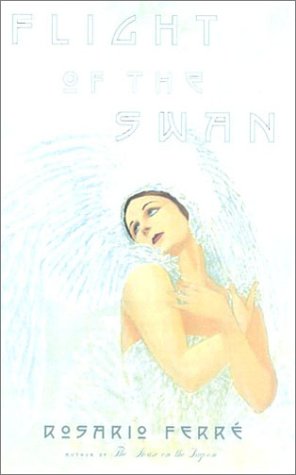
Imagen de portada de Amazon
Imagen de Amazon.com
Imagen de cubierta Syndetics
Portada de Syndetics
Imagen de OpenLibrary
Valoración
    Valoración media: 0.0 (0 votos)
Existencias
Imagen de cubierta Tipo de ítem Biblioteca actual Biblioteca de origen Colección Ubicación en estantería Signatura topográfica Materiales especificados Info Vol URL Copia número Estado Notas Fecha de vencimiento Código de barras Reserva de ítems Prioridad de la cola de reserva de ejemplar Reservas para cursos
Libro Biblioteca Encarnación Valdés Colección de Puerto Rico 813.54 F382f (Navegar estantería(Abre debajo)) Disponible 80000002139700
Total de reservas: 0

Descripciones mejoradas de Syndetics:

The story of a prima ballerina and her acolyte, set in Puerto Rico in 1917. Flight of the Swanis the compelling story of a world-famous Russian prima ballerina who finds herself stranded on a Caribbean island in 1917, due to political upheavals in her own country. This charming jeu d'esprit explores the complexities of love and betrayal, as the loyal servant Masha gradually comes to recognize that in spite of what she sees as Madame's propensity to be both pretentious and vain, the ballerina is prepared to sacrifice everything for her art. Madame's unfaltering commitment to dance above all else -- and her demand of nothing less from her disciples -- forces Masha to question what choices she herself is willing to make when it comes to her own loves, ideals, and relationships. Humorous, engaging, and coyly revealing, Flight of the Swantraces the decisions made by Masha, Madame, and other members of the troupe during their enforced three-month stay in Puerto Rico, and in doing so raises the question of where true happiness lies.

Extracto provisto por Syndetics

Flight of the Swan 1 Very few people know that Madame, the famous Russian ballerina, visited our island from April to September 1917. But my husband, Juan Anduce, and I remembered the time vividly. A few weeks ago, on April 23, 1932, Madame lay dying in an obscure hotel in Amsterdam, asking for her swan costume. "Play the last measure softly," she whispered to the friends who stood around her, the newspaper headlines quoted. No sooner did she pass away, as she lay still warm in her coffin, than her husband, Victor Dandré, was speeding toward London in search of the marriage license which would assure him of his inheritance: magnificent Ivy House, the mansion surrounded by English gardens and a lake full of swans that once belonged to the painter William Turner and which Madame had purchased with her savings. But I knew he'd never find it. I had destroyed the license, a yellowed parchment written in Cyrillic characters, years before. When I read the article I was overwhelmed with recollections. I have lived for fifteen years on this island, almost half as long as I lived in Russia. I still love the color red, as all Russians do-- russ, after all, means red, something few people realize becauseit's so obvious--but my Russian heart is beginning to feel stifled. Incredibly enough, I am growing tired of this island's splendid sun and I miss winter. I would give anything to hear its silence, the stillness that precedes the blizzard, oblivion's snowflakes sifting quietly over my graying head. When my husband, Juan, was still alive, I had very little time to brood about these things because we had the ballet school and needed to keep our students whirling like tops in the studio we built together in San Juan. It was on the second floor of an old house, with several wrought-iron balconies that opened onto the shady Plaza de Armas. The academy was Madame's gift to us when she left the island. The training is difficult and very demanding, but its benefits are countless. It not only gives young men and women the opportunity to find jobs as dancers; it also gives them selfrespect and a sense of who they are. This was Madame's original wish, and I have done my utmost to put it into effect. Juan died of a punctured appendix a few months ago and now I live alone. Fortunately, I still have my studio. But when I close the door after the day's last student has left, I plunge into despair. Time erases everything and at the end we are left with nothing. I refuse to become a ghost, a woman without a country, without love and without memories, clutching at my own shadow.     I was thirty-nine years old when I made the decision to leave Madame's company when she traveled to South America. I stayed behind on this island, where I married Juan Anduce, the cobbler hired to repair the dancers' slippers when our ballet company was stranded here during the Great War. For three months we were virtual prisoners; it was a nightmare for all ofus. The company's ballerinas wore out dozens of slippers each week and it was impossible to have new ones delivered during our tour because of the German submarines. So Madame had to improvise. That's when Juan Anduce, my future husband, turned up, his green eyes gleaming with the island's lushness and a mischievous smile on his face. I had met Madame a number of years earlier, in St. Petersburg. I was young and naive, and one day I went to her apartment on Kolomenskaya Street and asked if she would take me on as a private student. Madame had only recently graduated from the Maryinsky Imperial Ballet School and gave classes at home to a small group of girls to supplement her income. It was from this group that she eventually picked the dancers that formed her company, later taking them on short tours on the Continent when war was about to break out in Russia. I joined the flock of young women and accompanied Madame from Russia to the Baltic when I was nineteen. From there we toured many European countries, until one day we sailed to the United States. Many of our relatives in Russia perished during those years, when the White and Red Armies were grappling in mortal combat along a frontier thousands of miles long. Madame saved us from disaster. Like the rest of the girls in our company, I could have kissed the ground my mistress walked on, dragged myself over a bed of hot coals or needles of ice just to be near her. Those were anguished years, during which we, her followers, spent many sleepless nights worrying about the future. But Madame seemed to glide serenely over the troubled waters of her age: the Russian Revolution, the deaths of millions of her countrymen, even the suffering of this small island which she visited for a short time and to which she could have been indifferent, yet wasn't. It was hard not to revere her if you ever saw herdance; her Odile in Swan Lake and her Aurora in Sleeping Beauty were perfect. But our group held her in special esteem, because she always kept her promises. Madame and I have known each other from way back. I'm the daughter of a Russian peasant from Minsk who used to beat me with a poplar branch every time he got drunk. I survived thanks to a traveling merchant who went by the house one afternoon and saw him beat me. He punched Mastovsky on the chin and took me to live with his own family in St. Petersburg. He had a brother named Dassily who was a ballet master. He came by the house one day and suggested I take classes with him. Of course I was thrilled to do so. A few years went by and I was perfectly happy, but when I turned sixteen, the merchant raped me and began to beat me. Eventually I went to Madame's apartment and knocked on her door. It was 1897 and Madame had just opened a small ballet school at home, and she took in private pupils. I had a strong, slender body, like the peasants of Belarus usually do. Madame took me in as a maid, and later decided to continue my training in dance. Like so many of the young dancers who joined Madame's school, I was a fanatical admirer of the ballerina's art. Since I didn't have the training, I wasn't a good enough dancer to be a soloist, so I danced in the chorus. I was tall and lanky then, not fat and sluggish like I am now, wearing muumuus all the time to conceal my size. Because of my rawboned strength, I always danced at the tail end of the line of girls, always near the wings so I could dart off the stage to help Madame change into one of her costumes, or to help the stagehands out. I admit I was never attractive. I looked a bit like a stork, with a long nose and quick-darting eyes which Madame said were always suspiciously assessing my surroundings. During our free time I washed and ironed Madame's clothes, made her bed, helped dress her, and brushed and tidied up her hair with the silver swan brush and comb one of her admirers had given her, which were always kept in their own leather case. Little by little I became my mistress's confidante. I knew more about Madame than anyone else in the company: who her biological father was, for example, and why Madame would get so upset if anyone mentioned Matvey Federov, the reserve officer who had married her mother, Lyubovna Fedorovna, and who was killed in the war when Madame was only two years old. I knew all of her secrets: how Madame managed to enter the Imperial Ballet School in St. Petersburg, why she married Victor Dandré, a con man and a scoundrel, and why she had stayed with him for so many years. This knowledge gave me power, and the other dancers respected me for it. I was Madame's right hand, the keeper of her flame. The desire for something we do not have is what makes us struggle to better ourselves, as our priest in Minsk used to say. Madame admired and respected me for little things--for my patience and fortitude when there was something that had to be done which no one wanted to do, like mend her costumes, rinse her underwear, or scrub the toilets and pick up pubic hairs from the bathroom floor; for my frugality and generosity; even for my country bumpkin ignorance, which made me less dangerous than her sophisticated dancers from St. Petersburg and London, but also more reliable. I knew I represented the best of Russia for Madame: the muzhik's soul. One day Madame and I made a pact: "I'll take care of you and you take care of me," she said. I naturally agreed. Anyone who knows something about love knows it's the lover, rather than the beloved, who is the stronger, and my love for Madame made me as solid as a rock. Copyright (c) 2001 by Rosario Ferré All rights reserved Excerpted from Flight of the Swan by Rosario Ferré All rights reserved by the original copyright owners. Excerpts are provided for display purposes only and may not be reproduced, reprinted or distributed without the written permission of the publisher.

Reseñas proporcionadas por Syndetics

Library Journal Review

Puerto Rican writer Ferr first published novels and stories in Spanish and then with National Book Award nominee The House on the Lagoon began writing in English. Her most recent English-language effort, inspired by Russian ballerina Anna Pavlova's tours of Latin America, is the engaging story of a world-famous but aging ballerina named "Madame" who finds herself and her ragtag company of dancers stranded in Puerto Rico in 1917. Madame's affair with a 20-year-old Puerto Rican revolutionary is seen from the perspective of Masha, Madame's adoring servant and companion, who herself falls in love with a black Puerto Rican shoemaker. The stateless Russians are in Puerto Rico at a time of ferment, when that country has just been acquired by the United States. Masha, born a peasant in Minsk, recognizes herself as a true Bolshevik as she witnesses the oppression on the island that will ultimately become her home. This book is lighter than Ferr's previous English-language novels, which include Eccentric Neighborhoods as well as Lagoon, but should be equally applauded for its finely crafted language and its sense of history and place. [Previewed in Prepub Alert, LJ 2/15/01.] Mary Margaret Benson, Linfield Coll. Lib., McMinnville, OR (c) Copyright 2010. Library Journals LLC, a wholly owned subsidiary of Media Source, Inc. No redistribution permitted.

Publishers Weekly Review

Love and betrayal, political upheaval, the sacrifices required by dedication to art, and class differences are some of the themes that Ferr? (The House on the Lagoon) engages in this imaginatively conceived but strangely lackluster story of a Russian ballet company stranded in Puerto Rico in 1917. Suddenly rendered stateless by the Russian revolution, a touring troupe headed by a famous prima ballerina is forced to remain in San Juan. As narrated by Masha, a member of the company who idolizes Madame and serves as her devoted maid and confidante, the troupe becomes caught up in the nascent Puerto Rican independence movement. Madame, who preaches the sanctity of art to her virginal acolytes, herself falls in love with Diamantino M rquez, a young man half her age, who uses her to further his revolutionary activities. Devastated by Madame's emotional abandonment, Masha attempts to save her mistress from her unwise passion. At first, Ferr?'s straightforward narrative style ably conveys a wealth of background information, but soon digressions to explain historical events and long monologues overwhelm the plot. Jarringly, Masha's narration is broken off abruptly and briefly late in the story to introduce another voice. Overall, the novel is bland, devoid of stylistic distinction and sadly lacking in dramatic tension: even the climactic scene describing a tragic brawl during a carnival has little suspense. Despite Ferr?'s laudable intentions to encapsulate a period of Puerto Rican history by fictionalizing some events in the life of Russian ballerina Anna Pavlova, this novel falls short of her previous work. (June) Forecast: A highly successful novelist in Puerto Rico, Ferr? began her career writing in Spanish. She now writes directly in English, which may account for the pedestrian quality of this novel. Since there is more gusto in her Spanish prose, which she herself has called "baroque," a Spanish-language version of this novel will undoubtedly find a wider audience. (c) Copyright PWxyz, LLC. All rights reserved

Notas de autor provistas por Syndetics

Rosario Josefina Ferré was born in Ponce, Puerto Rico on September 28, 1938. She received a bachelor's degree in English literature from Manhattanville College, a master's degree in literature from the University of Puerto Rico, and a Ph.D. in Latin American literature from the University of Maryland. She was a professor of Latin American literature at several universities including the University of California, Rutgers University, Harvard University, Johns Hopkins University, and the University of Puerto Rico.

She was a novelist, poet, essayist, and children's book author. She was the editor of the literary magazine Loading and Unloading Zone as well as a newspaper columnist and critic. She wrote several books in Spanish and English including The House on the Lagoon, Eccentric Neighborhoods, and Sweet Diamond Dust: And Other Stories. She died on February 18, 2016 at the age of 77.

(Bowker Author Biography)

Compartir
logopucpr-y-vive

Contáctanos

¡Queremos saber de ti!

Tel. 787.841.2000 Ext. 1801

bibliotecavaldes@pucpr.edu

⁣Búscanos en las redes

© 2026 Desarrollado por Ignite Online • All Rights Reserved • Powered by Koha.