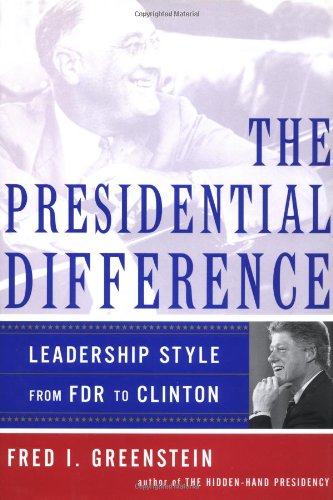

The Presidential Difference leadership style from FDR to Clinton with a new afterword on George W. Bush / Fred I. Greenstein.
Idioma: Español Detalles de publicación: New Jersey: Princeton University Press, c2000.Descripción: vii, 293 p.: ill.; 24 cmTipo de contenido:- 0684827336
- E 176.1 .G744 2000
| Imagen de cubierta | Tipo de ítem | Biblioteca actual | Biblioteca de origen | Colección | Ubicación en estantería | Signatura topográfica | Materiales especificados | Info Vol | URL | Copia número | Estado | Notas | Fecha de vencimiento | Código de barras | Reserva de ítems | Prioridad de la cola de reserva de ejemplar | Reservas para cursos | |
|---|---|---|---|---|---|---|---|---|---|---|---|---|---|---|---|---|---|---|
| Libro | Biblioteca de Mayagüez Sala de Referencia mb | E176.1 .G744 2000 (Navegar estantería(Abre debajo)) | Disponible | 50000002137684 |
Descripciones mejoradas de Syndetics:
Fred Greenstein is among the top students of the American presidency - his book on Eisenhower, THE HIDDEN-HAND PRESIDENCY, is regarded as a classic. His pioneering work in political psychology has done much to illuminate the nature of power and leadership writ large. Now, as the culmination of a half century of study and firsthand experience, THE PRESIDENTIAL DIFFERENCE rewrites the book on greatness in the presidency.
Greenstein looks at both personality and context to consider how well each president 'fit' his times. From FDR to Clinton, he paints a portrait, by turns sweeping and detailed, of the era of the imperial presidency. THE PRESIDENTIAL DIFFERENCE employs a concise set of six categories by which a chief of staff is rated: communication, organisation, natural skill, vision, cognitive style, and the unexpected key to the whole package - emotional intelligence. Not since Richard Neustadt's PRESIDENTIAL POWER has a scholar so clearly defined the keys to success for the world's most powerful office.
Includes bibliographical references and index.
Tabla de contenidos provista por Syndetics
- 1. The Presidential Difference(p. 1)
- 2. The Virtuosic Leadership of Franklin D. Roosevelt(p. 11)
- 3. The Uneven Leadership of Harry S. Truman(p. 27)
- 4. The Unexpected Eisenhower(p. 43)
- 5. Coming to Terms with Kennedy(p. 59)
- 6. Lyndon B. Johnson and the Primacy of Politics(p. 75)
- 7. The Paradox of Richard Nixon(p. 91)
- 8. The Instructive Presidency of Gerald Ford(p. 111)
- 9. Jimmy Carter and the Politics of Rectitude(p. 127)
- 10. Ronald Reagan: The Innocent as Agent of Change(p. 145)
- 11. The Highly Tactical Leadership of George Bush(p. 159)
- 12. The Undisciplined Bill Clinton(p. 173)
- 13. Lessons from the Modern Presidency(p. 189)
- Appendix Background on the Modern Presidency(p. 201)
- Notes(p. 236)
- Further Reading(p. 251)
- Acknowledgments(p. 270)
- Afterword on George W. Bush(p. 273)
- Index(p. 283)
Extracto provisto por Syndetics
Reseñas proporcionadas por Syndetics
Library Journal Review
American presidents are repeatedly evaluated, and this work by Princeton political scientist Greenstein (The Hidden-Hand Presidency: Eisenhower as Leader) systematically assesses each modern president from FDR to Clinton. Greenstein bases his chronological evaluation of the Chief Executives on six factors: public communication, organizational capacity, political skill, vision, cognitive style, and emotional intelligence. Psychologically healthiest, he concludes, were Eisenhower, Ford, and Bush. He finds LBJ, Nixon, Carter, and Clinton "emotionally handicapped" and notes that FDR, Truman, JFK, and Reagan all experienced "emotional undercurrents that did not significantly impair their leadership." The author's modest conceptual scheme serves as a balance between Richard E. Neustadt's Presidential Power: The Politics of Leadership (1960. o.p.) and James D. Barber's Presidential Character (Prentice Hall, 1992. 4th ed.), based upon a four-dimensional typology of personality that Greenstein finds too bold. For readers who find virtue in Eisenhower's presidential leadership, this book will appeal. For those who recognize that Eisenhower needed a specific mission to succeed (which explains why he was more successful in the military than in the White House), Greenstein's social science-lite treatment may be too mundane and subjective. Still, this book is quite readable. Recommended for presidential collections.DWilliam D. Pederson, Louisiana State Univ., Shreveport (c) Copyright 2010. Library Journals LLC, a wholly owned subsidiary of Media Source, Inc. No redistribution permitted.Publishers Weekly Review
What makes a successful president? Greenstein (The Hidden-Hand Presidency), a noted Princeton political scientist, attempts to answer that question by examining the terms of every chief executive of the last 70 years. He considers them in six categories: political communication, organizational capacity, political skill, vision, cognitive style and emotional intelligence. FDR receives high marks almost across the board; Eisenhower wins the prize for organization and Reagan for vision. In Greenstein's view, "emotional intelligence"--which is his shorthand for maturity and levelheadedness--is the most important attribute: "In its absence, all else may turn to ashes." As negative examples, he points to the terms of LBJ and Nixon, whose impressive respective domestic and foreign achievements were all but destroyed by their stubborn paranoia and mercurial tempers. Unfortunately, the brevity of Greenstein's case leads to some rather cliched observations, evident in such hackneyed chapter titles as "The Paradox of Richard Nixon" and "The Highly Tactical Leadership of George Bush." But what Greenstein loses in depth, he gains in contrast, and his most illuminating lessons come when he weighs the advantages of one president's style against another's (such as Eisenhower's military-like staff organization vs. the freewheeling chaos of the Clinton White House). This book may not become the executive tutorial that Greenstein seems to hope, but it is nonetheless a concise, interesting analysis from one our most knowledgeable presidential scholars. (May) (c) Copyright PWxyz, LLC. All rights reservedBooklist Review
Greenstein elevates the rank-the-presidents game by grounding it in six performance criteria. To the task, he brings a distinguished academic career in presidential studies and--a boon to civic-minded readers--economical prose. Greenstein applies his six standards to measure each man's performance concerning two or three fateful political actions he made: for FDR, the court-packing scheme and lend-leasing to a Britain at war; for Ike, the Dien Bien Phu crisis and the "missile gap" controversy; and so on to Bubba and Monica. Rendering astute insights on who was better at public communication (FDR, JFK, and Reagan) or at political operations (LBJ, hands down), Greenstein seems to believe that Truman, Eisenhower, and Ford are models of emotional steadiness in the Oval Office. Poor Jimmy Carter doesn't grade well by any criterion. In providing historical context, Greenstein admirably distills his erudition, and his final advice to future presidents echoes Justice Holmes' remark about FDR: it is better that they possess first-rate temperaments than first-rate intellects. Gilbert TaylorNotas de autor provistas por Syndetics
Fred Irwin Greenstein was born on September 1, 1930 in the Bronx, New York. He received a bachelor's degree from Antioch College in 1953. He spent two years in the Army, before receiving a doctorate in political science from Yale University in 1960. He taught at Yale and Wesleyan University before moving to Princeton University in 1973. He was chairman of the politics department from 1986 to 1990 and retired in 2001.He devised a checklist of six qualities used to evaluate the leadership styles of American presidents: public communication, organizational capacity, political skill, vision, cognitive style, and emotional intelligence. He wrote or co-wrote nine books including The Hidden-Hand Presidency: Eisenhower as Leader and The Presidential Difference: Leadership Style from FDR to Clinton. He died from complications of Parkinson's disease on December 3, 2018 at the age of 88.
(Bowker Author Biography)