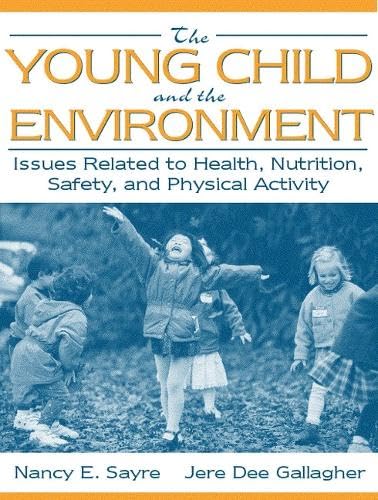

The young child and the environment Nancy Sayre and Jere Gallagher.
Detalles de publicación: Boston, MA Allyn and Bacon 2000.Descripción: xii, 241 p. ill. 24 cmISBN:- 0205302939 :
- 305.231 S275y 2001
| Imagen de cubierta | Tipo de ítem | Biblioteca actual | Biblioteca de origen | Colección | Ubicación en estantería | Signatura topográfica | Materiales especificados | Info Vol | URL | Copia número | Estado | Notas | Fecha de vencimiento | Código de barras | Reserva de ítems | Prioridad de la cola de reserva de ejemplar | Reservas para cursos | |
|---|---|---|---|---|---|---|---|---|---|---|---|---|---|---|---|---|---|---|
| Libro | Biblioteca de Mayagüez Colección General mb | HQ 774 .S28 2001 (Navegar estantería(Abre debajo)) | Disponible | 50000002131620 |
Descripciones mejoradas de Syndetics:
This comprehensive book for early childhood educators explores the various factors that influence the development of a physically and psychologically healthy and safe lifestyle for infants, toddlers, and young children. Physical and psychological health and safety are critical to the education of today's children. This book presents information, practical knowledge, and skills to develop positive attitudes in children and early childhood professionals by emphasizing the role of family and culture in child development. The Young Child and the Environment expands on the foundation of developmentally appropriate physical activity, with chapters on topics such as movement development, physical fitness, nutrition, safety in the early childhood learning environment, and the responsibility of parents and communities in developing healthy attitudes and lifestyles for the young. For anyone interested in early childhood education and physical education.
Includes bibliographical references and index.
Tabla de contenidos provista por Syndetics
- Preface(p. xi)
- Part 1 Global Issues Concerning Infants, Toddlers, and Young Children(p. 1)
- 1 Health and Fitness Concerns of Infants, Toddlers, and Young Children(p. 3)
- Health Indicators(p. 4)
- Reversing Health indicators(p. 5)
- Ecological Systems Theory(p. 8)
- The Early Childhood Educator and Reversing Health Indicators(p. 12)
- Health Education and the Early Childhood Educator's Concerns(p. 13)
- Summary(p. 15)
- Change and Advocacy(p. 15)
- References(p. 15)
- 2 Developmentally Appropriate Foundations for Infants, Toddlers, and Young Children(p. 17)
- Developmentally Appropriate Philosophy(p. 18)
- Development(p. 19)
- Developmentally Appropriate Guidelines(p. 21)
- Developmental Perspective(p. 24)
- Individual Differences(p. 25)
- Maturation(p. 25)
- Learning(p. 31)
- Motivation(p. 33)
- Cultural Influences(p. 34)
- Summary(p. 35)
- Change and Advocacy(p. 36)
- References(p. 36)
- Part 2 Health and Safety Issues Concerning Infants, Toddlers, and Young Children(p. 39)
- 3 Nutrition and the Healthy Child(p. 41)
- Nutritional Preferences and Guidelines(p. 43)
- Guidelines for Nutritional Planning(p. 43)
- Shopping for a Healthy Lifestyle(p. 60)
- The Food Guide Pyramid(p. 61)
- Nutrition for a Lifetime(p. 63)
- Prenatal Development(p. 63)
- Early Childhood Development(p. 63)
- Nutritional Programs to Aid Development(p. 65)
- Summary(p. 66)
- Change and Advocacy(p. 66)
- References(p. 66)
- 4 Principles of Environmental Hygiene and Infection Control(p. 69)
- Environmental Hazards(p. 70)
- Biological Hazards(p. 70)
- Physical Hazards(p. 76)
- Chemical Hazards(p. 77)
- Ergonomic Hazards(p. 81)
- Focus on Health Promotion(p. 81)
- Preventive Practices and Services(p. 82)
- Steps to Prevention(p. 84)
- Current Problems Facing Today's Children(p. 89)
- Reduction in Health-Care Differences(p. 89)
- Child Abuse(p. 90)
- Rural Environment(p. 90)
- Homeless(p. 91)
- Disabilities(p. 91)
- Summary(p. 91)
- Change and Advocacy(p. 92)
- References(p. 92)
- 5 Safety in the Early Childhood Learning Environment(p. 93)
- Psychological Safety(p. 94)
- Bioenvironmental Reciprocity Model(p. 95)
- Emotional Intelligence(p. 95)
- Oppositions to High Emotional Intelligence(p. 97)
- Physical Safety(p. 100)
- Poisoning(p. 101)
- Falls(p. 104)
- Burns(p. 107)
- Suffocation(p. 109)
- Drowning(p. 110)
- Cuts(p. 111)
- Electrocutions(p. 111)
- Injury Prevention(p. 111)
- Supervision(p. 111)
- Equipment Inspection(p. 112)
- Additional Hazards(p. 113)
- Emergency Procedures(p. 113)
- Summary(p. 114)
- Change and Advocacy(p. 115)
- References(p. 115)
- 6 Physical Fitness(p. 117)
- Importance of Physical Fitness(p. 118)
- Types of Physical Fitness(p. 119)
- Skill-Related Fitness(p. 119)
- Health-Related Fitness(p. 119)
- Health-Related Fitness(p. 120)
- Cardiovascular Endurance(p. 121)
- Muscular Strength and Endurance(p. 125)
- Flexibility(p. 126)
- Body Composition(p. 127)
- Temperature Regulation(p. 128)
- Participation for a Lifetime(p. 129)
- Physically Educated Children(p. 129)
- Summary(p. 130)
- Change and Advocacy(p. 130)
- References(p. 130)
- Part 3 Movement Issues Concerning Infants, Toddlers, and Young Children(p. 133)
- 7 Movement Development(p. 135)
- General Intratask Developmental Sequence(p. 137)
- Reflexes and Reactions(p. 137)
- Rudimentary Movement(p. 141)
- Movement Concepts(p. 141)
- Fundamental Motor Patterns(p. 142)
- Proficiency Barrier(p. 144)
- Transitional Skills(p. 144)
- Sport-Specific Skills and Fitness(p. 144)
- Intratask Sequences(p. 145)
- Classical Stage Theory(p. 146)
- Probability Theory(p. 146)
- Component versus Whole Body Analysis(p. 147)
- Skill Progression, Task Complexity, and Task Analysis(p. 148)
- Task Analysis(p. 150)
- Summary(p. 151)
- Change and Advocacy(p. 151)
- References(p. 151)
- 8 Movement Programs for Infants, Toddlers, and Young Children(p. 153)
- Planning Learning Activities(p. 154)
- Learning Assumptions(p. 155)
- Philosophy of the Program(p. 157)
- Planning Developmentally Appropriate Movement Programs(p. 159)
- Understand the Learner(p. 159)
- Select Developmentally Appropriate Content(p. 163)
- Learning Hierarchy(p. 170)
- Develop Criteria(p. 171)
- Structure the Learning Environment(p. 175)
- Interaction with the Learner(p. 175)
- Summary(p. 176)
- Change and Advocacy(p. 177)
- References(p. 177)
- Part 4 Programmatic Development(p. 179)
- 9 Developing Healthy Lifestyles(p. 181)
- Play(p. 182)
- Types of Play(p. 183)
- Social Role of Play(p. 184)
- Decision Making(p. 185)
- Developing Appropriate Decision Making(p. 185)
- Meal and Snack Planning(p. 187)
- Eat a Variety of Foods(p. 189)
- Prepare Foods Safely(p. 190)
- Maintain a Healthy Weight(p. 191)
- Disease Prevention(p. 191)
- Safety Promotion(p. 193)
- Activity Planning(p. 193)
- Teacher and Parent Physical Activity Plan(p. 197)
- Summary(p. 198)
- Change and Advocacy(p. 198)
- References(p. 198)
- 10 Parents and Community Partnerships(p. 201)
- Education Triad(p. 202)
- Teachers as Partners(p. 203)
- Families as Partners(p. 205)
- Communities as Partners(p. 209)
- Expansion of the Partnerships(p. 209)
- Communication(p. 211)
- Family and Teacher Communication(p. 213)
- Summary(p. 214)
- Change and Advocacy(p. 214)
- References(p. 214)
- Appendix A(p. 217)
- Appendix B(p. 219)
- Appendix C(p. 223)
- Appendix D(p. 225)
- Appendix E(p. 227)
- Appendix F(p. 229)